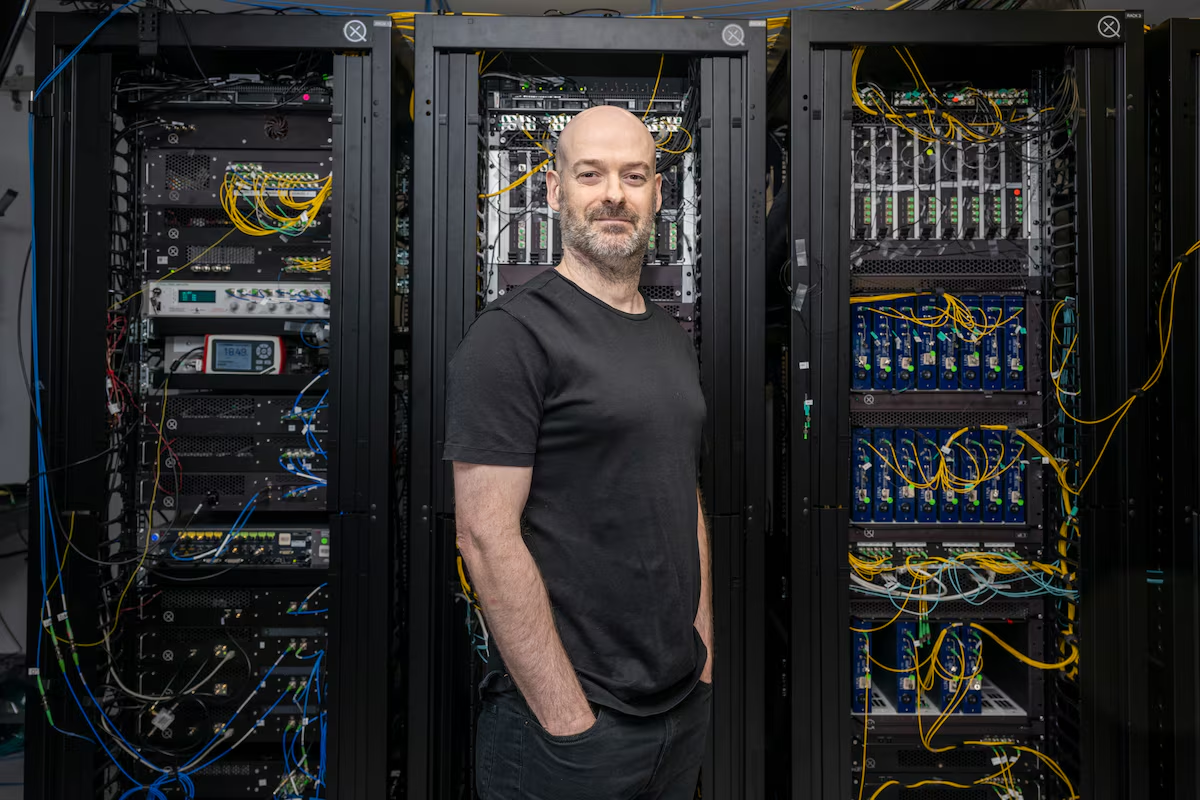

Open this photo in gallery:
Christian Weedbrook, founder and CEO of Xanadu, said that the end of the lockup will make it easier for large institutions to invest.Eduardo Lima/The Canadian Press
Xanadu Quantum Technologies Ltd. XNDU-T is about to face one of its biggest tests in its brief, rocky life as a public company.
On Sept. 22, a lockup lifts for holders of the vast majority of the quantum computing company’s stock, six months after it went public by merging with a Nasdaq-listed special purpose acquisition company. That means early shareholders including angel investors, venture capitalists, pension funds and banks will be free to sell for the first time.
The question is, how many will? The stock quadrupled in value in its first few weeks and crashed just as quickly. It has continued to tail off, and closed Friday at US$7.42 a share.
Xanadu founder and chief executive Christian Weedbrook told The Globe and Mail that he’s “really excited” about the lockup lifting. He said the 10-year-old company’s small, freely tradeable float – just 13 million of its 300 million shares up to now – meant that the stock was vulnerable to “crazy” price swings. Indeed, it moved by 10 per cent or more 13 of the first 26 trading days.
“The way to get around that is have more shares available,” said Mr. Weedbrook, adding that the end of the lockup will make it easier for large institutions to invest. “I don’t know where the stock will be on the 22nd, but long term, this is really important for Xanadu.”
CIBC Capital Markets analyst Todd Coupland, who has a US$22 stock price target, said in a Sept. 1 note that Xanadu is entering a period in which it could hit several “technical de-risking” milestones. He advised investors to “use weakness around the Sept. 22 lockup” to buy.
The stock faces “substantial upside” if Xanadu can demonstrate technical progress, while delays in hitting milestones or advancing to commercialization “remain the key downside risks.”
Xanadu “should be judged less on near-term monetization and more on whether it converts capital into measurable and technical and commercial de-risking,” he added.
One early investor who’s still bullish is Toronto tech entrepreneur Michael Hyatt.
“I’ve held Xanadu since the start and I believe in the business,” he said. “My view is that quantum computing will be commercially viable by 2030. My guess is investors who sold quantum names early during past liquidity events ended up regretting it.”
A quick exit would have looked more tempting to investors – most of whom are Canadian – in late April when the size of their unrealized paper returns beggared belief.
OMERS, other Canadian backers sitting on massive Xanadu stock returns – but they can’t sell yet
For example, Ontario Municipal Employees’ Retirement System’s Xanadu stake was worth US$1.6-billion at its peak; its venture-capital arm invested less than US$30-million for that position. That was twice the value of its top public stock holding on June 30, in Nvidia Corp.
Even after the subsequent selloff, OMERS’ Xanadu stake was worth US$299-million on Friday. That’s more than the value of its holdings, on June 30, in three of Canada’s big banks and six times the worth of its Shopify Inc. stake.
It will likely be tempting for OMERS to reduce its Xanadu stake and lock in gains given it typically holds nine-figure positions only in established market giants, not speculative companies still proving if their approach (or entire sector) works.
The quantum industry is in its infancy. No company, including Xanadu, has yet produced a commercially relevant machine that can achieve the technology’s full potential, though many are valued into the billions of dollars. (Quantum computers derive their computational power from the peculiar effects of subatomic particles. They are expected to someday vastly outperform supercomputers, opening up uses in finance and materials and drug discovery.)
That said, Xanadu is coming up to some catalysts that could move the stock, Mr. Coupland wrote.
Xanadu secures $195-million from Ottawa for quantum computing in Canada
Xanadu and two other Canadian companies will find out this fall if they have advanced to the third and final stage of a U.S. Defence Advanced Research Projects Agency (DARPA) competition challenging developers to show that they can build a commercial-grade quantum computer by 2033. Canada is a leader in the nascent field thanks to early support from governments, universities and tech pioneer Michael Lazaridis.
Companies that prevail could qualify for US$300-million each in American government funding and become front-runners in the global quantum race.
Ottawa has agreed to match the DARPA funds that Canadian participants have received so far; the government has also committed US$195-million in repayable funding to Xanadu to help build an advanced manufacturing facility in Toronto.
Xanadu, which derives its quantum effects from light, unveiled a chip last year capable of performing quantum error correction, a measure seen as essential for reaching reliable performance for practical uses. Continued efforts to correct errors and improve performance remain a key challenge for Xanadu and its rivals.