
Open this photo in gallery:
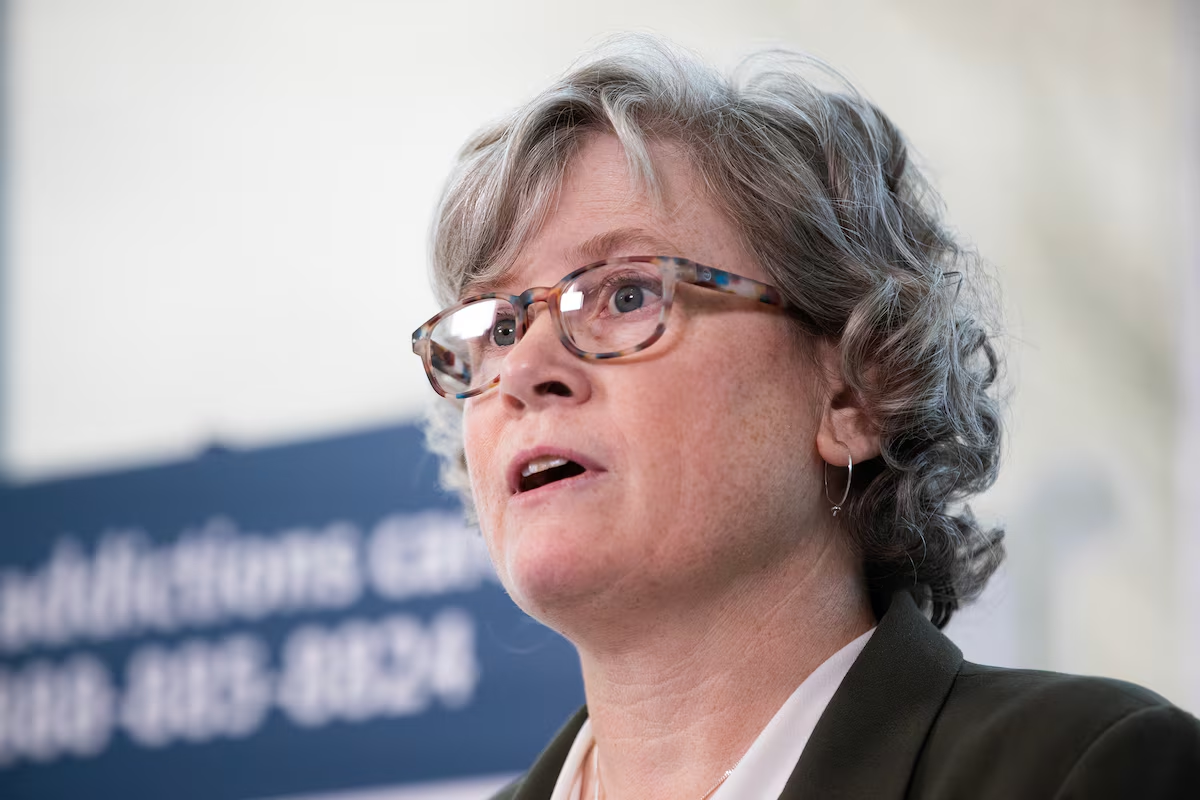
B.C. Finance Minister Josie Osborne says wildfire fighting costs are projected to be $614-million more this year.CHAD HIPOLITO/The Canadian Press
British Columbia’s record budget deficit is now seen to be $450-million higher than previous estimates, and Finance Minister Josie Osborne chalked it up to factors including a math error that resulted in an earlier overestimation of natural-gas revenue and an expensive wildfire season.
The additional $450-million brings the 2026 budget’s overall debt to $13.8-billion for the fiscal year that began in April, according to Monday’s fall update from Ms. Osborne, who took over the portfolio last month.
Her ministry estimates $887-million more in income tax revenue will come in over the course of this budget year. But that was offset by the “serious mistake” the government first admitted to making last month when it miscalculated the amount of natural gas royalties by $306-million this year and in the next four fiscal years for a total of $1.46-billion.
Plus, Ms. Osborne said, wildfire fighting costs are projected to be $614-million more this year and refundable tax credits for business and renters rose by $458-million.
B.C. government overstates gas revenue forecasts by $1.46-billion due to errors
She did not provide a timeline as to when the province may return to balancing its budgets as Premier David Eby promised before getting re-elected two years ago.
“What’s different today then right after the 2024 election is the situation that we see ourselves in with respect to Trump and his administration and the unjustified actions that he has taken engaging in a trade war with Canada,” Ms. Osborne said. “This is not a situation we expected to see ourselves in, and it is one that requires government to staunchly defend and protect the services that people rely on – especially at a time of such economic uncertainty.”
Mr. Eby inherited an almost $6-billion surplus from former premier John Horgan in 2022, but has since run deficits, leading to multiple bond rating agencies issuing downgrades to B.C.’s credit rating.
Despite the turmoil, the provincial Finance Ministry said businesses are adapting to changes in global trade, with exports rising by 16 per cent year-over-year to destinations like China, South Korea and India.
Opinion: Fiscal fantasy: Believe it or not, fiscal reality hasn’t gone away
Gavin Dew, the Opposition BC Conservatives’ finance critic, said the update does not engender confidence, noting his party is still calling on the NDP government to explain what Mr. Eby knew about the natural-gas accounting issue and when he first learned about it.
Before the trade tensions with the U.S. escalated this summer, other provinces had warned of coming budgets drenched in red ink. Ontario’s fiscal watchdog said in the spring that the province is not on track to deliver its promised balanced budget by 2027. And Quebec announced an estimated deficit of $8.6-billion this year.
Alberta initially projected $9.4-billion deficit for this year, but last month its first-quarter update showed it now projects a surplus of $2-billion, thanks to oil prices, which have surged because of the U.S. conflict with Iran.
B.C. isn’t as lucky, Ms. Osborne noted, but her ministry reported the overall value of B.C. exports increased 4.2 per cent until July, 2026, mostly due to a strong demand for copper. Plus, she said, the province stands to benefit from the influx of federal funding for several major projects.
Editorial: Canada is a country drowning in a flood of red ink
Meanwhile, B.C. has also been hit by lower revenues from the property transfer tax it places on home sales because more and more people have been postponing the purchase of a new home over the past year, according to Bryan Yu, chief economist for Central 1, a payments and treasury company owned by credit unions from across B.C. and Ontario.
Plus, he added, real estate prices have dipped, which means the resulting property transfer taxes have also been lower than in past frothier markets. For example, he said, the province took in $3.3-billion in these taxes in the 2021 fiscal year compared to $1.6-billion in this budget update, which was down nearly $300-million from the initial spring estimates.
“It wouldn’t be necessarily that bad if prices were declining if there was still kind of some movement, but having that coupled with the lack of sales really is hurting the bottom line here,” Mr. Yu said.
With a report from The Canadian Press