
Listen to this article
Estimated 4 minutes
The audio version of this article is generated by AI-based technology. Mispronunciations can occur. We are working with our partners to continually review and improve the results.
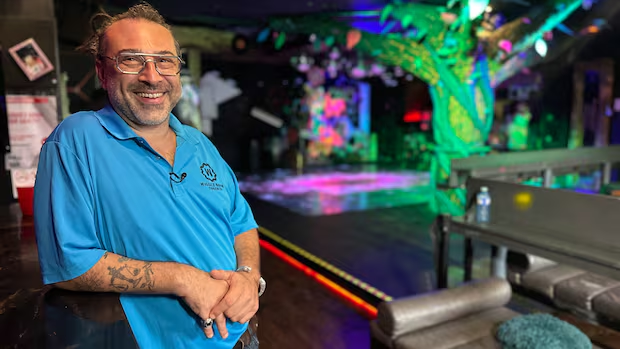
A Toronto dance venue recently announced a policy banning smart glasses — a move that has been met with support online and sparked a broader conversation about privacy on the dance floor.
The ban at Wiggle Room, a club known for being music focused with a safe-space approach, is less about photography itself and more about whether people know when they are being recorded, says owner Takin Nateghi.
“It’s mostly a safety concern for our guests, for everybody really. It’s kind of sneaky to have a camera no one is aware of and that’s the main thing,” he said.
The issue is becoming increasingly relevant as wearable technology makes it possible to record without the person being filmed necessarily knowing it’s happening, and smartphones make it easy to document public spaces.
When Nateghi, who is also a DJ, posted about the smart glasses policy online it was met with overwhelming support in the comments.
New Toronto nightclub bans photos altogether
Wiggle Room has no plans to prohibit patrons from taking the occasional photo with their phones, Nateghi says.
“If someone wants to take a phone out and snap a photo for memory’s sake … why not?”
But another Toronto venue is taking this idea a step further, barring cameras entirely.
Complex19’s owners say they want to give people a place where they can dance, socialize and let loose without worrying about ending up in someone else’s social-media feed.
“One of our priorities here is the privacy of our audience,” said co-owner Bradley Blaylock. “We want to make sure people can have the time they want, and do what they want without the fear of getting their photos taken.”
The idea isn’t entirely new. Blaylock says no-camera policies are more common in parts of Europe and in Montreal, and they want to bring some of that culture to Toronto.
He says the hope is to create an environment where people can focus on the experience itself, rather than documenting it.
“It’s just one night to put your phone away and enjoy yourself.”
 Bradley Blaylock co-owns Complex19 alongside event producers and party promoters Marc Bou-Fadel and Mitch Gibson. He says while the no-camera policy presents some challenges, it’s essential to the experience they’re trying to create. (Talia Ricci/CBC)
That desire to disconnect comes as technology has fundamentally changed what it means to go out. In the 1990s rave scene, there was no smartphone in your pocket and no expectation that a night out would be documented and shared online.
Natalie Coulter, an associate professor of communication and media studies at York University, says young people may be losing some of the freedom that once came with being in social spaces where nobody was watching.
“I think young people aren’t experimenting publicly in the same way that we used to,” Coulter said.
She says the possibility of being photographed or recorded — and not knowing where that image could eventually end up — can change how people behave, and it’s impacting an entire generation’s experience growing up.
“More and more it’s becoming a privileged space of being where you’re not being recorded.”
Eliminating cameras not always easy for venues: owner
But for many nightlife businesses, social media is now an important part of getting people through the door.
At Toronto’s first listening bar, The Little Jerry, owner Jodie Dewald says photos and videos have become almost unavoidable when it comes to promoting events and attracting new audiences.
“It’s become almost a necessary evil because in order to promote and get new people to your events, you have to post on Instagram,” she said.
On top of that, she says technology is constantly changing — from AI-generated promotional material to wearable cameras such as smart glasses — and the challenge is keeping up with it while also making sure people feel safe in the spaces they’re paying to enjoy.
 Jodie Dewald runs The Little Jerry, a bar and restaurant with a hi-fidelity sound system designed for playing vinyl records. (Talia Ricci/CBC)
Still, she says she’s noticing some people beginning to move in the opposite direction.
Dewald says some parties are going back to being promoted through email lists rather than public social-media posts, the way underground events were organized before social media became central to nightlife.
It is a slow shift, she says, but one that could bring some of the old underground culture back.
“In my eyes its about taking the corporation out of the underground scene and that can only be a good thing,” she said.