
Listen to this article
Estimated 4 minutes
The audio version of this article is generated by AI-based technology. Mispronunciations can occur. We are working with our partners to continually review and improve the results.
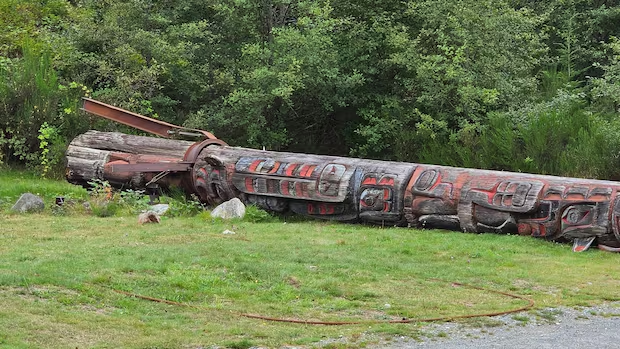
The world’s tallest totem pole was brought down this week in Alert Bay, B.C., a community off the coast of northeast Vancouver Island.
For two ‘Na̱mǥis chiefs, the pole — recognized in the Guinness Book of World Records — represented much more than its height.
“This pole was so much more,” said Ho’miskanis Don Svanvik, hereditary chief and elected chief councillor of the ‘Na̱mǥis First Nation.
“It was a beacon for our people coming out of a pretty dark time in history,” he said, referencing the potlatch ban — the federal law that outlawed potlatching on the coast for more than 60 years.
Svanvik said his great-grandparents were jailed in the 1920s for taking part in potlatch.
“The pole, in some ways, represents people being who they always have been and continue to be,” he said.
“This is who we are. This is how we govern ourselves. This is how we celebrate and acknowledge things, through our ceremonies … this was a time when that was all coming back, coming into the forefront of things.”
Crews began dismantling the 173-foot pole on Wednesday in a carefully staged, multi-hour process, after the ‘Na̱mǥis First Nation confirmed the structure had become too unstable and hazardous to remain standing.
The nearby Gukwdzi (Big House) and its surrounding parking area were closed the evening before to establish a safety perimeter, and community members gathered nearby to witness.
Nothing lasts forever
The original pole was raised in 1973. It was one tree spliced into two connected sections, according to ‘Na̱mǥis Hereditary Chief William Wasden Jr.
He said the pole was designed to carry the crests of 22 Kwakwa̱ka̱ʼwakw tribes — a deliberate statement of unity.
Tribes have amalgamated since then, Wasden said, but it was a powerful symbol of solidarity, an essential theme of the times.
“Our Big House was finished around then too … it was the same theme … somewhere for everybody to come and utilize,” Wasden Jr. said.
“Alert Bay was like Grand Central Station, it was almost like the center of Kwakwa̱ka̱ʼwakw territories physically, but people were amalgamating there and so it almost became Kwakwa̱ka̱ʼwakw central.”
 The pole was carved by numerous carvers at the time, overseen by Jimmy Dick. (Emilee Gilpin/CBC)
When the pole came down, Wasden said he felt proud.
“Nothing lasts forever, especially the cedar tree,” he said, sharing a story of an ancestor who recognized in ancient times that neither a cedar tree nor a mountain would always stand.
For Wasden, the pole’s takedown is part of a much older pattern, one where each generation is left to answer for itself.
“It’s our ancestors challenging us now,” he said. “Are you gonna ride on our coattails, or will you be as great as we were, by doing the things you need to do to uplift your people?”
The pole was carved by a number of carvers at the time, overseen by Jimmy Dick.
Wasden named Jimmy Dick’s son “Blackie,” Ben Dick Senior, as the main carver. He named other carvers like Adam Dick, Andy “Beanie” Beans, Gus Matilpi and Dick Dawson.
Svanvik named Henry Hunt and Henry Speck, along with others who may have dropped in at the time.
LISTEN | The day the totem pole was taken down:
All Points West9:10World’s tallest totem pole comes down
Both acknowledged Dora Cook who learned to carve alongside the men, one of very few women to do so at the time.
“She was ahead of her time,” said Wasden.
Both Wasden and Svanvik remember the pole being carved when they were kids.
Svanvik jokingly said he played a small role when he was called over by the carvers to “squirt oil on the saw” they were using. Wasden carries a photo of himself and his friends sitting on the pole before it was raised.
Both said they look forward to what’s next.
“This is not the end of anything,” Svanvik said.