LISTEN | Why U.S. nurses are moving north:
White Coat Black Art26:30Why U.S. nurses are moving north
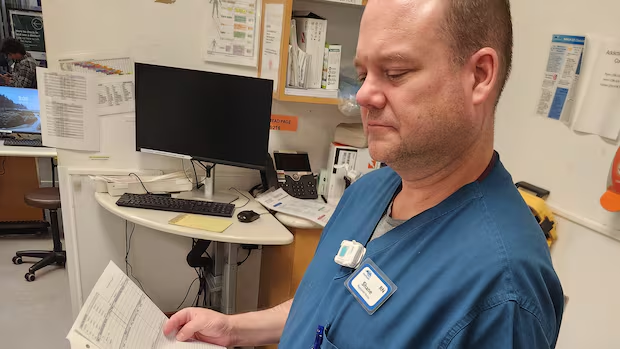
Registered nurse Shane Tyson was done with the U.S.
He was working in Minnesota at the not-for-profit Mayo Clinic Health System and the Olmsted Medical Center. But in 2025, Tyson says he became increasingly concerned about the deterioration of health care, as well as tighter immigration enforcement.
Then ICE agents arrested a patient as they were leaving a primary care appointment where he worked, Tyson says.
“That was definitely a wake-up call,” he said. “And I am married to a U.S. permanent resident that was born in Bolivia … and it scared the crap out of me for him and for the others in that situation,” Tyson told Dr. Brian Goldman, host of CBC’s White Coat, Black Art.
Tyson says he’d been noticing Facebook ads from provincial recruitment service HealthMatch BC. The more he researched, the more he contemplated a move north. So he registered, got interviews with two B.C. health authorities, and received two job offers within a week.
Tyson is one of many health-care professionals making the move from the U.S. With shortages of nurses, physicians and other health workers, some provinces are actively recruiting U.S. health-care professionals — and they’re getting results.
CBC reached out to health ministries in all 10 provinces for data on health-care professionals recruited from the U.S. since efforts ramped up in 2025.
The number of doctors recruited ranged from three in Saskatchewan to 33 in Nova Scotia and 570 in Ontario.
Ontario also recruited 2,300 nurses in 2025, while, all told, more than 580 health-care professionals accepted jobs in B.C. since March 2025.
For Tyson, the targeted recruitment worked. It took him just three months to get his B.C. nursing licence through a fast-track process, and eight days to receive a provincial nomination for permanent residence.
Since January, he’s been working in the emergency department of Nanaimo Regional General Hospital (NRGH) on Vancouver Island. Tyson says he’s pleased with the community, the weather, and what he sees as more inclusive health care.
“There’s not the insurance companies and corporate health-care companies taking billions of dollars. The patient is the focus here and whether you’re the unhoused or the banker or lawyer, you have equal access to care in Canada,” he said.
 Damian Lange, executive director of clinical services at Nanaimo Regional General Hospital, says filling some of the health region’s vacant positions with recruits from the U.S. has made things better for patients and staff alike. (Brian Goldman/CBC)
The recruitment push
Health-care workers are bringing experience and ideas from some of the largest hospitals in the U.S., says Damian Lange, executive director of clinical services at NRGH.
“The American system has significant talent,” Lange said.
He said Island Health started recruiting from the U.S. in April 2025. Since then, it has hired 76 physicians and 102 nurses — 31 of them at NRGH. He said another 87 U.S. health-care providers will hopefully join by year’s end.
Lange said the new recruits make for a “better staff experience … better patient experience, improved quality care, improved access to care. And so it’s been a real benefit as we close the gap there with our vacancy rates.”
Even with the new hires, Lange said Island Health still has a 15 per cent vacancy rate for nurses.
And recruiting U.S. health-care workers is only part of the equation. A lot of questions go along with an international move.
Volunteers helping ease the move north
Tod Maffin and his wife, Jocelyn Maffin, are helping pave the way with an online community they started in early 2025. Tod is a digital strategist and former CBC journalist, and Jocelyn works with Spinal Cord Injury BC.
It started with Tod’s invitation to Americans to visit Nanaimo last year. So many health-care workers interested in moving to Canada came that Maffin made a Discord channel where people can chat and ask questions about everything from health-care licensing to real estate to services for autistic children.
 Tod Maffin and his wife, Jocelyn, run the Healthcare Infusion project together, and say they are seeing success across the country. (Tod Maffin/Hey.Café)
Tod said it’s about connecting people.
“If you’re an ER nurse in Dallas and you’re ready … to move into Canada, you’ve figured out which area you’re going to go to, but you have a trans kid and you just need to talk the parent of another trans kid in that community to make sure that your daughter is going to be OK,” you can find that support in the Discord group, he said.
It includes out-of-area health-care workers (mostly Americans), recruiters, immigration consultants and local citizens who just want to help out. Of around 1,200 current users, 84 have recently accepted job offers.
Tod created a template for other Healthcare Infusion communities and there are now 45 of them across Canada.
Jocelyn said she initially worried about poaching health-care workers from the U.S., but: “Canada has dealt with brain drain to the U.S. for years and that’s always been a big issue,” she said.
“So maybe we’re just borrowing them back.”
Call for better retention
In an email to CBC, the Canadian Medical Association said that with a shortage of more than 23,000 family doctors, Canada needs to remove barriers to immigration and licensing for internationally trained physicians. It also needs to make it easier for those currently practising in Canada to stay, the association said.
Canadian Nurses Association CEO Valerie Grdisa emphasized the need to retain the nurses Canada already has.
“We welcome U.S.-educated nurses into the nation, but we don’t see it really as a long-term recruitment strategy,” she said. “We really have to get back [to] what matters to Canadian and domestically educated nurses.”
Grdisa said Health Canada’s Nursing Retention Toolkit lays out strategies to retain nurses, like safe staffing levels, manageable workloads, mentorship and career support. But she said health-care systems haven’t implemented or evaluated them consistently enough to determine what actually works.
“If those things were to happen, would we be losing such a large cohort — up to 40 per cent of the workforce by the age of 35?”
 Shane Tyson recently received his certificate of Canadian citizenship. (Brian Goldman/CBC)
Meanwhile, though, nurse Shane Tyson says he is here to stay. He recently got his certificate of Canadian citizenship. A kind stranger also left a moose sticker and a welcome note on his car.
“That really made me emotional, you know. I was concerned, driving around with Minnesota plates, how I’d be received, because at that time the tariffs were coming in, talk of the 51st state — and that just really meant a lot to me.”
Now Tyson is logging onto the Maffins’ Discord community to help other U.S. health-care workers come to Canada.
“Have to pay it forward.”