
Open this photo in gallery:
Nolan Quinn, right, Ontario’s minister for colleges and universities, tours a University of Toronto robotics lab earlier this year. He said new funding for postsecondary education would be geared toward meeting the labour needs of local businesses.Nathan Denette/The Canadian Press
The Ontario government has reinforced its preference for practical job training over the liberal arts by announcing that 40,000 new seats at the province’s universities and colleges will go to STEM, health care, teaching and trades programs.
Nolan Quinn, Ontario’s Minister of Colleges, Universities, Research Excellence and Security, said Thursday that new funding for postsecondary education – first announced in February – would be geared toward meeting the labour needs of local businesses, many of which are fighting to survive the Canada-U.S. trade war.
The province set aside $1.7-billion to add more than 70,000 spaces at publicly funded colleges and universities, 40,000 of which were allocated through a new process. Schools had to confer with local industries to identify in-demand careers, then make proposals to the ministry over the summer explaining why particular fields of study deserved more seats.
“We know what Hamilton needs is different than what Thunder Bay needs, or what Belleville needs, or what Sarnia needs,” Mr. Quinn said at a news conference at Hamilton’s McMaster University. “This investment is not growth for the sake of growth. It is a targeted, strategic investment in our workers, our businesses and our economies.”
Mr. Quinn made this latest announcement at a critical moment for the higher-education sector. Many Canadian postsecondary institutions are still trying to recover from Ottawa’s decision in 2024 to cut the number of visas for international students. Their high tuition fees had become critical sources of funding, especially for public and private colleges.
The Ontario government responded in February by lifting a long-standing tuition freeze, promising $6.4-billion in new funding for the sector over four years and shifting the Ontario Student Assistance Program away from non-repayable grants toward more repayable loans. The $1.7-billion for 70,000 new seats is part of that $6.4-billion commitment.
At the same time, universities and colleges are grappling with how to prepare the next generation for a job market that could be fundamentally changed by artificial intelligence. Premier Doug Ford acknowledged the game-changing potential of the technology by adding an associate minister of AI adoption to his cabinet in a shuffle unveiled Thursday.
Open this photo in gallery:
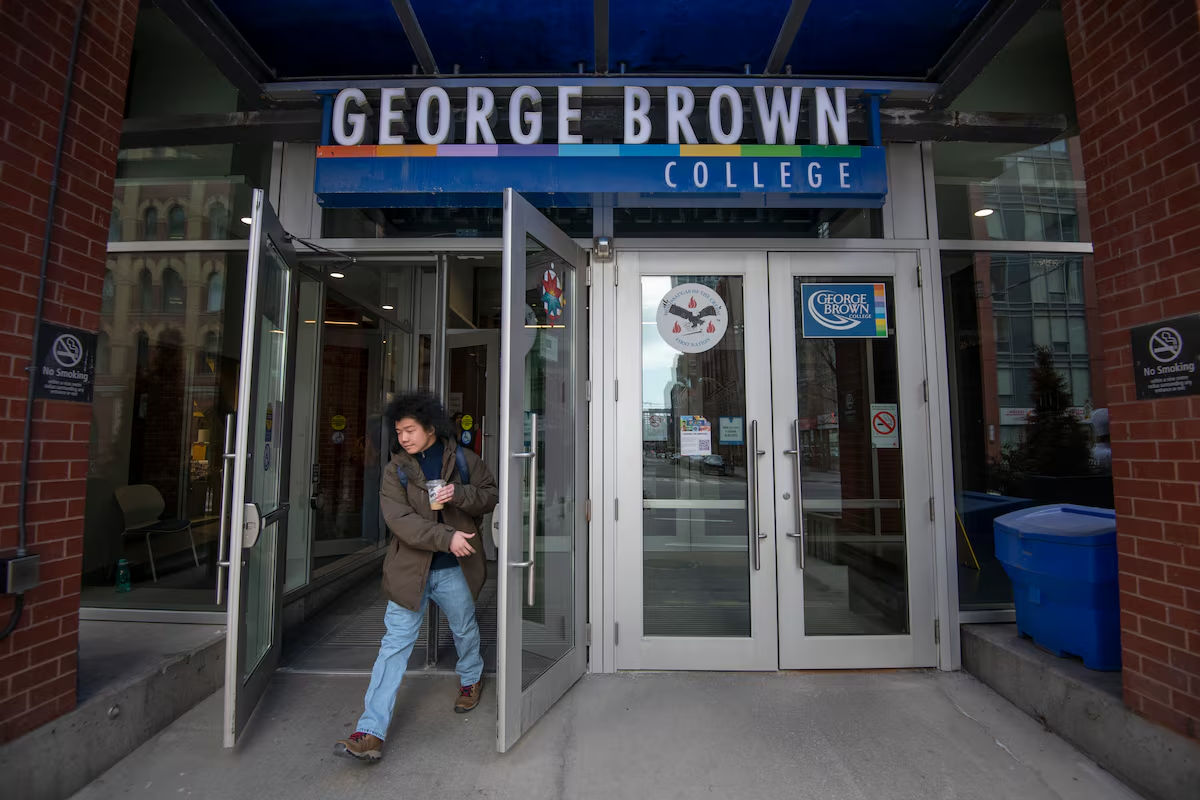
George Brown College in Toronto. Schools are grappling with how to prepare the next generation for a job market that AI could transform.Fred Lum/The Globe and Mail
Some observers argue the economy could be better served by more graduates with degrees in the humanities, social sciences and other liberal-arts disciplines, because they learn critical-thinking skills that set them apart from bots and machines.
“University graduates often don’t even work in jobs that seem to resemble the programs they graduate from,” said Rob Kristofferson, a labour market historian at Wilfrid Laurier University and president of the Ontario Confederation of University Faculty Associations.
“It’s because they learn all sorts of transferable skills in those programs,” Prof. Kristofferson said, adding that this applies to humanities and social sciences as well as science, technology, engineering and math (or STEM) programs. That kind of adaptability will be especially important in the face of AI, he said.
Mr. Quinn and the ministry released only high-level information Thursday on the new seat allocations. Of the more than 70,000 newly funded spaces, 40,200 are in STEM programs, 16,100 are in health care programs, 7,900 are in education, 3,800 are in trades and 3,000 are in other “labour market-driven” programs.
Details were otherwise thin. The minister didn’t identify any specific schools or programs that garnered new seats other than McMaster, where the announcement was held. The Hamilton university is receiving $90-million to fund 2,769 new seats starting this academic year.
In the age of AI, professors try to make cheating hard again
Surge in student violence brings Canadian teachers to a breaking point
Seat allocations for other colleges and universities will be released in the coming weeks. The allocation for the initial 30,000 seats was announced back in May.
McMaster president and vice-chancellor Susan Tighe said in an interview after the news conference that her school expects details from the ministry very soon about which programs garnered the more than 2,700 new spots.
She said she thinks most will be in health care and STEM, and she singled out nuclear medicine, nuclear energy and training for physician assistants as McMaster programs that could be on the list.
“We’re not in the business of being everything to everyone, but what we do, we want to be world-class and do it well,” Prof. Tighe said.
The Council of Ontario Universities and Colleges Ontario, each speaking on behalf of their sectors, welcomed news of the new seats.