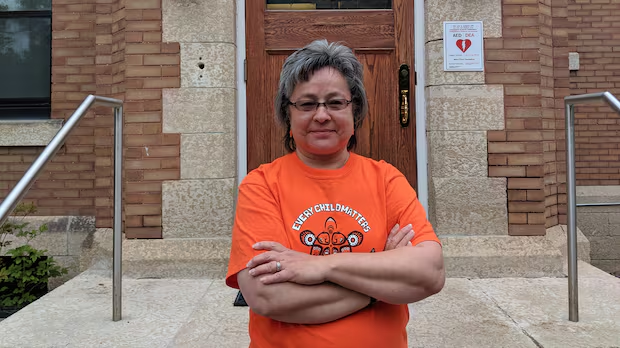
The founder of Orange Shirt Day says she was sick to her stomach when she learned orange shirts with slogans like “Dig deeper” and “Still no proof” were being sold online.
Holding back tears and speaking from Tk̓emlúps te Secwépemc in B.C., which announced a discovery of potential unmarked graves near a former residential school site in 2021, Phyllis Webstad said her campaign was being used in a “hateful way.”
“I’ve been trying to understand why they believe that it’s OK to hurt people,” she said.
In 1976, Webstad wore a present from her grandmother, an orange shirt, on her first day at a residential school at St. Joseph’s Mission, in Williams Lake, B.C. The shirt was taken from her by school officials and never returned.
Webstad founded Orange Shirt Day on Sept. 30, 13 years ago, to honour Indigenous children who were forced to attend residential schools.
In late August, Rebel News announced it was selling orange T-shirts on its website for the National Day for Truth and Reconciliation and that the shirts are about “challenging the identity politics that Canadians are increasingly pressured to accept and standing up for the whole truth in our complex Canadian history.”
Statements printed on the shirts include “Still no proof,” “You can’t handle the truth,” “Buried Truth” and “Dig Deeper,” as well as “Canada was built not stolen.”
Webstad called the sales a direct attack on her work with the Orange Shirt Society.
“It’s my truth and what I know is the truth,” Webstad said.
“It seems like this truth is not being respected. It’s not being understood. It’s being pushed aside.”
 Orange T-shirts with various slogans were posted to the Rebel News store at the end of August. (Rebel News Store)
In an emailed statement, Ezra Levant, founder and owner of Rebel News, pointed CBC News to a video on its website launching the sale of the shirts, saying their reporter “approaches these issues with compassion.”
“The stated purpose of the National Truth and Reconciliation Day is noble – to honour residential school survivors and their communities by recognizing the lasting impacts of Canada’s residential school system, so Canadians can better understand its legacy as part of our ongoing journey toward truth, healing, and reconciliation,” Levant quoted what was said in the video.
In the video, the Rebel News reporter goes on to say “But five years later, Canadians are still being told that there are some truths they’re not allowed to question.”
Levant added in the statement that Rebel News staff are “dedicated to freedom of expression including the right to seek the truth” and “these orange shirts are a response for people who are forced to wear orange shirts at school or at work, as part of an ‘official’ political narrative.”
“No Canadians should be compelled to support any political view, including Orange Shirt Day’s politics.”
In the video promoting the shirts, the Rebel News reporter says “what’s more than likely underneath the apple orchard soil at the Kamloops site is probably an old septic plot.”
Webstad pointed to the National Centre for Truth and Reconciliation, which has so far documented more than 4,000 deaths of Indigenous children in Canada’s residential school system.
WATCH | B.C. regional chief speaks on residential school denialism:
‘Denialism is not an academic debate. It’s hate speech,’ says regional chief
Regional Chief of the British Columbia Assembly of First Nations Terry Teegee said violence, anti-Indigenous rhetoric and hate speech are linked to residential school denialism and that, if left unaddressed, denialism ‘undermines truth and reconciliation.’
She said her own auntie, Agness Jack, shared a personal story about what it was like living in the Kamloops Indian Residential School in a book published in 2001, Behind Closed Doors: Stories from the Kamloops Indian Residential School.
Webstad also said her grandmother and her grandmother’s 10 children including Webstad’s mom were all forced to attend residential school.
“My mother was so traumatized that she could not take care of me; thank God my Granny was there, thank God my auntie was there,” said Webstad.
“I want to say that we aren’t liars. Indian Residential School survivors are not liars. Have some respect and give us the space and time to do what we need to do as individuals, as family, as a community, as a nation.”
The orange shirts available on the Rebel News website are listed in youth sizes as well as adult.
“That is a whole new level of every word in the book: disgusting, unbelievable, sickening. Where are their minds?” said Webstad about the youth sizes.
MPs and ministers condemn shirts
Last week, the Liberal Indigenous Caucus published a statement that said merchandise “that mocks survivors’ experiences and dismisses their truths is reprehensible and beneath any organization.”
A request for comment from Conservative MP Billy Morin, the party’s shadow minister of Indigenous Services, was not returned by time of publishing.
Morin told APTN News last week, “I find it racist and I find it absolutely disgusting that they’re attempting to make a profit off the pain and suffering of residential schools.”
Indigenous Services Minister Mandy Gull-Masty, who is a member of the Waswanipi Cree Nation in northern Quebec, said people across the country have raised concerns about the shirts to her.
“Not just people living in my riding but also from Canadians who are appalled about this really disgraceful and grotesque attempt to exploit human suffering for financial gain,” said Gull-Masty.
Gull-Masty’s mother and grandmother were both forced to attend the La Tuque Indian Residential School in Quebec.
 Indigenous Services Minister Mandy Gull-Masty, a member of Waswanipi Cree Nation in northern Quebec, says she heard concerns from people all over Canada about the shirts being sold online. (Marie-Laure Josselin/Radio-Canada)
Gull-Masty said she expressed her concerns to Justice Minister Sean Fraser, but didn’t say what avenues the government would explore. She said she felt Fraser understood how serious the matter is.
“I think this is one of the areas where we are seeing behaviour that is not only being perpetuated more commonly but it is reaching a level that is unacceptable,” said Gull-Masty.
In a statement to CBC Indigenous, a spokesperson for Fraser said, “Seeking to profit from Indian residential school denialism is deeply disgraceful and represents a cruel and grotesque attempt to exploit human suffering.”
“Residential school denialism is a serious and distinct issue, and our government has said this issue warrants dedicated further parliamentary study,” the statement said.
“Any legal response should be developed carefully in consultation and co-operation with Indigenous Peoples and the communities most affected.”
Earlier this year, Canada’s Senate voted down an amendment to Bill C-9 that would have criminalized residential school denialism, by making it illegal to wilfully promote “hatred against Indigenous Peoples by condoning, denying or downplaying the Indian Residential Schools System.”
Webstad said she supports the idea that residential school denialism should be added as hate speech to Canada’s Criminal Code.
“I believe what Rebel News is doing right now is what is needed to convince our Canadian government that yes, a law needs to be passed,” said Webstad.
Shirts designed to provoke conflicts in schools, says academic
Sean Carleton, an associate professor in history and Indigenous studies at the University of Manitoba, said he feels the shirts monetize anti-Indigenous racism and deliberately profit off of pain and suffering.
“Thousands of Indigenous children died, we know that,” said Carleton.
“So what [Rebel News] is trying to do is cast doubt, shake public confidence and are trying to convince Canadians that maybe we shouldn’t care about Indigenous people and reconciliation anymore.”
Carleton said the easiest way to understand denialism is to look at the Truth and Reconciliation Commission’s simple formula.
 Sean Carleton, an associate professor in history and Indigenous studies at the University of Manitoba, says the shirts monetize anti-Indigenous racism, and deliberately profit off of pain and suffering. (Submitted by Sean Carleton)
“We’ve got to have truth first,” he said.
“Truth will lead to healing and justice. Healing and justice will lead to reconciliation. Denialists know that and what they’re trying to do is keep us stuck in the truth part.”
Carleton said he believes the inclusion of youth sizing is a tactic designed to provoke conflicts within schools where parents may be influenced by denialist rhetoric and use their children to challenge school policies.
He said the slogans on the shirts not only defend the colonial status quo but promote colonization as a compassion project, and said they question survivors’ lived experiences.
NDP MP Leah Gazan tabled a private member’s bill in Parliament last fall to criminalize residential school denialism.
In a letter to the Indigenous Liberal Caucus on Tuesday, Gazan said anti-Indigenous racism and denialism are growing and have now resulted in “the production of merchandise denying genocide and mocking the National Day for Truth and Reconciliation. We must respond to this as what it is – the incitement, monetization and promotion of hate.”
Gazan called on the Indigenous Liberal Caucus to table her bill as a government bill.
A national 24-hour Indian Residential School Crisis Line is available at 1-866-925-4419 for emotional and crisis referral services for survivors and those affected.
Mental health counselling and crisis support are also available 24 hours a day, seven days a week through the Hope for Wellness hotline at 1-855-242-3310 or by online chat.