
Open this photo in gallery:
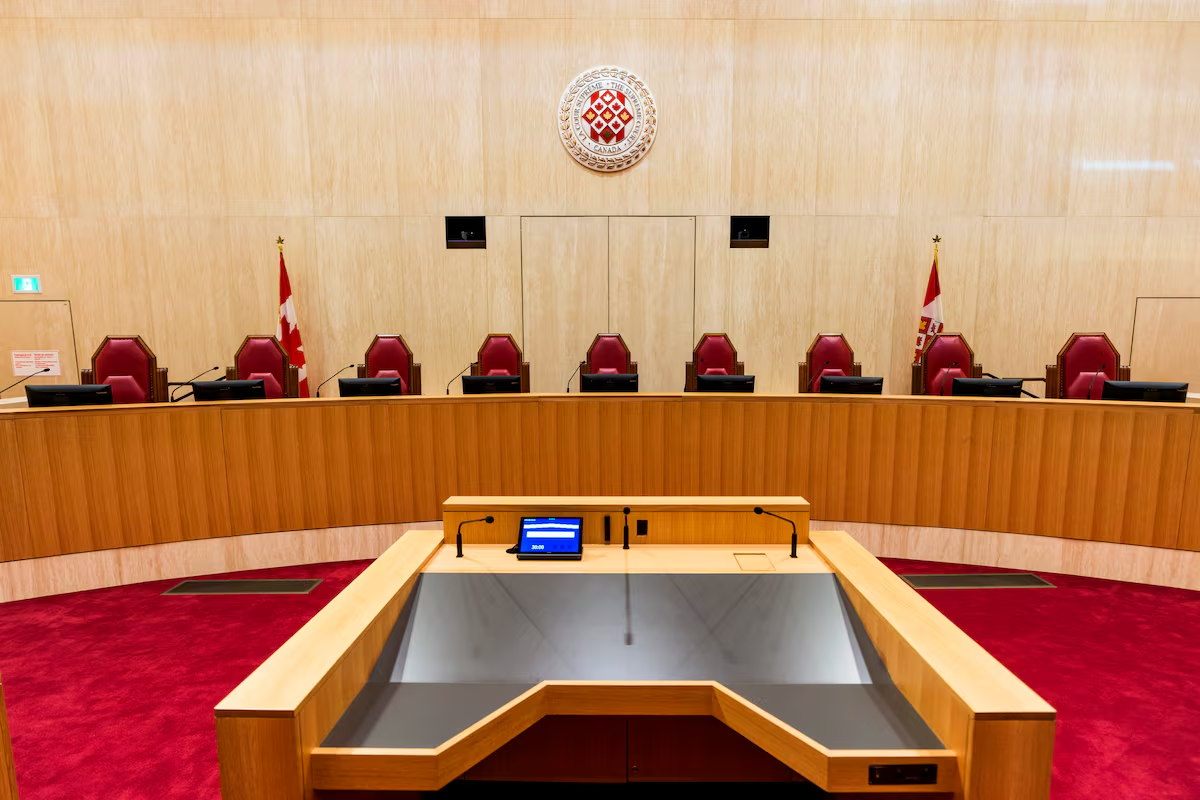
The Supreme Court of Canada’s landmark Jordan judgment set strict deadlines for criminal trials: 18 months in provincial courts and 30 months in superior courts. Cases that breach the Jordan limits result in automatic stays.Justin Tang/The Canadian Press
When the Charter right to a trial within a reasonable time is violated, there is only one outcome: A person accused of a crime walks free. There is no verdict of guilty or not guilty.
Unreasonable delays upend about 10,000 criminal cases a year – more than 4 per cent of the total across Canada.
Data obscure the personal pain. Activists have escalated their calls for change, decrying the litany of cases involving allegations of serious offences, such as sexual assault, that conclude without real resolution.
But after years of debate, the justice system appears to be on the cusp of a major change.
In recent months, both Parliament and the Supreme Court of Canada have considered other ways to resolve the question of what happens when the process of justice goes on for too long, causing an unreasonable delay in a criminal trial.
Court delays in sex-assault cases increase despite Supreme Court deadlines, report finds
A Supreme Court ruling in May clearly stated that the country’s top judges are ready to reconsider one of their long-standing precedents. Another ruling is coming this Friday that could add to that thinking. And legislators passed a law in June, which took force in mid-July, to try to address the issue.
Together, the moves show that the justice system is pushing toward an overhaul of how unreasonable delays are handled.
What it means is that a trial delay might not automatically result in a stay, where a case is effectively shelved and the trial ends without a verdict on the allegations against the accused.
But no one has worked out what change might look like.
Parliament’s new law, Bill C-16, calls on judges to consider “alternative remedies” to a stay if there is an unreasonable delay. But the law is open ended, leaving it up to the courts to figure out.
Open this photo in gallery:
Justice Minister Sean Fraser in Dartmouth, N.S., on Sept. 2.Devin Stevens/The Canadian Press
Federal Justice Minister Sean Fraser said in an interview that Ottawa chose to take a general approach in Bill C-16.
“I don’t want to prejudge what other remedies courts may look at,” Mr. Fraser said. “We deliberately want to leave it open.”
The debate over how to handle delays starts with Section 11(b) of the Charter of Rights and Freedoms. This protects Canadians’ right to a trial within a reasonable time if charged with an offence.
Veteran criminal-defence lawyers call it the least popular provision in the Charter. Few people are happy when a person accused of crimes such as sexual assault walks free because the process took too long.
That outcome goes back almost four decades, to a Supreme Court precedent from 1987 called Rahey.
In 1981, Carl Rahey was charged with contraventions of the Income Tax Act, making six years of false tax returns and evading about $130,000 in taxes. But the case dragged out, and he asserted that his Charter right to a trial within a reasonable time had been violated.
Opinion: Lady Justice may be blind, but Canadians shouldn’t shut their eyes to the system’s shortcomings
At the Supreme Court in 1987, the judges didn’t quantify what “reasonable time” meant; the court highlighted the circumstances of Mr. Rahey’s case.
The key decision in Rahey was that if a trial goes on too long, “a stay of proceedings will be the appropriate remedy.”
That has been the rule on unreasonable delays ever since. But the lack of a clear definition of what constituted “unreasonable” meant it was mostly considered on a case-by-case basis – until a decade ago, in the Supreme Court’s 2016 Jordan ruling.
Seeking to spark a speedier justice system, the Supreme Court delineated how much time is reasonable. The court’s landmark Jordan judgment set strict deadlines for criminal trials: 18 months in provincial courts and 30 months in superior courts.
The new Jordan deadlines supercharged the Rahey precedent. With a rigid formula in place, cases that breach the Jordan limits result in automatic stays.
Rahey and Jordan sparked havoc.
About 10,000 Jordan cases thrown out annually as Ottawa, provinces call on Supreme Court for change
No one doubts the importance of a trial in a reasonable time. The accused cannot be left to languish, free on bail waiting many months for trial or behind bars in jail and still presumed innocent. And for people who have suffered sexual assault and other serious crimes, a resolution in court is of obvious importance.
But the high volume of cases derailed by Rahey, a situation compounded by Jordan, has pushed Parliament and the Supreme Court to think about change.
Ottawa took on the issue in Bill C-16, tabled last December. The bill added a new part to the Criminal Code titled “Unreasonable Delay.”
The law states that a court shall not order a stay because of unreasonable delay unless there is “no other remedy” that would be appropriate and just.
The goal is clear, but the complication is Rahey. It remains a Supreme Court precedent that guides the lower courts.
It’s not obvious how Ottawa’s new instructions to judges in the Criminal Code on unreasonable delays will function in practice.
Hundreds of sex-assault cases are being halted because of trial delays, watchdog warns
A solution may be coming from the Supreme Court. Judges on the top court are rethinking Rahey and the rigidity of automatic stays.
In late May, the Supreme Court published its Vrbanic judgment. The case focused on Jordan deadlines in complex cases. But the potential blockbuster element of the ruling, written by Chief Justice Richard Wagner, appeared in paragraphs 80, 81 and 82.
“It may be that the time is near at hand when Rahey should be revisited,” the Chief Justice wrote.
He noted that four decades had passed since Rahey, with numerous changes in jurisprudence, legislation and society.
“It may be necessary to consider whether this precedent remains workable or whether its foundations have been eroded by significant societal or legal change,” Chief Justice Wagner declared.
But the Supreme Court stopped there. It said the Vrbanic case was not the time to reconsider Rahey, in part because the issue wasn’t properly addressed or argued in the lower courts.
Supreme Court clarifies details on strict Jordan time limits on criminal trials
The work at the Supreme Court and on Parliament Hill has run parallel since late 2025.
The court heard Vrbanic in early December, shortly before Ottawa tabled Bill C-16, and composed its ruling while Parliament debated the legislation. The court issued the Vrbanic judgment three weeks before Bill C-16 became law.
Mr. Fraser called it an interesting coincidence.
“The court would have been aware of the political context at the time and what’s playing out in the real world,” Mr. Fraser said. “I have no idea if that informed their decision.”
There are more indications of change from the top court.
In mid-January, the Supreme Court heard a case titled R.B.-C., which involved sexual assault, the Jordan deadlines and stays dictated by Rahey. The ruling is expected Friday.
Judges need different options when cases exceed deadlines, Justice Minister says
“There appeared to be little appetite on the court for stay of proceedings as the only remedy,” Torys LLP lawyer Jeremy Opolsky observed of the judges at the January hearing.
Mr. Opolsky, who was not involved in the case, said the judges asked questions that “showed an openness to reconsider” Rahey and that Chief Justice Wagner was “unusually active” in questions from the bench.
Then there’s the issue of what alternative remedies to a stay might look like.
Michael Plaxton, a law professor at the University of Saskatchewan, has said that Bill C-16 is not proposing a radical departure from how the courts decide on remedies for Charter violations. He suggested the strictness of Rahey was the outlier in the general flexibility of how Charter remedies are supposed to work.
Prof. Plaxton said a person accused of a crime and denied bail might be allowed out of jail if their trial is running too long, or their bail conditions relaxed. If convicted, their sentence could be reduced.
Prof. Plaxton further noted the general case for the importance of completing a trial: “The state has a legitimate interest in pursuing criminal cases on behalf of the community, even when they go on too long.”