
Open this photo in gallery:
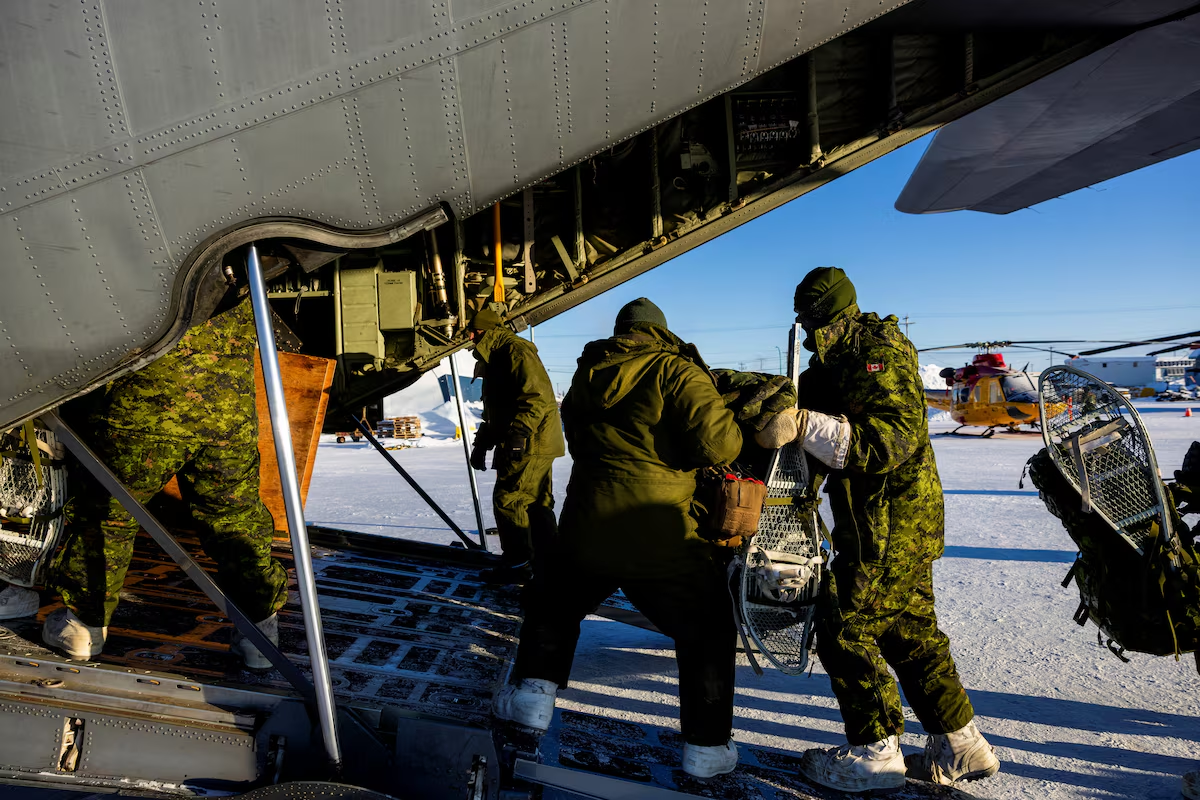
Canadian Armed Forces artillery members load equipment onto a plane in Yellowknife. The Army is reorganizing into three divisions focused on foreign combat, home defence and infrastructure support.Carlos Osorio/Reuters
The Canadian Army is about to undergo its most extensive reorganization in more than 30 years, centralizing operations to prepare for what officials have described as the “future battlefield.”
For years the Army has been organized into four divisions primarily based on geography. The new structure, announced last year, takes effect Thursday and will see the Army reorganized into three divisions focused on foreign combat, home defence and infrastructure support.
Major-General Stéphane Masson, director-general of army capability development, said the restructuring is in response to a complex array of threats facing Canada − including competition among great powers − climate instability, technological advancements and lessons from allies at war.
“When you compile all that, we are at a pivoting point in Canada and for the defence of Canada,” Maj.-Gen. Masson said in a recent interview with The Globe and Mail.
The restructuring is part of a long-term effort by the Canadian Armed Forces to expand its ranks and prepare for the possibility of major conflict.
The pressure to shore up the military has increased over the past year and a half, as Ottawa works to make Canada less reliant on the United States for trade and defence in the face of U.S. President Donald Trump’s trade war and annexation rhetoric. Canada is ramping up its spending on military staffing and equipment to meet the higher defence investment targets agreed to last year by NATO members.
Invading Canada would be ‘preposterous,’ U.S. commander says
The Army has been organized into four regional divisions headquartered in Edmonton, Valcartier, Que., Toronto and Halifax, a structure designed primarily for domestic administration and overseas expeditionary missions rather than major combat operations.
For the first time since the Cold War, it is organizing itself to fight as a division.
The 3rd Canadian Division, based in Edmonton, becomes the 1st Canadian Division − also known as Manoeuvre Division − which will be Canada’s primary fighting force.
The 2nd Canadian Division, in Quebec, will be known as the Defence of Canada Division, responsible for domestic response, territorial defence and mobilization. Canada’s 10 reserve brigade groups and the Canadian Rangers will now operate under that division.
A Canadian Army Support Division in Kingston will be responsible for administrative support.
And finally, the Canadian Army Doctrine and Training Centre, also in Kingston, will lead training and professional military education.
In depth: Arctic snowmobile trek pits Canadian Rangers’ resolve against a ‘nightmare’ storm
David Perry, president and CEO of the Canadian Global Affairs Institute, said the restructuring comes at a critical time, as the military works to modernize itself. He said the Army has also struggled as a result of not having enough people or the right equipment.
However, he cautioned that implementing the changes could be challenging.
“Bureaucracies generally, military bureaucracies in particular, have a tendency to not want to change a lot,” he said, adding that it could take some time to assess the reorganization’s impact.
The Army released a report last year titled Inflection Point 2025 that outlined the broad plans for the reorganization.
Maj.-Gen. Masson said the Army has run three war games to test its redesign. “Take the idea, test the idea, park the emotion and use the science, the data, and privilege evidence over preference,” he said.
The most visible change is in Edmonton. Major-General Wade Rutland, who commanded the 3rd Canadian Division, will now oversee the newly formed Manoeuvre Division.
Maj.-Gen. Rutland will preside over a ceremony in Edmonton on Thursday that will mark the retirement of the 3rd Canadian Division and the introduction of its replacement.
The plans for Manoeuvre Division have evolved as the Army prepared for the reorganization.
The Globe and Mail reported in May that a leaked presentation slide revealed that Manoeuvre Division would house a proposed “Protection Brigade,” which would include ground-based air-defence battalions to protect the Army against threats such as aircraft and drones.
Saab intensifies pitch to sell Gripen jets to Canada
But Maj.-Gen. Masson said the Army has since decided it doesn’t need a separate brigade.
“Protection Brigade is something that we envisioned at the early stage of modernization. … But when we war gamed, we discovered that we don’t need a protection brigade,” he said, without elaborating on the issues that came up in the war game.
Instead, he said, those capabilities will be kept separated and integrated when needed, allowing the commander to “plug and play.”
The war game that shaped the division was held at Valcartier in April of last year and used Russia as the adversary.
“This is the most imminent threat that we have right now with the folks that are deployed in Latvia,” Maj.-Gen. Masson said, adding that the war game confirmed gaps in air defence, long-range fires and command and control.
Maj.-Gen. Masson said the reorganization process will not end when the changes take effect Thursday. He said the Army will be constantly evaluating the plan and its implementation, including at a meeting with senior leadership this month.
“We’re humble enough as an army,” he said, “that we will modify and do the course correction every year if need be.”