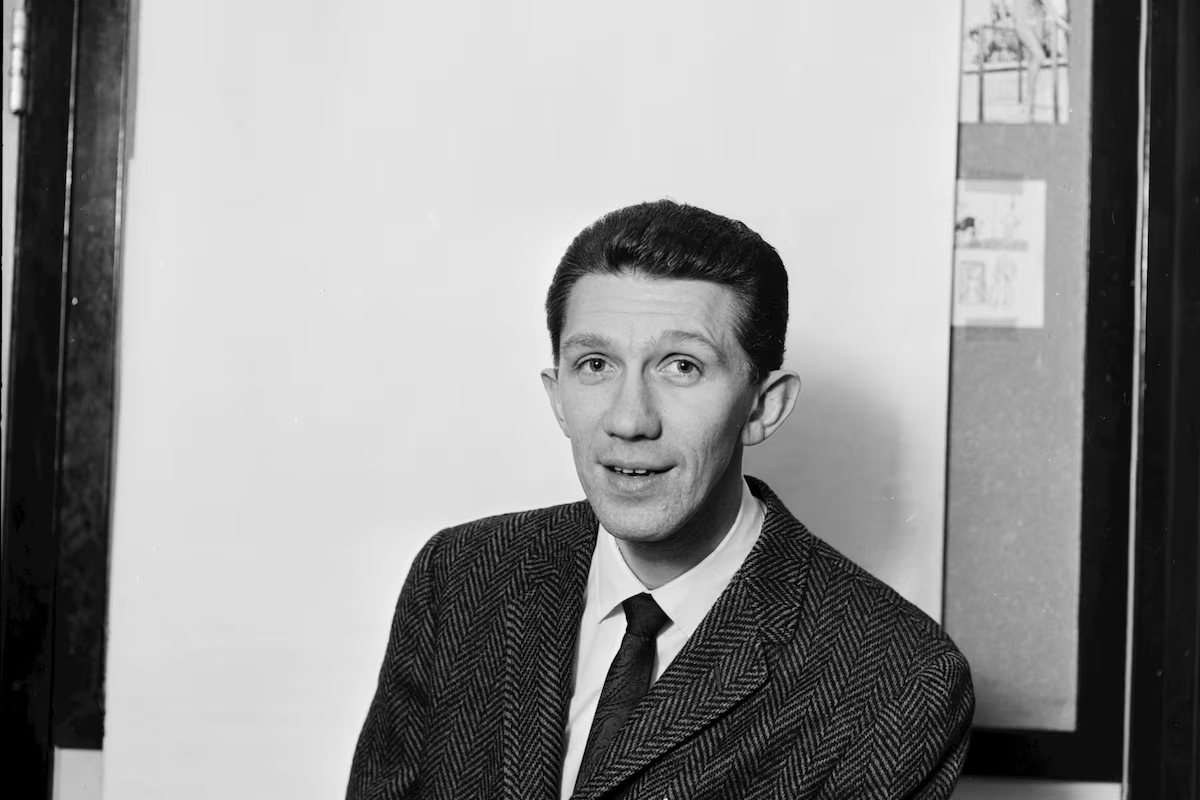

Open this photo in gallery:
Globe reporter Rudy Platiel would make a name for himself covering Indigenous affairs. He died this summer at the age of 91.Harold Robinson / The Globe and Mail
Rudy Platiel was hopeful for reconciliation between Indigenous peoples and the rest of Canadian society decades before it became a buzzword.
The Globe and Mail reporter and photographer, who died on July 27 in Burlington, Ont., worked in journalism for more than three decades, during which he often wrote about Indigenous people.
Rudy Emil Platiel was born during the Great Depression, on Oct. 2, 1934, in Owen Sound, Ont., to Louisa and Emil Platiel. Mr. Platiel considered himself lucky to work first as a teenage factory worker, a bookkeeper and then finally a reporter for the Brampton Times and Conservator before being hired as a freelance writer and photographer for The Globe and Mail. He soon joined the staff and remained at the newspaper until his retirement in 1997.
Open this photo in gallery:
Mr. Platiel, right, was the designated driver in a race to see which Globe staffer could get across Toronto faster in rush hour: Him in a car, Michael Valpy on a bicycle or Amanda Valpy by subway.Barrie Davis/The Globe and Mail
As a teen, he developed a friendship with the Johnston family from Neyaashiinigmiing, part of the Chippewas of Nawash (formerly known as Cape Croker). His family says this friendship planted a seed in him that led him “to give First Nations, Métis and Inuit peoples a stronger voice in the Canadian media.”
In the 2020 book Seen but Not Seen: Influential Canadians and the First Nations from the 1840s to Today, author Donald B. Smith refers frequently to Mr. Platiel’s work.
In the prologue, Mr. Smith lays out an incident in 1969 in which the Liberal government of the day tabled a white paper in the House of Commons that aimed to upend the status rights of Indigenous peoples and eliminate treaties, reserves and the Department of Indian Affairs and Northern Development.
Opposition among Indigenous groups was strong and Indigenous groups mounted vigorous protest and presented the government with their response, known as the Red Paper. The federal government eventually withdrew its policy proposal.
Mr. Platiel witnessed the Red Paper’s submission and 50 years later, recalled the experience in Mr. Smith’s book: “In 1970, I was assigned by The Globe and Mail to travel for a year across Canada to write about the situation of Indigenous people – then called Indians.
“Despite the now continued existence of systemic racism, the march of Indigenous rights and their reality, today is light years beyond anything I actually thought possible back then. This progress gives hope that despite our human flaws and occasional cruelty, as a nation we may one day yet reach a new dawn of acceptance and cooperation between two societies that at times seems so tantalizingly far beyond us today. There is indeed hope.”
Over the next two decades, Mr. Platiel was a friendly fixture on the national landscape of Indigenous news, contextualizing stories and going beyond basic reporting that often stereotyped Indigenous people as troubled, plagued and contentious.
Open this photo in gallery:
Mr. Platiel’s reporting would take him to Frobisher Bay (now Iqaluit) in 1973, where Martha Agnasiak and Dragalee Kownirk were in a class teaching traditional Inuit survival skills.Rudy Platiel/The Globe and Mail
Open this photo in gallery:
Mr. Platiel also covered the legal saga of Jeanette Lavell, an Ojibwe woman whose marriage to a non-Indigenous man removed her treaty rights – something that the Indian Act would not allow if the genders were reversed. She fought the policy at the Supreme Court.Rudy Platiel/The Globe and Mail
Open this photo in gallery:
In 1993, Mr. Platiel was at the Six Nations reserve near Brantford, Ont., as some Mohawks asserted their right to sell cigarettes tax-free.Rudy Platiel/The Globe and Mail
In the newsroom, Mr. Platiel was known as a kind and gentle soul, virtues “worth a lot” says Sean Fine, who sat across from him in the Globe and Mail newsroom at the beginning of his career, circa 1989. “He seemed to have covered everything. Reliably and fairly,” Mr. Fine said.
However, one day in 1966, when Mr. Platiel was covering two simultaneous trials at the Halton County Courthouse, he inadvertently caused a mistrial in one of the cases and received a $100 fine for contempt.
The episode has since become a cautionary tale known to journalism students at Carleton University taking the mandatory media law course.
The story, as told in part by Wilf Kesterton in his book The Law and the Press in Canada, goes that while a judge was deciding in voir dire (a trial within a trial) whether certain evidence would be permitted in the trial of four men charged with criminal negligence, Mr. Platiel was in another courtroom reporting on the second trial.
Upon his return, Mr. Platiel asked a reporter from another media outlet what he missed and was briefed on the evidence considered by the judge. But the other reporter failed to tell Mr. Platiel that the judge had deemed the evidence inadmissible – so it was therefore not publishable.
The headline that appeared with Mr. Platiel’s byline in the paper the following day contained the exact evidentiary detail that the judge had ruled out.
His fine was appealed and later withdrawn before a judge scolded The Globe and Mail (which was also fined) for assigning the reporter to do double-duty.
True to his humility, Mr. Platiel would later explain to Mr. Fine the circumstances of the voir dire mishap, without taking any offence at the subject.
“I’m pretty sure we laughed about it,” Mr. Fine recalled.
Open this photo in gallery:
Hugo the basset hound, the ‘centennial dog’ of 1967, was one of Mr. Platiel’s many photo subjects over the years.Rudy Platiel/The Globe and Mail
Mr. Platiel’s creative force of storytelling didn’t end with retirement. Staying forever curious, he continued to capture the stories of his family and friends’ lives through writing and photography. He also wrote a work of fiction for young adults, In The Land Of Ebyam: The Dangers of the Shadow World are Real, as well as having the occasional byline in the Globe.
A “gentle giant” to his grandchildren and nieces and nephews, Mr. Platiel was 91 years old. He leaves his wife of 63 years, Agatha Platiel, their three daughters Tina, Louise and Vicki; and four grandchildren.
You can find more obituaries from The Globe and Mail here.
To submit a memory about someone we have recently profiled on the Obituaries page, e-mail us at obit@globeandmail.com.