
Listen to this article
Estimated 2 minutes
The audio version of this article is generated by AI-based technology. Mispronunciations can occur. We are working with our partners to continually review and improve the results.
A former Quebec cardiologist who was convicted of second-degree murder in the 2009 stabbing deaths of his children is requesting a temporary release from prison.
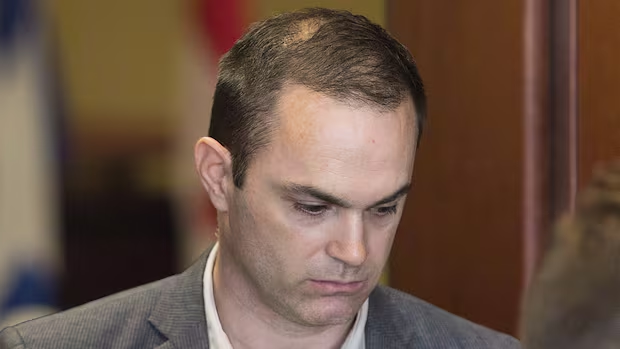
Guy Turcotte was found guilty of killing his two young children — Olivier, 5, and Anne-Sophie, 3 — by an 11-person jury in 2015. He was subsequently sentenced to life in prison with no chance of parole for 17 years.
Turcotte will appear before the Parole Board of Canada on Sept. 22 to request an escorted temporary absence, which allows an inmate to leave a correctional institution for a limited time, accompanied by a Correctional Service of Canada staff member.
Offenders can apply for an escorted temporary absence at any point during their sentence.
Isabelle Gaston, Turcotte’s ex-wife and the children’s mother, said she will read a letter at the hearing.
“I knew this day would come and I have been trying to prepare myself for a long time,” she wrote in a social media post Wednesday.
“I choose to believe in the process, even though I have been disappointed countless times.”
Parole board will consider multiple factors
Turcotte was initially found not criminally responsible for the children’s death in a trial held in 2011.
At the time, his defence argued that Turcotte was suffering from mental illness that stemmed from his troubled marriage. He and Gaston were recently separated when he killed their children.
Escorted temporary releases may be granted for a variety of reasons, including medical, personal development or counselling, community service, family contact or on compassionate grounds.
The parole board will consider Turcotte’s conduct in prison, risk to reoffend, and proposed release plan when determining whether or not to grant his request.
In her social media post, Gaston said she hopes the hearing will be “be rigorous, prudent, and worthy of what Olivier and Anne-Sophie deserve.”
“When a criminal act occurs, we are no longer just victims. We become, despite ourselves, representatives of society,” she wrote, adding that that comes with a responsibility to ensure that justice is served with prudence and humanity.
“The same applies to a request for privileges.”