
Open this photo in gallery:
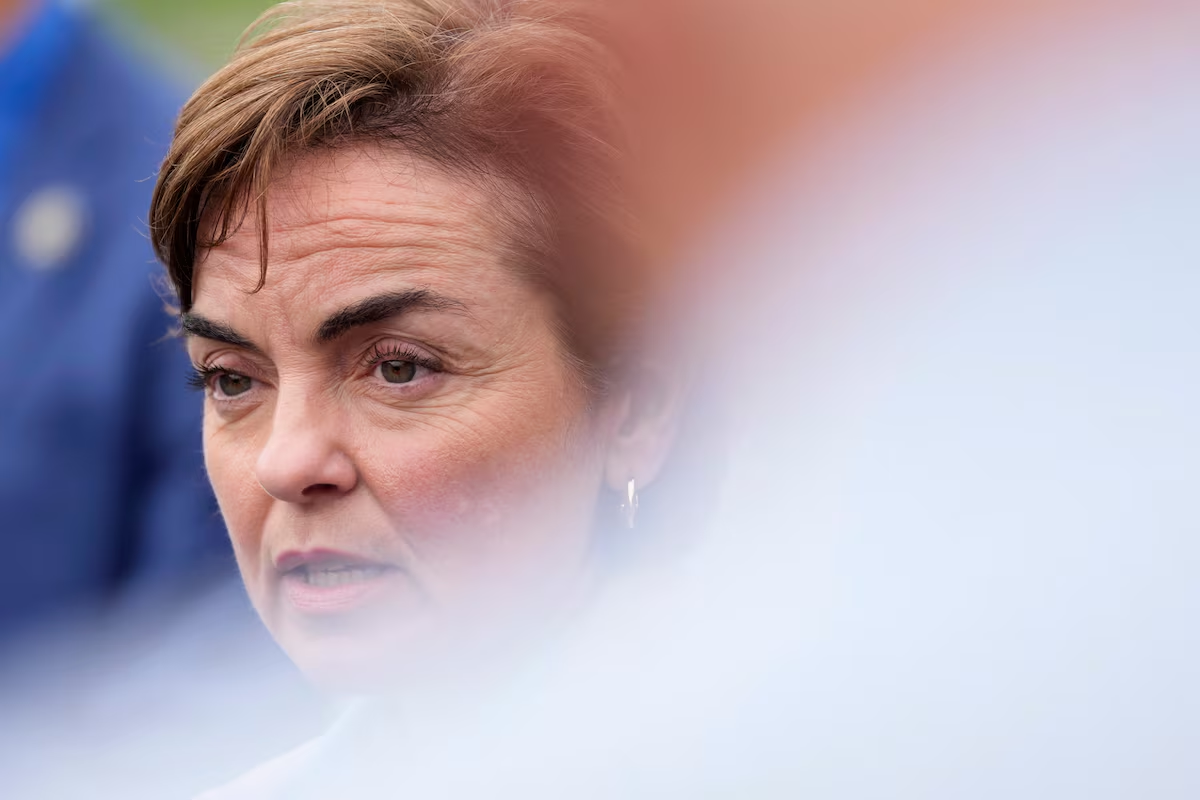
Quebec Premier Christine Fréchette, leader of the Coalition Avenir Québec, responds to questions during a campaign stop in Gatineau last week.Adrian Wyld/The Canadian Press
On the eve of the 2018 Quebec election campaign, François Legault made a promise that would help define his nearly eight years as premier.
A Coalition Avenir Québec government would table a bill on secularism within a year, he declared. Judges, police officers and teachers would no longer be allowed to wear religious symbols on the job.
Bill 21 was the first in a series of controversial and broadly popular laws, intended to defend Quebec values, which became a cornerstone of Mr. Legault’s brand of nationalism. But in this fall’s election campaign, overshadowed by an escalating trade war with the United States, no one wants to talk much about identity politics.
The subject could return to the fore with the country’s top court expected to issue a landmark decision on Bill 21 in the coming months. But ahead of the Oct. 5 election, the province’s political leaders seem to have little desire to reignite a debate over secularism and language rules that now seem like a fait accompli.
Late last month, in the first days of the campaign, Parti Québécois Leader Paul St-Pierre Plamondon stood in front of a Quebec City high school and declared that the province’s schools are overflowing because of too many immigrant children. He used the modular classrooms recently added to the school as a backdrop to reiterate his promise to slash immigration to Quebec.
The stunt earned him considerable pushback. Quebec newspaper Le Devoir revealed the numbers he’d cited didn’t differentiate between newcomers and the Quebec-born children of immigrants. Ruba Ghazal, a co-leader of the left-leaning Québec solidaire, demanded to know who Mr. St-Pierre Plamondon considers to be true Quebeckers.
Journalist and author Francine Pelletier said the move blew up in his face. “Suddenly he was being negative and anti-immigrant.”
PQ Leader accuses Ottawa of election interference to help Coalition Avenir Québec
It was a rare moment in a campaign that has largely steered clear of such thorny subjects. Christine Fréchette, who succeeded Mr. Legault as premier in April, has shown little interest in pursuing her predecessor’s nationalist agenda.
“It’s something that’s uncomfortable and doesn’t come to her naturally, so it’s mysteriously disappeared,” Ms. Pelletier, who recently published a book on Quebec nationalism, said.
Meanwhile, U.S. President Donald Trump has emerged as the bogeyman of the campaign, and there are “much bigger fish to fry,” she added. “As long as we’re dealing with the monster … I don’t think we’ll be dabbling in quaint provincial policies.”
Montreal-based Stephen Brown, CEO of the National Council of Canadian Muslims, said it’s “actually a breath of fresh air to not see minorities front and centre” in this campaign. The CAQ government has long used identity issues “to play wedge politics” and shore up the nationalist vote, he said, including after its support collapsed in recent years. In the last year alone, the CAQ passed two new laws strengthening the province’s secularism rules, including by expanding the ban on religious symbols and limiting prayer in public places.
But right now, Mr. Brown said, nobody’s interested. “As long as Quebeckers are much more concerned with pocketbook issues, that’s what politicians are going to talk about.”
Still, that silence cuts both ways. If no one is proposing major new identity policies, they’re also not complaining about the ones that already exist. The CAQ government’s laws on secularism and protection of the French language were generally popular in Quebec, and political parties don’t have anything to gain by attacking them, Ms. Pelletier said.
“I think people would like to move on.”
Open this photo in gallery:
Accompanied by local candidates, Parti Québécois Leader Paul St-Pierre Plamondon speaks in front of the National Assembly in Quebec City on Tuesday.Jacques Boissinot/The Canadian Press
This was on full display last week, when Élections Québec announced it would be mailing out voter information in French only for the first time, to comply with the CAQ government’s 2022 overhaul of the province’s French-language charter, known as Bill 96.
Despite backlash, Ms. Fréchette said the decision would stand, and insisted the rights of English-speaking Quebeckers were being respected.
Eva Ludvig, president of TALQ, a group representing Quebec anglophones, said the decision “has created a lot of anger in the English-speaking community.” But she said there is currently no champion of Quebec’s English speakers among the province’s main political parties. And there will be no English-language debate during the election campaign.
“We’ve always had much greater access,” she said. “This is the first time where we are totally excluded from this election.”
Legendary film producer René Malo helped introduce Quebec film to the world
Ms. Ludvig said that even the opposition Liberals, traditionally the defenders of minority language rights, have not wanted to rock the boat. The Liberals are lagging far behind the PQ and the CAQ among francophone voters, as Leader Charles Milliard tries to build momentum after a lacklustre start to his campaign.
“He has been really avoiding much of anything that would be perhaps controversial in terms of support for the English-speaking community,” Ms. Ludvig said.
The debate over how Mr. Legault reshaped Quebec nationalism may be on hold, but it’s certainly not over. The Supreme Court of Canada’s coming ruling on Bill 21 could set limits on the use of the notwithstanding clause, which the CAQ government invoked repeatedly to protect its secularism and language laws from constitutional challenges.
Ms. Pelletier said the court’s decision could bring identity politics back to centre stage. “Nothing riles us more here … than having someone outside Quebec tell us what we should do, or tell us who we are.”