
Open this photo in gallery:
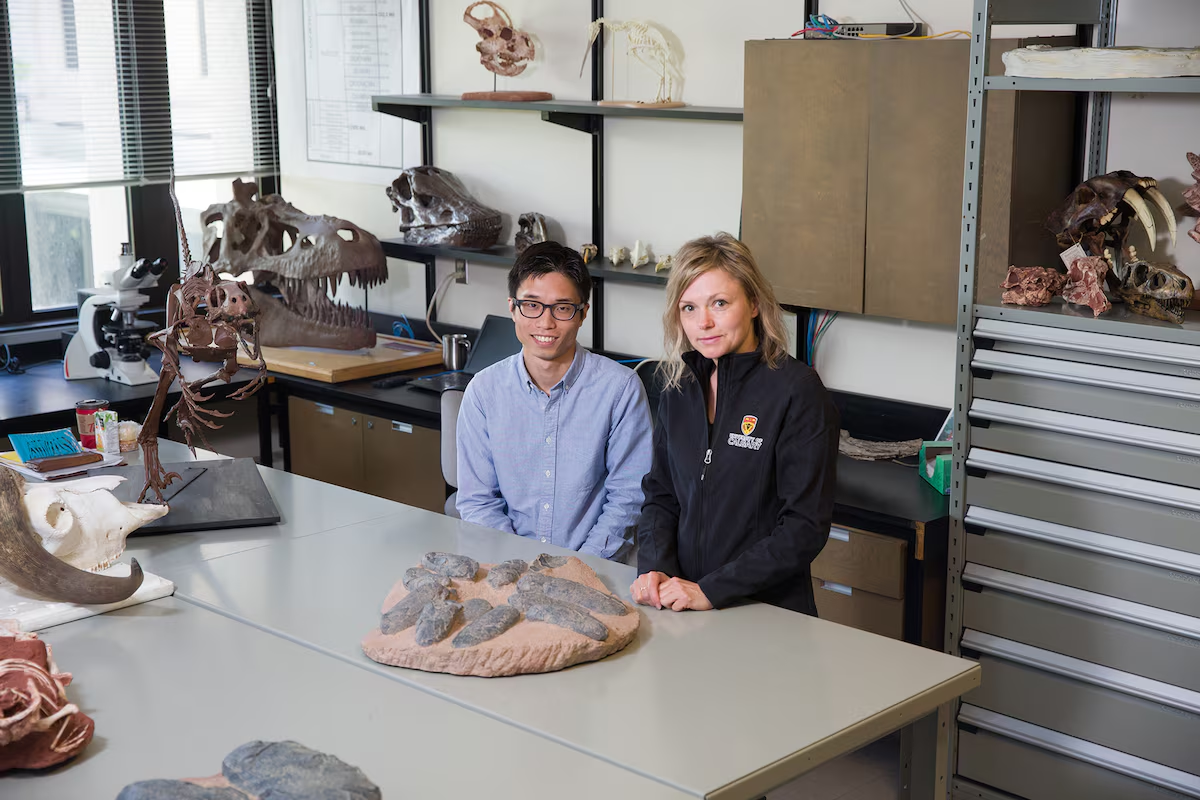
Geoscience PhD student Kohei Tanaka and his supervisor Darla Zelenitsky have been working on a dinosaur eggshell fossil discovery in Japan.Riley Brandt/Supplied
If you were present during the late Cretaceous, about 70 million years ago, it would be hard to miss a titanosaur walking by – one of the largest dinosaurs, adults could weigh up to 75 tonnes.
Now, thanks to some fossilized eggshell fragments discovered in southern Argentina, scientists have determined that the ground-shaking creatures, that belong to the sauropod group of dinosaurs (think of gigantic beasts lumbering on four legs), were laying their eggs hundreds of kilometres further south than previously known.
The record breaking find sheds new light on how such large reptiles managed to survive and breed in cool climates. Titanosaurs were plant-eating dinosaurs with species found on every continent.
“It’s the most southern site to produce dinosaur eggshells,” Darla Zelenitsky, a paleontologist at the University of Calgary, said. “That’s the evidence we need to show that dinosaurs were nesting in this area.”
Dr. Zelenitsky, an expert in dinosaur eggs and embryos, was among the researchers who examined the fossils. The results were published Tuesday in the research journal Royal Society Open Science.
Rare hide from extinct woolly dog bred by B.C. First Nations is on display
The work is based on about 200 pieces of titanosaur eggs that were unearthered by a team of Japanese and Argentine paleontologists during an expedition in Patagonia, near the southern tip of South America, that ran from 2020 to 2024.
Today the location is at a latitude of 50 degrees south – far enough from the equator to experience freezing temperatures during the winter months.
Because the South American continent is currently shifting to the north, the site was even further poleward – about 60 degrees south latitude – at the time the eggs were laid. And while Earth was warmer overall at that time, the average annual temperature at the site would have only been about 12 C, roughly similar to modern day Vancouver.
Open this photo in gallery:
Artist’s reconstruction of a young titanosaur hatchling in a region that is now part of southern Argentina. A nest made of rotting vegetation may have helped to keep eggs warm in what would have been a relatively cool climate for dinosaurs.Masato Hattori/Supplied
Based on geochemical and fossil evidence the location would have likely been a low-lying and rainy river valley, with relatively high humidity and large seasonal shifts in temperature and daylight hours because of its high latitude.
The variability of the food supply would have posed a challenge to titanosaurs aiming to give their hatchlings a good chance at survival.
While eggs measured about four litres in volume, the young still had a huge amount of growing to do after hatching in order to catch up with their giant size parents.
For obvious reasons, titanosaurs did not sit on their eggs to keep them warm with their body heat. “That would have been disastrous,” Dr. Zelenitisky said.
Instead, the dinosaurs likely timed their breeding to be laying eggs during the spring, she said.
A study of the eggshells found them to be highly porous on microscopic scales, so they would have been prone to drying out if they were too exposed, she added.
Reconstructing skeletons, retelling life stories
Instead, she and her colleagues suggest that the eggs were buried by titanosaur mothers under mounds of rotting vegetation. There the eggs could have been warmed by the breakdown of plant matter by bacteria, which would have generated additional heat.
Robert Reisz, a University of Toronto paleontologist who was not involved in the study, said the research was noteworthy for shedding light on reproductive strategies of dinosaurs living far from the tropics.
“That titanosaurs laid eggs at such high latitudes is inherently interesting, especially since the evidence points to mound incubation by plant decay as the main source of heat for these animals,” he said.