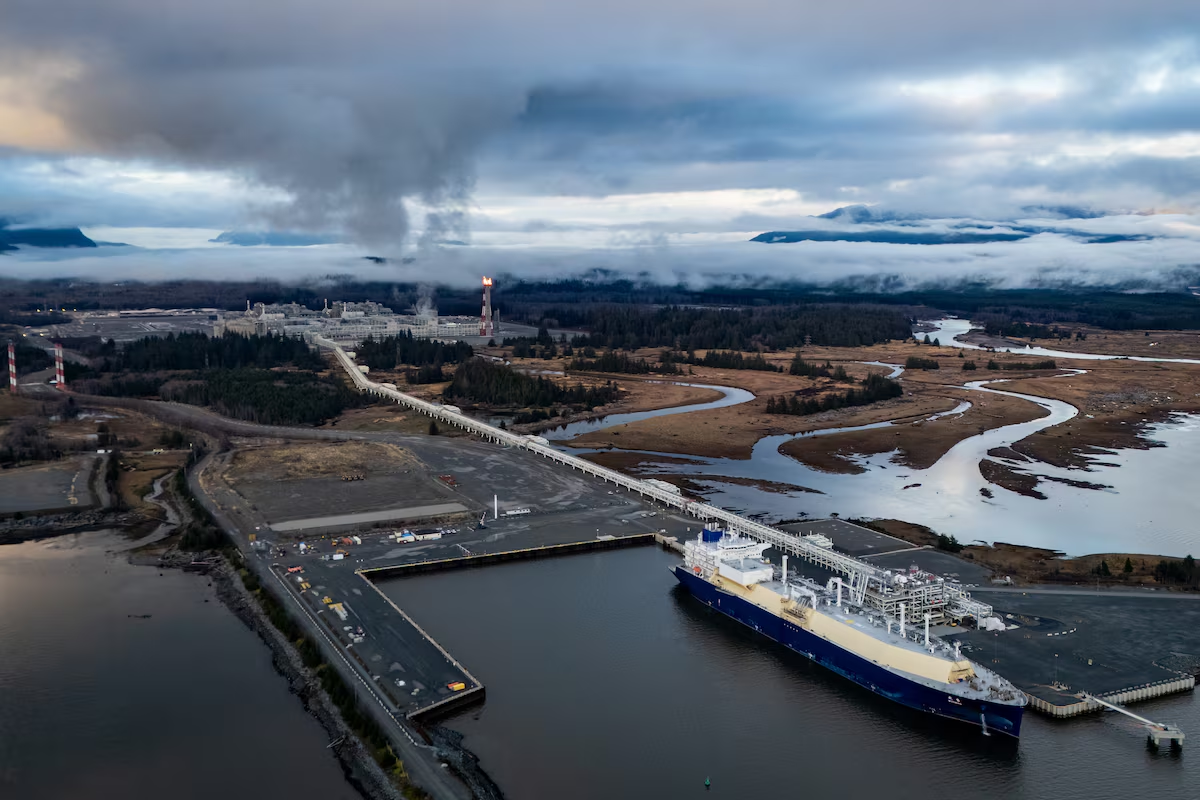

Open this photo in gallery:
A liquefied natural gas tanker fills up at an LNG Canada facility in Kitimat, B.C. Shell’s embrace of Canada as a reliable energy producer signaled that a new round of mergers and acquisitions are reshaping the domestic oil patch, Andrew Willis writes.ETHAN CAIRNS/The Canadian Press
Canadians have always appreciated validation from foreigners.
Last week, London-based Shell PLC validated the country’s potential as an energy superpower by closing its $22-billion takeover (including debt) of ARC Resources Ltd. Shell chief executive officer Wael Sawan used words such as “tent-pole” and “heartland” to describe the strategic value of ARC’s natural gas properties in Western Canada’s Montney basin.
Shell’s global operations give Mr. Sawan the freedom to invest in energy projects anywhere in the world. He chose Canada.
In addition to the ARC acquisition, Shell led the consortium that built the country’s first deep water gas terminal, an $18-billon LNG Canada facility in Kitimat, B.C., that opened last year.
The system is now running at capacity, sending 15 tankers a month to customers in South Korea, China and Japan. Given the uncertainty surrounding Middle East gas suppliers, it seems all but certain the Shell consortium will sign on for a $30-billion LNG Canada expansion.
Canada’s oil patch ripe for deals once turmoil blows over, Deloitte says
Shell’s embrace of Canada as a reliable energy producer, including the bet-the-house investment in ARC, signalled that a new round of mergers and acquisitions are reshaping the domestic oil patch. The biggest players in energy all want more exposure to the massive gas-rich Montney region, which stretches across 130,000 square kilometres of northeastern B.C. and northwestern Alberta.
Acquisitors in the oil patch, such as Canadian Natural Resources Ltd., are always looking for opportunities to buy properties on the cheap. Canadian Natural guiding light and executive chair Murray Edwards made his fortune buying oil sands projects from global players that wanted to exit Alberta, at any price.
Right now, there is a disconnect between the premium valuation on natural gas liquids-heavy properties in Montney and the relatively cheap price of public companies that own these assets. That dynamic feeds M&A activity. So do balance sheets boosted by the recent spike in oil and gas prices.
Calgary-based Kelt Exploration Ltd. is a case study in the takeover targets that investment bankers are pitching to potential buyers such as Shell and Canadian Natural.
Kelt has a $2-billion market capitalization. In a recent report, analyst Kevin Fisk at Bank of Nova Scotia broke down the value of its Montney holdings.
Monica Rizk: Bullish on Kelt Exploration Ltd.
Kelt’s Wembley property in Alberta is worth up to $2-billion, Mr. Fisk calculated, based on the precedent set by $40-billion of M&A in the region over the past three years. He projects the company’s Oak/ Flatrock division holdings in B.C. could fetch $600-million.
For a potential buyer, Kelt’s properties could be worth 50 per cent more than its share price. Mr. Fisk said the company may choose to sell a property to raise money. He also said: “The Montney is consolidating and Kelt’s high-quality assets make it a takeout target.”
The culture of the oil patch is also feeding the Montney M&A boom. Kelt executives, who own a significant chunk of the company, are examples of the circle-of-life approach that sees junior companies develop properties, then sell out to senior companies and repeat the process.
In 2013, Kelt’s founders sold a Montney play called Celtic Exploration Ltd. for $3.1-billion to North America’s largest oil company, ExxonMobil Holdings Corp.
There are numerous public and private domestic companies with the same characteristics as Kelt, an enticing combination of promising properties and relatively low valuations. There are also deep-pocketed buyers sniffing around.
Analysis: Oil and gas companies are falling back in love with Canada, one multibillion-dollar deal at a time
Last week, RBC Capital Markets analyst Greg Pardy hosted executives from three large energy companies – Canadian Natural, Cenovus Energy Inc. and Ovintiv Inc. – for “back to school” meetings with institutional investors. In a report on the sessions, Mr. Pardy said all three companies are hunting for deals.
Canadian Natural president Scott Stauth, who has spent $1.5-billion buying properties so far this year, said: “Any asset acquisition needs to be accretive, synergistic, and importantly support strong shareholder returns.”
Cenovus chief financial officer Kam Sandhar, who oversaw last year’s $8.6-billion takeover of oil sands neighbour MEG Energy Corp., said Cenovus “won’t shy away from opportunistic M&A.”
Denver-based Ovintiv, which moved its head office from Calgary six years ago and changed its named from Encana Corp., highlighted the company’s eligibility for the S&P/TSX composite index. Chief operating officer Greg Givens said the homecoming could take place by Sept. 21.
This year, Ovintiv has spent $230-million on Montney acquisitions as the company exits mature regions in Texas and targets Western Canada.
Shell’s massive acquisition of ARC put a spotlight on the action in the oil patch. An emerging Asian export market for Canadian energy, along with U.S. and domestic demand for natural gas, will fuel a new round of takeovers.