People in the Tisdale district are anxious to learn more about the massive alumina discovery announced in January 2026 by the Saskatchewan government and Canadian Energy Metals (CEM).
CEM estimates that approximately one-third of the world’s known supply of alumina, a critical metal used to create aluminum, is in the ground below farmland north of the small town, which is located about 220 km northeast of Saskatoon.
Community members are looking for clarity on how potential mining activity at CEM’s “Thor Project” might impact the local economy.
“I hear rumours, that’s all,” Francis Gress said. He owns land in the area of the deposit and said it would affect his family.
“It will help the community build and develop and hopefully, young people will stay here.”
Josh Kowal said he hasn’t heard any new information since the January announcement. He’s wondering if the company is looking for investors.
“It would definitely transform the whole area. It would bring a lot of economic potential into the area and create some jobs,” he said.
Ardith Brace is wondering how people can prepare for mining operations.
“I heard that we’re all going to be rich and everyone should buy a new house in town,” she said, jokingly. “For people who are investing and things, I think that they should have more information.”
 Canadian Energy Metals estimates that approximately one-third of the world’s known supply of alumina is in the earth below farmland north of Tisdale, Sask. (Lisa Risom/CBC)
What’s the project timeline?
As it stands, the Thor Project is in its early stages or development phase.
CEO Christopher Hopkins said CEM will eventually move to acquire surface rights from land owners to start open-pit mining operations at several sites.
The timing is uncertain, as development will likely involve the participation of major companies in the aluminum sector.
More exploration work is underway. The company drilled its first test holes in the Tisdale area in June 2022 and continues to explore the vastness of the deposit. This spring they drilled 12 more, bringing the total to 169 sites.
The results of a pre-feasibility study are expected in the first quarter of 2027.
Following this, the company plans to build a demonstration plant in Tisdale, with operational activity projected for 2029 or 2030. CEM will use the demonstration plant to conduct research and fine-tune the processing of the alumina before scaling up to commercial production.
 Canadian Energy Metals CEO Chris Hopkins said the company will eventually move to acquire surface rights from Tisdale area land owners for open-pit mines. (Lisa Risom/CBC)
Reducing reliance on other markets
Currently, North America imports bauxite, a type of sedimentary rock containing alumina, or alumina itself, then refines it to produce aluminum.
Hopkins said the Tisdale alumina deposit has the potential to eliminate North America’s reliance on other countries and add stability to the aluminum marketplace.
“This would establish the first opportunity to have a fully integrated aluminum supply chain within the continent. Right now, aluminum is a highly sought-after metal,” Hopkins said.
The deposit is part of the Pasquia Hills oil shales. It’s a polymetallic, black shale about 25 to 30 metres below the surface that continues downward for another 90 metres or so.
The company’s drilling so far spans an area of 625 square kilometres, roughly spread between Star City and Zenon Park.
To date, a high-confidence estimate shows it to contain 6.8 billion tonnes of alumina within 49.5 billion tonnes of polymetallic black shale, the company says.
“It’s huge, and the more drilling we do, the huger it gets,” Hopkins said.
Black shale
Alumina traditionally comes from bauxite, which is different from the black shale at the Tisdale site. Extracting the alumina consumes a large amount of energy, water and leaves behind environmental contamination known as “red mud.”
Black shale extraction is different. CEM is working with the Saskatchewan Research Council and Hatch Ltd. to develop processes to extract the alumina from the black shale. Labs in Ontario, Australia and the United States are also involved.
Acids would be used to leach the alumina from the ore, with 98 per cent of it recycled in the process, lowering the environmental impact.
“Water is not used in the extraction process at all. There’d be no tailings, no toxic waste in the process. Our energy use would be reduced. Environmentally this would produce the first truly green alumina,” Hopkins said.
CEM says that in 2025, it successfully produced high-purity alumina and chemical grade alumina from the shale ore at its pilot facilities. High-purity alumina is used to make LEDs and chemical-grade alumina has thousands of uses.
“Now we are trying to close the envelope by demonstrating our ability to produce the metal from the alumina,” Hopkins said.
If successful, CEM would have the world’s first commercial aluminum plant based on alumina from black shale.
For now, CEM is focused on extracting alumina. However, other rare earth minerals — including lithium; vanadium, which is used to strengthen iron; and scandium, a metal with aerospace and military uses — have also been found in the shale and plans are in the works to mine them as well.
100s of potential jobs
CEM has hired Hatch Ltd. to do hydrometallurgical testing to process and extract metals. Stantec Engineering is conducting resource evaluations, mine planning and environmental work.
Hopkins expects that with a demonstration plant, mining, processing and smelting operations could start on a small scale and possibly employ a couple hundred people.
Sean Wallace, managing director of Invest Tisdale, which promotes economic development in the area, said his organization will do what it can to support mining and smelting operations when the time comes, but believes this could be 10 or more years away.
“Unfortunately, we don’t have a whole lot of information at this stage about how many people are going to be employed at the mine, so it’s rather impossible for us to predict,” he said.
“At about the five-year mark, that’s when we start to work in earnest to figure out exactly how much housing we’re going to need and what those supply chain companies are going to look like.”
Wallace said Invest Tisdale will conduct a community readiness study to determine housing, infrastructure and service needs once it has more details from CEM.
Tisdale and the surrounding RM have a combined population of nearly 3,900 people. The local economy is supported by agriculture and inland grain terminals.
Wallace said the area is well poised to handle an influx of industrial traffic. The town has major grocery stores, hotels, restaurants, heavy equipment dealers and mechanics.
There is also regional infrastructure to support the mining industry such as hydroelectricity, natural gas, two railroads and two major highways.
 Sean Wallace, managing director of Invest Tisdale, says municipal governments plan to fully support mining and processing operations. (Lisa Risom/CBC)
Economic spinoffs
Tisdale Mayor Mike Hill said the announcement of the critical metal discovery was welcome news for the business communities in Melfort, Nipawin and Tisdale.
“The initial investment just put some enthusiasm and some excitement in everyone — that these minerals are here in our backyard,” said Hill.
He anticipates economic spinoffs from exploration and mining in the area. The town also offers tax abatements on residential and commercial properties to entice settlement in the community.
“Tisdale is a vibrant town. We have a hospital here, a police force, beautiful schools and parks and we’re in close proximity to the lakes,” Hill said.
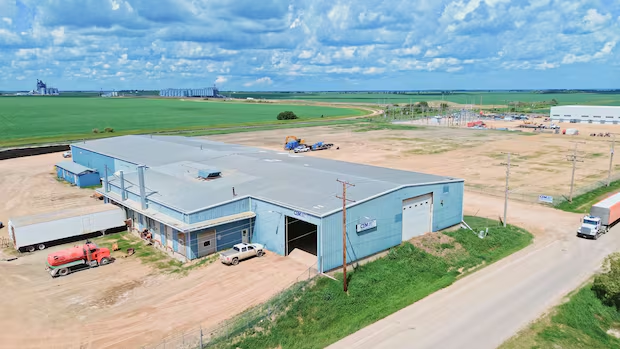
So far, CEM has purchased the former Westeel Grain Bins property and buildings in the industrial section of Tisdale for a research and development centre.
 Tisdale Mayor Mike Hill says the announcement of the critical metal discovery was welcome news. (Lisa Risom/CBC)
Canadian Energy Metals projections
Hopkins said CEM plans to maintain a major stake in the Thor Project and is looking to partner with a major industrial alumina company.
CEM is working with international banks and investment firms for assistance with financial and strategic planning.
The long-term goal of the company is to establish a fully integrated aluminum industry in Saskatchewan, spanning mining to metal production, Hopkins said.
The feasibility study expected next year is the next step. An environmental impact study will occur once mining sites have been identified, he said.
CEM has acquired 21 mineral claims, covering about 322 square metres of land, according to the Saskatchewan Ministry of Energy Resources. In total, the Thor Project comprises Saskatchewan mineral exploration rights totalling 287,873 hectares.
“The ongoing work at Thor Project will be critical to determining the viability of the alumina resource and its potential,” the ministry said.
The province has assisted the Thor Project through its Targeted Minerals Exploration Incentive, but does not have a stake in the project, the ministry said.
There are no reserve lands included in the Thor Project zone, but CEM has signed a memorandum of understanding with six First Nations with ancestral ties to the region.
The North East Tribal Energy Resource Alliance is made up of Fishing Lake First Nation, James Smith Cree First Nation, Kinistin Salteaux Nation, Yellow Quill First Nation, Muskoday First Nation and Red Earth Cree Nation.
The MOU is meant to create a collaborative forum to help shape resource development and reciprocity in northeast Saskatchewan.
A spokesperson from CEM told CBC News the company will be releasing more information about the Thor Project in early September.