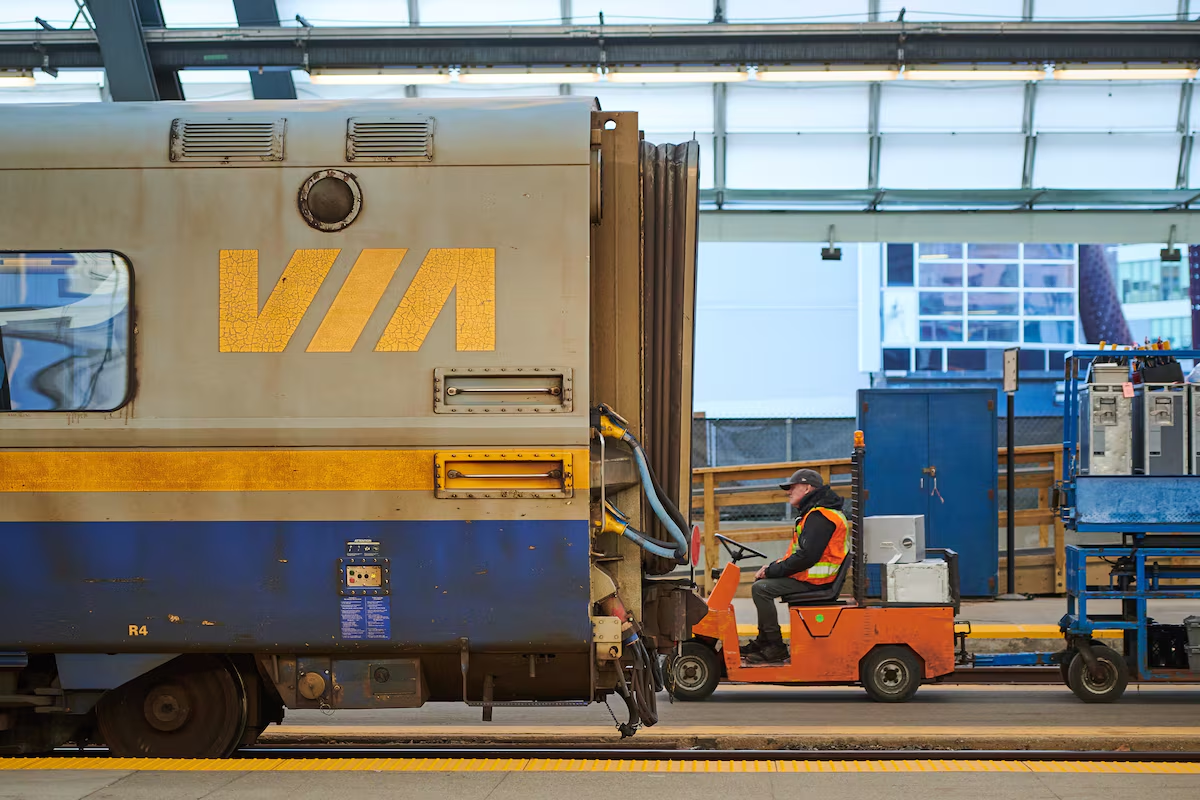

Open this photo in gallery:
Prime Minister Mark Carney speaks at the Alstom Plant in Thunder Bay on Thursday. The new trains the PM announced will serve Via Rail’s long-distance and remote routes.David Jackson/The Canadian Press
The federal government will spend $4.7-billion to build and maintain more than 300 Via Rail passenger rail cars in Canada, using facilities in Quebec and Thunder Bay, Prime Minister Mark Carney announced Thursday.
At a news conference in the northwestern Ontario city, Mr. Carney said the move represents a shift away from importing trains from south of the border.
“For too long, we bought from abroad what we were more than capable of building right here at home. We’re bringing that work back, and we’re turbocharging it,” Mr. Carney said.
The Prime Minister framed the train car announcement as an example of how the federal government is encouraging more domestic manufacturing at a time when its largest trading partner is taking a protectionist turn with waves of new tariffs.
Opinion: Don’t worry, Canada. The trade war will end, and end quickly
“For the first time in four decades, those cars will be produced and assembled and maintained in our country. Cars that used to be built in the United States will be built right here in Thunder Bay, at Alstom, by the best workers in the world,” he said.
The announcement said design and engineering work for the 313 new cars will take place in Saint-Bruno-de-Montarville, Que., while some manufacturing will also happen in La Pocatière, Que.
Via’s most recent trainsets are from Siemens Canada and were built in Sacramento, Calif. Siemens received a $989-million contract in 2018 to build 32 trainsets for the Quebec-City Windsor corridor. Those trains began to enter service in 2022.
The trains currently operating outside of the Windsor-Quebec City corridor have an average age of 77 years old. The new replacements are scheduled to begin entering service in 2031. They will include sleeper cars, dining cars and cars with panorama views.
Open this photo in gallery:
Via Rail’s Siemens Charger locomotives at a Montreal maintenance centre.Christinne Muschi/The Canadian Press
In July, the Prime Minister announced $1.6-billion for the production of 45 new locomotives for Via Rail by Switzerland-based Stadler, as well as $357-million for a new assembly and maintenance facility in Montreal.
The new trains announced Thursday will serve Via Rail’s long-distance and remote routes.
Trade tensions between Canada and the United States could escalate next week as Ottawa plans to impose new countertariffs on Tuesday. They are in response to U.S. President Donald Trump’s new 50-per-cent tariffs on about $28-billion worth of Canadian goods.
The President announced those new tariffs after trade negotiations between the two countries collapsed last month.
Senior U.S. officials have said Canada should expect an additional response if the Sept. 8 countertariffs go ahead.
Open this photo in gallery:
Railway workers pass through Toronto’s Union Station, Nov. 13, 2024.Sammy Kogan/The Globe and Mail
When asked about the state of trade relations with the U.S., Mr. Carney said a deal remains possible provided that the Americans accept Canada’s positions related to protecting the French language, manufacturing and retaining its sovereignty with respect to trade deals with other countries.
“We’re ready to sit down and strike that deal when the Americans are ready,” he said.
Mr. Carney was also asked to respond to recent criticism from U.S. Commerce Secretary Howard Lutnick, who has said he believes Mr. Carney’s team deliberately derailed the negotiations to gain political advantage ahead of October votes on a sovereignty-related referendum question in Alberta and the Quebec provincial election, where the sovereigntist Parti Québécois has been leading in the polls.
Konrad Yakabuski: As Fréchette cozies up to Carney, the Quebec election is becoming a toss-up
Mr. Lutnick has predicted that Canadian negotiators will want to resume talks after those two elections.
Mr. Carney dismissed that analysis.
“I don’t think, with all respect, appointed, unelected, cabinet ministers in the United States are experts on Canadian politics,” Mr. Carney said.
He said talks between the two countries will resume at the appropriate time.
“But the most important thing we can do is not to spend all our time waiting by the phone, waiting for a call … refreshing on social media to see what’s coming across. No, it’s building. It’s building here,” he said.
Mr. Trump commented on Canada again Thursday on Truth Social.
“It is very good for Canadian Politicians like Prime Minister Carney to make President Donald J. Trump “the enemy,” until their Economy collapses, then it will prove to be very bad for Politics – Worse than anything that has ever happened to a Canadian Politician. Just watch!” he said.
Opinion: Canada, no one is coming to save us
The Prime Minister also said Thursday’s announcement is a show of support for passenger rail in Canada, with traditional trains supporting plans for a new high-speed rail line between Quebec City and Toronto.
A recent report from Alto, the Crown corporation leading the high-speed rail project, said ridership on the existing Via Rail service has declined to 4.4 million passengers a year in 2025 from about eight million in the 1980s.
Via Rail has long said its ability to provide faster and more dependable service is hindered by the fact that it primarily operates on privately-owned tracks where slower-moving freight traffic is prioritized.
Alto estimates that ridership on its planned high-speed rail line, which would operate on new tracks dedicated exclusively to passenger rail, will reach 24 million passengers a year by 2055 and up to 43 million by 2084.
Alto has estimated that the project will cost between $60-billion to $90-billion.
Tony Keller: Is high-speed rail the best way to spend $90-billion?
The Globe and Mail reported this week that an internal estimate shows the total cost will be much higher when operational and maintenance expenses are included.
Alto’s regularly stated cost range only accounts for the capital cost of building the line. An internal 2023 draft obtained by The Globe showed operating and maintenance costs over 40 years are projected to be between $62.6-billion and $67-billion. The cost of rolling stock is estimated at around $2-billion over that same period.
The document said the total cost, including capital and operating expenses, over 40 years will be between $148.1-billion and $152.7-billion.
The document also says total revenue over that period will be $105-billion, which would more than fully cover the operational expenses.
Editor’s note: A previous version of this article incorrectly stated that Siemens Canada built 32 passenger cars for Via, after receiving a contract in 2018. Siemens built 32 trainsets.