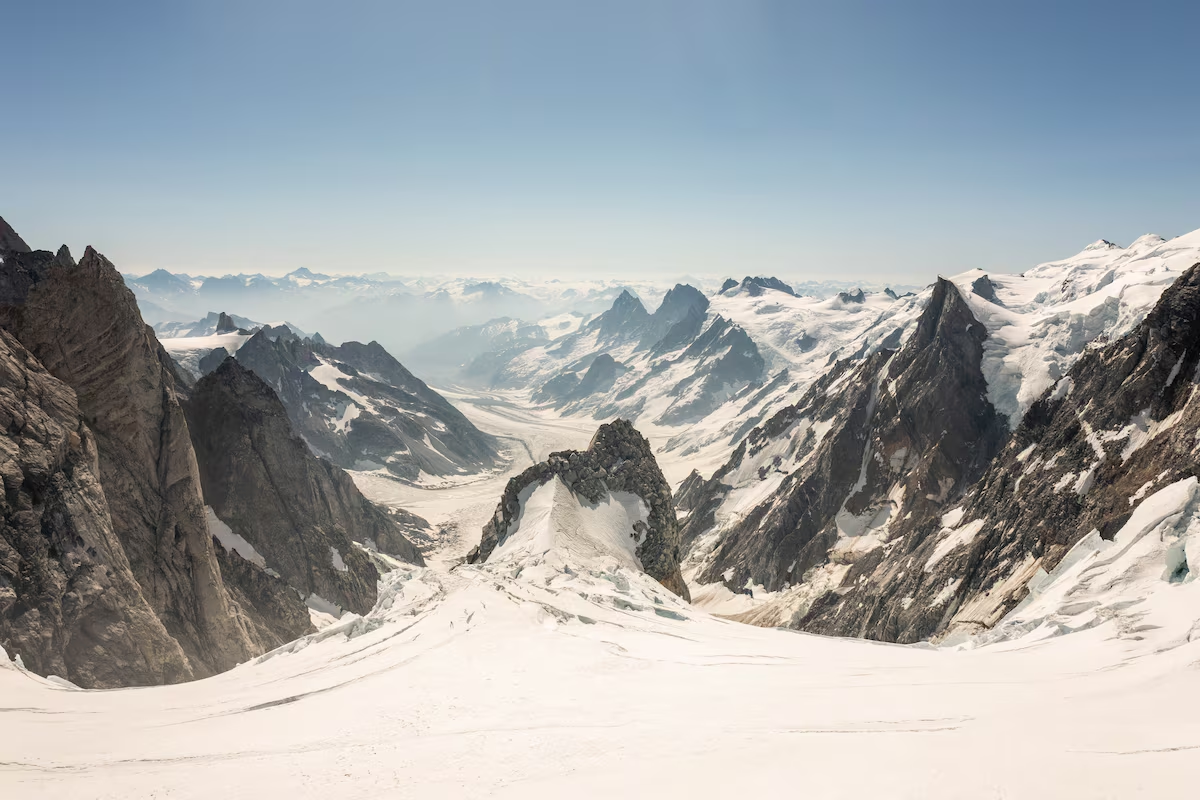

Open this photo in gallery:
Combatant Col, a saddle of snow and ice between Mount Waddington and Mount Combatant in British Columbia’s Coast Mountains, lies 300 kilometres northwest of Vancouver on July 9.Bastian Fleury/Supplied
Six years ago, a rapidly retreating glacier in the southern Coast Mountains of British Columbia shrunk away from the base of the nearby mountainside causing millions of tonnes of rock to fall.
The Elliot Creek landslide, with a mass similar to that of all Canadian automobiles combined, landed in an alpine lake, creating a tsunami and draining the lake. The displaced water flooded a nearby fjord, destroying kilometres of salmon habitat and scouring nearby forest.
According to a 2022 study, despite detecting the resulting seismic event, its location remained unknown until forestry workers found the site two weeks later.
In the remote valleys of the Coast Mountains, the tsunami and flooding caused no structural damage or fatalities. But its root cause appears to be similar to the landslide behind the Aug. 26 floods in Nepal, which have claimed the lives of more than 1,250 people.
As the Himalayan glacier thinned and retreated, geologists believe the removal of ice could have caused the high-altitude landslide.
But in both the Himalayas and Canada, scientists don’t know where the next such event will happen.
Ottawa issues comprehensive climate report that reflects country’s physical transformation
The effects of climate change are creating evolving risks in high mountain regions, Daniel Shugar, a geomorphologist and associate professor at the University of Calgary, said.
“With glaciers, they’re changing so quickly that the hazard – and therefore the risk – is not the same now as it was five years ago or in five years’ time from now,” Prof. Shugar said.
Climate change is leading to conditions that can destabilize high-mountain rock and ice, strengthening prospects for disasters such as the Himalayan flood along the border between Nepal and China’s Tibet, scientists say, while warning climate change may not be sole trigger.
Reuters
Glaciers are receding and thinning at an unprecedented rate, with glaciers in Western Canada expected to largely disappear by the end of the century, according to a report released by Environment and Climate Change Canada this week.
The report expects the number and severity of floods and landslides to increase as glacier ice melts, even if carbon dioxide emissions reach net-zero. The Paris Agreement established a global goal to reach net zero by 2050.
“Even if we did turn off the taps today, we have a lot of global warming that’s already built into the system, baked in, and so we are going to see these impacts,” Prof. Shugar said.
Between 2021 and 2024, glaciers in Western Canada lost 12 per cent of their volume, melting twice as fast as they did in the last decade, according to a study co-authored by Prof. Shugar, Brian Menounos, Hakai affiliate and geography professor at the University of Northern British Columbia and others.
Glaciers in Western Canada shrank at near record rates in 2025
“It’s clear that our high mountains are changing rapidly, and it really does call for a combined systematic effort to monitor these high elevations,” Prof. Menounos said. However, risk mapping and management is often only completed after a disaster happens.
“Sadly, in many cases, we use a whack-a-mole approach,” he said.
Jeffrey Crompton, a researcher at the Geological Survey of Canada, is in the early stages of creating a monitoring system which would identify the greatest hazards and the risks they pose to people and infrastructure.
“It’s a huge problem, and we need a lot more resources than we currently have to be able to get at it,” he said.
Luck has saved many Canadians from alpine disaster, Dr. Crompton said. Despite Canada not having the same densely populated river valleys as in the Himalayas, several large landslide events in North America could have led to tragedies.
Last year in Tracy Arm, an Alaskan fjord, a landslide event, similar to the Elliot Creek event occurred. As the South Sawyer glacier lost ice, it exposed a cliff face that soon gave way, displacing enough water to cause a tsunami. Tracy Arm sees a lot of marine traffic, with tour boats and cruise ships frequently operating in the fjord. Happenstance meant few boaters were near the landslide when it happened.
Other events have also come close to tourist areas and mining communities, such as northern B.C.’s Canoe Glacier landslide in 2021, and have posed threats to infrastructure, such as highways, pipelines and power lines.
“Back to back to back, all of these very large events [are] happening, and they all kind of follow this common theme of happening in these mountainous regions where there’s rapid deglaciation,” Dr. Crompton said.
Anxious about the climate? Here are 7 ways to cope
Glaciers in the Arctic are also melting at a rapid pace, increasing the threat of disaster in the region. As shipping increases through the north, the area could be the next frontier for these hazardous events, Prof. Shugar said.
“We’re starting to see really, really big [landslides], and that’s a concern, and that’s something that I think we as a scientific community, but also we as a society, need to be paying attention to as we consider development in mountain environments,” Prof. Shugar said.
Switzerland and Norway both have risk mitigation systems, which allow the two countries to monitor for hazards and keep communities safe in alpine locations and fjords, Prof. Shugar said.
“We in Canada have nothing like that,” Prof. Shugar said. “We don’t even know where the unstable slopes are, let alone knowing which ones might collapse.”