
Listen to this article
Estimated 4 minutes
The audio version of this article is generated by AI-based technology. Mispronunciations can occur. We are working with our partners to continually review and improve the results.
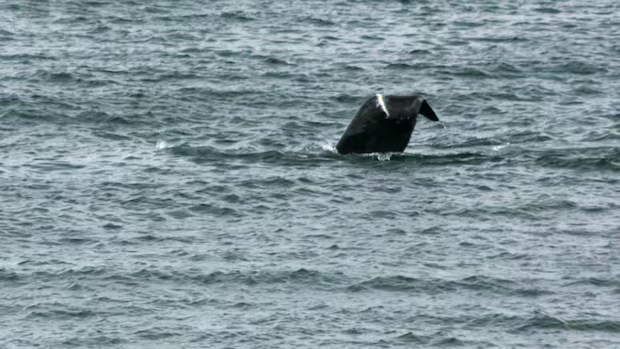
When Heather MacAulay and her husband, Chris Murphy, got a call there was something strange in the water off Blackhead Cove in Conception Bay North earlier this week, the pair were stumped by what they saw.
MacAulay described the creature as a “large misshapen something” moving across the water with a vertical tail that had an apparent injury. She says she was perplexed because it was so different.
“Once we saw it, we all became hugely invested in it… Anytime you see something for the first time you become invested,” MacAulay told CBC Radio’s The Broadcast.
It turns out they stumbled across a rare North Atlantic right whale — a critically endangered species of whale with only an estimated 384 individuals remaining.
Alex Cole, with the Canadian Wildlife Federation and the Atlantic Right Whale Project, confirmed the species sighting was a right whale to MacAulay.
The Department of Fisheries and Oceans (DFO) also confirmed the whale spotted was one and the calf of Checkmark 3705; a right whale that was first spotted with the calf in Florida last year.
Cole said getting to see the video MacAulay took of the whale was incredible. She says she made sure MacAulay knew how special the moment was.
“Any time that you see one of these whales, it truly is remarkable,” said Cole.
WATCH | See a rare North Atlantic right whale sighting off Blackhead Cove:
‘Did you see it?’ Get a rare look at a North Atlantic right whale off N.L.
Videographers Heather MacAulay and Chris Murphy got quite the shot on Sept. 1 when they spotted a North Atlantic right whale off the coast of Blackhead Cove, N.L. The whales are a critically endangered species, but encouraging signs are pointing to the population stabilizing.
MacAulay says she and Murphy, who live in Nova Scotia but share a summer home in Blackhead, are now obsessed with right whales. She learned from DFO the whale was also seen earlier this year in Massachusetts.
Though the right whale stuck around in Blackhead, Broad Cove on Sept. 1, at the time of her interview with CBC on Sept. 3, MacAulay hadn’t seen the whale again.
“We are trolling social media to see where it might be, to see if we might get another encounter with it, to analyze it a bit more,” said MacAulay.
In terms of seeing the species in N.L., Cole said it isn’t unusual to see right whales off the east coast of the island. There are sightings of one or two every few years. However, this type of whale does frequent the southern Gulf of St. Lawrence, she added.
What’s impacting the right whale population?
While there was a population decrease around 2010, Cole says it seems to have hit a plateau where they are not really decreasing nor increasing. But any time a right whale is sighted, she thinks it’s a good thing and important for researchers to understand what waters they are using.
“If you see a whale, whether it is a right whale or not, report that sighting… it will really go a long way in helping with the recovery of the species,” said Cole.
A DFO officer told CBC Prince Edward Island that while the right whale population is not skyrocketing, the birth of calves this year is an encouraging sign and if it continues in the next decade the species could be in “good shape.”
There was concern the whale sighting could trigger a fishing prohibition locally, but DFO said in a written statement the detection didn’t warrant one and asked harvesters to operate with caution.
According to Cole, the largest threats to the right whales population are net entanglements and vessel strikes — in terms of mortality she would call it a 50/50 split.
One of the things MacAulay noticed was the damage to the right whale’s tail. She says she was told it was possibly a shark bite but Cole thinks it had an interaction with a vessel.
Cole says fishing technology exists that is protective to whales and her team has been investigating the gear for years to ensure they really work. She encourages its use for the better protection of all whale species.
“We are still at a stage where we are trying to find a way to make it more wide-ranging but it is a reality at this point,” said Cole.
Download our free CBC News app to sign up for push alerts for CBC Newfoundland and Labrador. Sign up for our daily headlines newsletter here. Click here to visit our landing page.