
Listen to this article
Estimated 4 minutes
The audio version of this article is generated by AI-based technology. Mispronunciations can occur. We are working with our partners to continually review and improve the results.
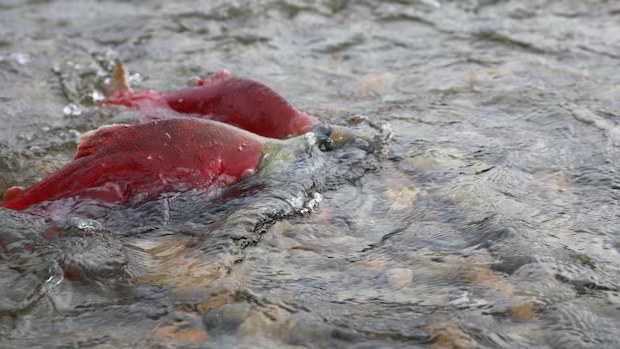
Many Fraser River sockeye salmon fishers are coming home empty-handed, following a dismal run that shut down fisheries this season.
“This year, it didn’t even fill up the boat once — not once,” said Mike Baird, fisheries co-ordinator for the Tsawwassen First Nation.
And he’s not the only one noticing the sharp decline.
“Well, [in] the Fraser River, unfortunately, there’s no fish,” said Darin Chung, a fisher and owner of B.C. Live Spot Prawns & Seafood.
 Mike Baird, Tsawwassen First Nation fisheries co-ordinator, said the decline in sockeye is a stark contrast to the 2010 run, when salmon were jumping around his boat off the shores of Steveston. (Steven Chua/CBC)
Fisheries shut down
As a result, Fisheries and Oceans Canada, also known as DFO, has shut down Fraser River sockeye fisheries, though there might be leeway for First Nations food, social and ceremonial purposes.
“The forecast for this year was 7.7 million but we’re now sitting at a run size of just over three million,” said Fiona Martens, director of the Pacific Salmon Commission.
Diminishing runs are an ongoing trend.
Sockeye salmon go back up the Fraser River in cycles. A dominant cycle — when the most fish return — occurs every four years.
 Fraser River salmon counts from the Pacific Salmon Commission shows a declining dominant runs after a spike in 2010. (CBC)
But they’ve been getting smaller in recent years, dropping by millions each cycle from a peak of 28 million in 2010.
Baird said that year he saw salmon jumping out of the water around his boat, which was sailing off Steveston.
He was able to fill his coffers with sockeye within three hours — a far cry from this year’s disappointing run.
“This is probably the lowest dominant cycle that I can recall,” said Greg Taylor, fisheries advisor with Watershed Watch Salmon Society, a conservation group.
And it’s hitting fishers in their pocketbooks.
 Darin Chung, a gillnet fisher, says he’s had to look elsewhere to harvest fish as a result of the downturn in Fraser sockeye. (Steven Chua/CBC)
Darin Chung, a gillnet fisher, estimates Fraser River sockeye makes up between 40 to 50 per cent of his business.
“Without the Fraser River sockeye, we’re going to be massively short … basically from November to June of next year,” he said.
As a result, he’s had to fish for sockeye elsewhere, but he said it’s no replacement for the Fraser catch, which is particularly coveted because of its high Omega-3 content.
Why such a low run?
Conservationists, fishers and government are trying to figure out why the return is so low.
“Most would link it to abnormally high water temperatures,” said Taylor.
He noted it’s a challenge to know exactly what’s going on in the ocean, but said there have been also been lower runs in Alaska, Russia and Japan.
“It appears to be something linked to the ocean environment,” Taylor said.
Baird blames the unseasonably hot weather this year, which has triggered wildfires throughout B.C.
 Mike Baird says ongoing drought conditions are a likely contributor to the low Fraser sockeye run this year. (Steven Chua/CBC)
“We live in a rainforest and we’re dealing with drought,” he said.
Baird also noted there may be an overpopulation issue with seals and sea lions, which are consuming endangered fish.
Chung, on the other hand, is calling for changes in the bureaucracy.
“The way that it’s managed — the Government of Canada is not managing it properly,” he said.
For its part, Fisheries and Oceans Canada said a low snow pack, forest fires and drought conditions are making it hard for the fish.
The agency said it’s invested $412 million to help preserve and restore wild Pacific salmon.
But while there are a multitude of reasons why the run is so low this year, most can agree on one thing.
“We all have to do our part to look after the river,” Baird said.