
Open this photo in gallery:
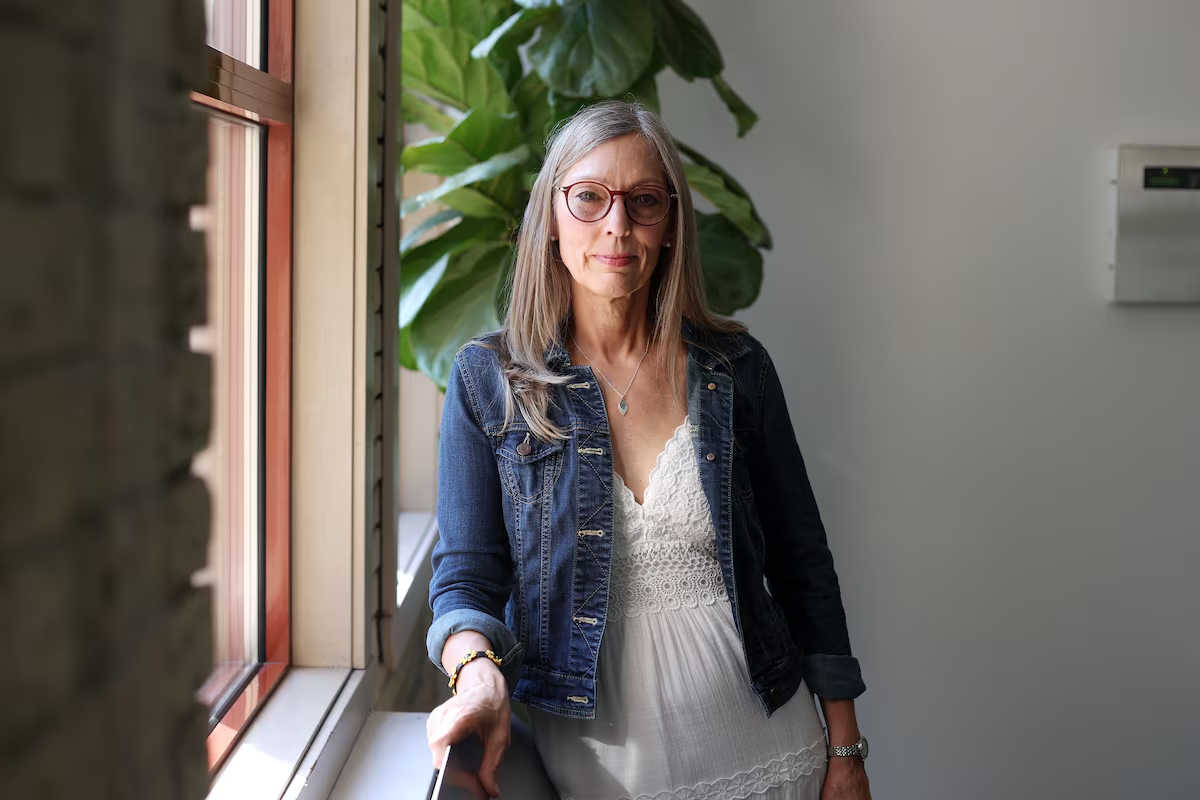
For roughly six years, Nanette Godbout, 59, has volunteered with No One Dies Alone, a program where trained volunteers provide comfort to individuals who are nearing death and have no family or close friends available to sit with them.Shannon VanRaes/The Globe and Mail
Sitting at the bedside of a dying man, Nanette Godbout flipped slowly through an illustrated book about life after death. Although the gentleman was unresponsive, Ms. Godbout said he managed to open his eyes, which drifted across the pages of The Next Place.
“The next place that I go will be as peaceful and familiar as a sleepy summer Sunday and a sweet, untroubled mind,” the book opens before detailing a gentle transition into the next realm. “There will be no room for darkness in that place of living light.”
Ms. Godbout, who volunteers her time sitting with strangers in Winnipeg who are nearing the end of their life, has come to understand that death doesn’t follow a schedule. Nurses told her that it would likely be days before the man died, but he closed his eyes for the final time after the book was read aloud.
At this Ontario hospital, a volunteer corps preserves small-town warmth
“It just seemed to speak to him,” said Ms. Godbout. “One would never know but it’s just my intuition, my interpretation of what he was feeling. There was something in that book that I felt he maybe needed to hear.”
For roughly six years, Ms. Godbout, 59, has volunteered with No One Dies Alone, a program where trained volunteers provide comfort to individuals who are nearing death and have no family or close friends available to sit with them.
The program, which began in 2019, is run through the provincial charity Palliative Manitoba, and takes place at two Winnipeg locations that provide end-of-life care, Riverview Health Centre and Deer Lodge Centre.
The concept of No One Dies Alone, or NODA, was born in Eugene, Oregon in the 1980s. Sandra Clarke, a registered nurse working the night shift at Sacred Heart Medical Center, said a dying patient who could barely speak asked her to sit with him. She promised him that she would come back after making her rounds, but he died by the time she returned, Ms. Clarke explained in a 2013 interview with Mayo Clinic.
This hospital volunteer has been giving patients good hair days for more than 50 years
“The sense of frustration and anger was overwhelming. He had a simple wish that was easily granted and I couldn’t do it,” she said, tears gathering in her eyes.
“I always say it’s a man whose name I have no idea, but it’s a man I’ll never forget.”
In 2001, Ms. Clarke’s No One Dies Alone program was founded, serving as the model for hundreds of chapters that have since launched across the United States, Canada and around the world, including in the United Kingdom and Singapore.
While each group operates independently, all have the same underlying mission, a hope made clear in its very name. That no one dies alone.
In places where it is available, these volunteers make it so health care workers can focus solely on medical care. But service availability does vary, especially in rural and remote regions, making it difficult at times to fulfill every patient’s last wish.
Open this photo in gallery:
Ms. Godbout said her time volunteering for NODA Manitoba traces back to her first encounter with death.Shannon VanRaes/The Globe and Mail
Asked how she became a volunteer with NODA Manitoba, Ms. Godbout said it traces back to her first encounter with death.
She was just a teenager when her aunt died suddenly and the adults in her life were so consumed with their own grief that she was left to navigate hers alone. The death, for many years, haunted a young Ms. Godbout, who was left with uncomfortable, difficult questions about her own finite existence.
Rather than drown in those feelings, the lifelong educator decided to confront them, beginning an enduring journey demystifying death and dying. She is trained as an end-of-life doula, has a master’s degree in education with a specialization in grief and bereavement and another one in counselling.
Through schooling, Ms. Godbout took a 10-week compassionate care course offered through Palliative Manitoba, a prerequisite for any volunteer with the organization who supports individuals with life-limiting illnesses and the bereaved.
It covers topics such a spiritual care and how to differentiate between spirituality and specific religious beliefs, end-of-life ethical issues and how to comfort the dying.
Her volunteer work started soon after, first as a co-facilitator with children’s grief groups then with the telephone bereavement program and as an end-of-life companion, supporting people with an incurable illness and their families. In 2019, she raised her hand to join NODA and has since been called to the bedsides of 16 individuals.
“Being with someone at the end of life is like standing in a doorway between two worlds. It feels like being present for a birth in that we both stand at opposite ends of the same sacred mystery,” Ms. Godbout said.
“At a birth, we watch someone take their first breath and at death, we may witness their last. And in each case, we’re powerless to control the moment itself. All we can do is provide care and comfort and support.”
Despite the emotional weight of being a NODA volunteer, Kathleen Williamson, Palliative Manitoba’s end-of-life volunteer co-ordinator, said they have not had difficulties finding people willing to step up.
She said they have about 40 volunteers, all of which have varying availabilities to take on bedside vigils. Typically, volunteers are called to sit with people who are expected to die in the next 24 to 72 hours, typically taking on three hour shifts between 8 a.m. and 8 p.m.
In addition to the completion of the compassionate care course, volunteers are required to have enhanced criminal record checks, provide personal references and complete additional training.
Still, some applicants are denied for various reasons, for example if they have recently experienced a personal loss and are still grieving, explained Ms. Williamson.
Most often, people nearing the end of life refer themselves for NODA but family or a power of attorney can also make a referral. Referral forms, said Ms. Williamson, detail the individual’s cognitive and mental state, comfortability with touch, cultural or religious background and any other relevant details.
For example, someone may write about their love for classical music, wanting the Bible read to them or having their hand held.
Open this photo in gallery:
Ms. Godbout has what she calls a “vigil bag” that she can pack quickly to leave with a moment’s notice.Shannon VanRaes/The Globe and Mail
Ms. Godbout has what she calls a “vigil bag” that she can pack quickly to leave with a moment’s notice. Inside are books on life and death, some religious, with sticky notes peaking out of their pages, which are filled with highlights and scribbles. There are also essential oils and a portable speaker to play gentle music.
She prefers to drive in silence to vigils and purposefully parks her vehicle a distance away, giving herself time to mentally transition before sitting at an individual’s bedside. She always introduces herself, whether the person is responsive or not, as a “new friend who has come to spend some time with them.”
What happens next varies. Sometimes they pray or read a book. Sometimes they listen to music or sit in silence, Ms. Godbout’s hand gently resting on theirs.
“It’s the act of consciously bearing witness to their transition and so I try to offer a calm, loving and safe environment so the individual can pass away on their own terms and timeline,” she said.
When she leaves, Ms. Godbout says a special prayer for the individual and their life, thanking them for allowing her into that sacred space.
She said through “befriending” death she has healed her teenage self and unearthed a passion to provide comfort to others who must confront death themselves.
“I have been so inspired to live more deeply.”
Care Between the Lines is a summer series, which will introduce you to volunteers in health care who fill gaps and provide compassion in a system that can be isolating and scary.