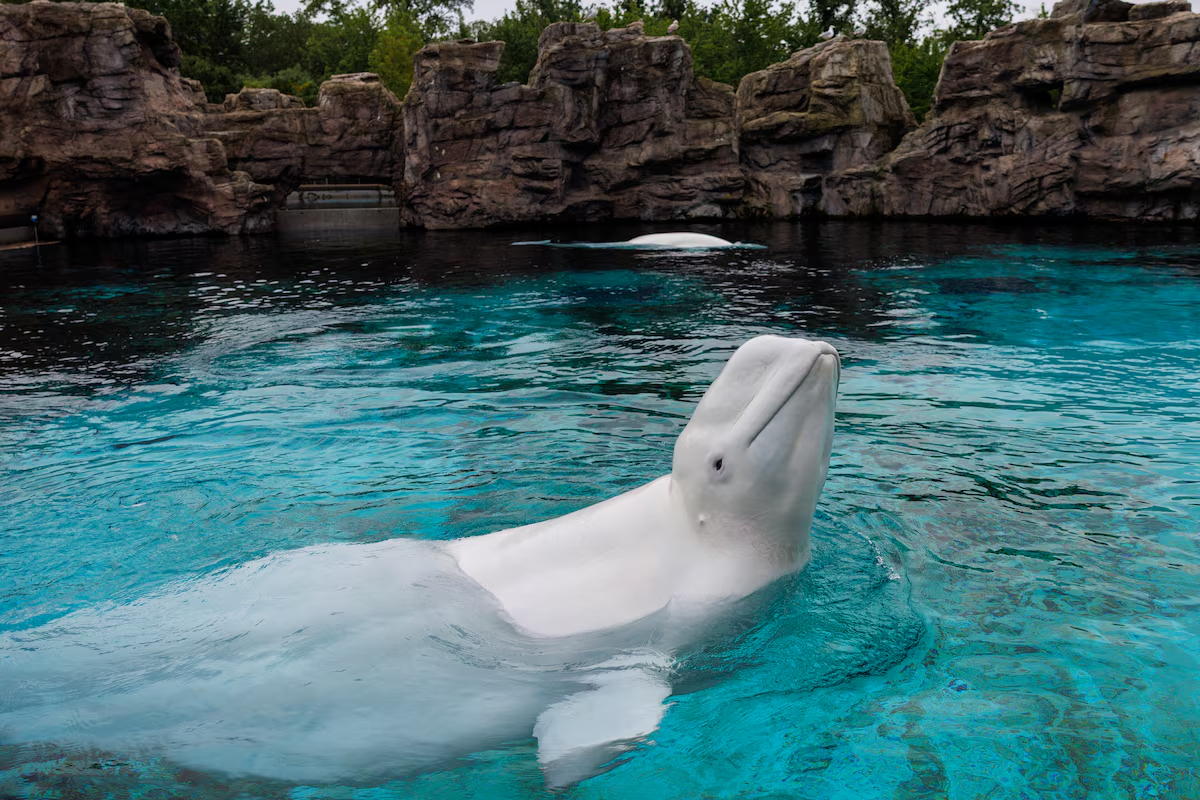

Open this photo in gallery:
A beluga whale swims in a tank at Marineland in Niagara Falls, Ont., on Monday.Carlos Osorio/The Canadian Press
Tofino, a massive beluga weighing more than 1,500 kilograms, has made history as the last captive whale in Canada to be plucked out of Marineland’s waters.
The shuttered tourist attraction in Niagara Falls, Ont., completed the largest collective move of captive whales the world has ever seen Monday, shipping 30 belugas and four dolphins to five aquariums in the United States and Spain over several weeks.
No whales or dolphins are known to be left in captivity in Canada. A 2019 federal law ensures there will be no more.
A team of experts gathered Monday to move Marineland’s last six belugas. Two of them – Yukon and Gimli – are destined for the Shedd Aquarium in Chicago. Four others – Tank, Odin, Orion and Tofino – will call SeaWorld San Antonio their new home.
It took about 12 people to wrangle the whales in a net and guide them, one at a time, into the slings before a crane lifted them into tanks on transport trailers.
Emotions ran high as trainers at the park said their goodbyes to the animals.
Taylor-Lee Dell became close with Odin over the past five years. She held Odin’s head as the crane operator lifted the whale out of the waters of Friendship Cove.
“I tried to say goodbye and tried to tell him I love him and comfort him,” she said, choking up.
“All I’m trying to do is be that voice of someone that he knows and he finds comfort in. It’s just really hard to lose a family member. It literally feels like I’m losing my children.”
Some trainers will soon be out of work. Dell is not sure what she’ll do next, but plans to take some time for herself.
“I’ll never get to do this again ever in my life and that’s something I’ve kind of accepted,” she said.
Last captive dolphins leave Marineland as recently relocated beluga dies in Chicago
Dell said few people know what it’s like to work with whales, especially amid a growing anti-captivity movement in Canada.
“I want everyone to know that the whales were loved, really loved,” Dell said.
The whales would have been euthanized if they couldn’t be moved to new homes, the park’s adviser Andrew Burns said.
“We were out of money, out of time,” he said, adding it’s “unbelievable” that Marineland pulled off the complex operation.
Over six moves, the park shipped its marine mammals to Shedd Aquarium in Chicago, SeaWorld locations in San Diego and San Antonio, Georgia Aquarium in Atlanta and Oceanogràfic València in Spain.
Canada banned whale and dolphin captivity in 2019, but grandfathered in the animals at Marineland. The law also forbids breeding, which forced Marineland to separate its male and female belugas and banned performances.
That was the beginning of the end of Marineland, whose founder, John Holer, died the year before in 2018.
Whale captivity in Canada began in 1964 with a killer whale named Moby Doll. Vancouver Aquarium initially sought to kill and display a killer whale.
When the harpoon didn’t kill Moby Doll, officials put the animal in a makeshift tank. Moby Doll died after 88 days in captivity.
By then, a new industry in Canada came to life.
Holer was smitten with the circus world and bought a small parcel of land not far from Horseshoe Falls in 1961. He built up Marineland over the years, leaning heavily on acquiring and showing off marine mammals such as killer whales, belugas and dolphins, along with building roller-coasters and other rides.
At one point, Marineland was the country’s most popular amusement park.
Holer’s widow, Marie Holer, took over after his death in what would prove to be difficult years, as the COVID-19 pandemic wreaked havoc on Marineland and other tourist attractions.
As the world recovered, Marineland did not. By early 2024, Marie Holer put the park up for sale before she died in September of that year.
It was also a difficult time for the animals. One killer whale, one dolphin and 19 belugas have died at Marineland since 2019, according to an ongoing tally by The Canadian Press based on internal government documents and official statements.
At one point in 2021, the provincial government, which enforces animal cruelty laws, declared all marine mammals at the park were in distress due to poor water quality.
Marineland spent millions of dollars to fix its water. The province’s chief animal welfare inspector later said the water problems did not cause or contribute to the animals’ deaths.
The park has pointed the finger at the 2019 law as the reason behind some of the deaths.
Over the past few years, the park relocated many of its animals, though several hundred deer still remain. The bison herd was moved, as were its penguins. A dozen bears were moved earlier this year to a sanctuary in Colorado.
Sources have said a deal is in place for the sprawling property near Horseshoe Falls, but it is conditional upon the park removing its animals.
Last year, Marineland was prepared to sell all of its belugas and dolphins to Chimelong Ocean Kingdom in China, which holds a Guinness World Record for the world’s largest aquarium. It was the only place in the world Marineland could find that was capable of taking the largest collection of captive belugas on earth.
The federal government blocked Marineland’s request to export the belugas there. Fisheries Minister Joanne Thompson said it would not be in the whales’ best interests, as China do not have the same laws against breeding and performing.
Marineland threatened to euthanize its whales unless it received an emergency cash infusion from the federal government.
Burns scrambled to find another partner and eventually a consortium of aquariums, largely in the United States, came together to help.
The whale and dolphin moves have not been without risk.
Peekachu, a 23-year-old beluga that moved earlier this month to the Shedd Aquarium, died two weeks later. The Chicago aquarium said blood work revealed Peekachu was severely dehydrated.
The whales’ departures have also been difficult for several former Marineland trainers.
Marineland fired Kristy Burgess in February 2025 after a young beluga at the park, Eos, was euthanized for health reasons.
Burgess said the park thought she was the source in a news article that revealed the beluga’s death. She went public last fall, saying the whales needed to be moved as soon as possible.
Four more Marineland beluga whales arrive in Chicago as part of rescue plan
“Part of me is relieved because obviously the animals are safe and not under the constant threat of euthanasia, but it’s also bittersweet and sad because, well, they’re leaving,” Burgess said.
Debbie Silva, who worked at the park until 2021, said it was unfortunate the anti-captivity law came into force without much thought of what to do with Marineland’s whales.
“Nobody stopped to think about what would happen with the ones that we did have in human care,” Silva said.
“But ultimately, I’m happy with where they’re ending up. They’re going to top-notch facilities with high standards facilities, and that’s the best scenario for the situation that we find ourselves in right now.”
In 2012, a former Marineland trainer spoke publicly about the treatment of animals there, accusing the park of neglect for not fixing its water problems. The stories of Phil Demers and other former workers helped change the public’s and politicians’ views on whale captivity.
On Monday, Demers stood outside the park and watched the police-escorted convoy of belugas as the trucks rumbled by.
“Wishing my friends a safe trip,” he wrote on social media. “We have officially emptied Marineland’s tanks.”