
Open this photo in gallery:
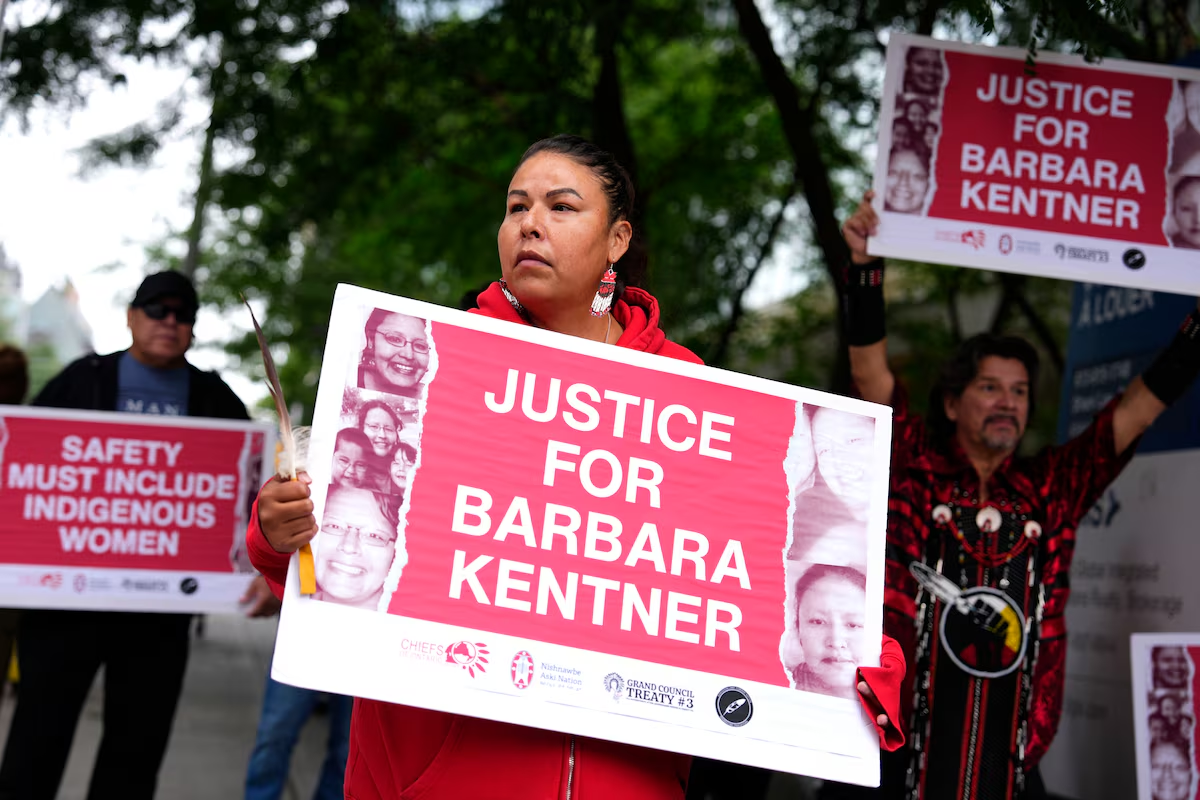
Connie Kentner, sister of Barbara Kentner, participates in a march following the decision to grant full parole to the man who was convicted of her sister’s manslaughter, in Ottawa, on Aug. 31.Justin Tang/The Canadian Press
Family members of an Indigenous woman who died after a hate-fuelled attack say they want the Parole Board of Canada to explain why they weren’t told of a decision to give the man who killed their sister full parole earlier this month.
Indigenous leaders joined Connie and Melissa Kentner on Parliament Hill Monday morning for a news conference calling for a review of the parole board’s decision to release Brayden Bushby, who served five years of an eight-year sentence for manslaughter in the high-profile 2017 death of Barbara Kentner in Thunder Bay.
“When the parole board makes a decision like this, they are not deciding in a vacuum. There is a family on the other side of that decision, which is us. There is a community on the other side of that decision, which is where we live. There are Indigenous women and girls watching. There are families who are asking themselves whether the justice system will protect them and whether their voices will matter if something happens to them,” said Connie, Barbara’s sister.
Mr. Bushby was convicted of manslaughter in 2020 after he pleaded guilty to aggravated assault for throwing a trailer hitch at two of the Kentner sisters from a passing car, hitting Barbara in the stomach and rupturing her small intestine. He was sentenced to eight years in prison in 2021.
On Aug. 13, the parole board granted Mr. Bushby full parole with conditions and notified media of its 13-page decision on the case by e-mail on Aug. 18. At that time, The Globe and Mail contacted Melissa Kentner, who wasn’t aware Mr. Bushby had been released from prison.
She also said no one in her family was contacted by the parole board to inform them of its decision or told that Mr. Bushby was even being considered for full parole, even though family members had registered for such notification.
“They know our e-mails, for some of us, our cellphones haven’t changed since 2017 and still we were not invited to participate in the parole process as victims,” Melissa said in a statement.
The parole board did not respond to a request from The Globe Monday. In its decision, the board said it determined Mr. Bushby would not pose undue risk to the public.
Melissa said she no longer feels safe knowing Mr. Bushby is free, and neither do her children.
Six months after Barbara, a 34-year old Anishinaabe mother, was struck with the trailer hitch hurled at her and Melissa as they walked down a Thunder Bay street, she died from injuries to her abdomen.
Evidence from the preliminary hearing and trial heard that on the night of the assault, Mr. Bushby, a Thunder Bay resident, was intoxicated after a day of ice fishing and drinking. He and three friends went driving around the city, and Mr. Bushby told his friends he wanted to “yell at hookers.”
That night, Melissa said, she saw a vehicle approach them with someone hanging out the window. Then she heard someone yell, “I got one!” as it drove off. Barbara was behind her on the ground and had been hit in the stomach with a trailer hitch she found nearby.
The blunt force trauma ruptured Barbara’s small intestine, requiring emergency surgery.
The forensic pathologist who performed her autopsy said Barbara died of bronchopneumonia and acute chronic peritonitis. She determined that both were consequences of a “traumatic rupture of the small intestine” caused by the blunt force injury.
Barbara also had end-stage liver disease, and while it was a significant contributing factor, it was not a direct cause of her death, the forensic pathologist who conducted the autopsy testified in 2020.
Superior Court Justice Helen Pierce said in her sentencing that Mr. Bushby’s fatal attack was motivated by a hatred of women and disregard for their lives.
Justice Pierce said while there was no evidence Mr. Bushby knew the Kentner sisters were Indigenous on the night of Jan. 29, 2017, it was proven beyond a reasonable doubt that he was motivated by hate toward women.
“Your actions have signalled to Indigenous people across Canada that they cannot expect to be safe, and that their lives are not valued,” she said.
Indigenous leaders from Northern Ontario said greater consideration has to be given in parole board risk assessments that involve Indigenous victims.
“There has to be a review on this particular case,” Deputy Grand Chief Anna Betty Achneepineskum of Nishnawbe Aski Nation said Monday.
In its August decision, the board said it determined “a release on full parole now will not pose undue risk and the release will contribute to the protection of society by facilitating [Mr. Bushby’s] reintegration back into society as a law-abiding citizen.”
Mr. Bushby was previously granted day parole in 2023, allowing him to live at his mother’s home in Thunder Bay, but the parole board revoked his release the following year.
At the time, the board said it found Mr. Bushby had violated several terms of his day parole, including a prohibition on consuming alcohol.
Mr. Bushby had failed a breathalyzer test during a traffic stop, the board said. He had also failed to remain at the scene after he reversed a car into another vehicle, and was a suspect in a car theft investigation, the parole board said in the decision.
He also got a new tattoo of a Confederate flag, which the board said was widely linked to “racist ideologies.”
Mr. Bushby, however, said he fell asleep and didn’t know what the tattoo artist was doing until the piece was done and questioned whether it was relevant to his case.
He also cut a swastika into a correctional facility’s lawn in August, 2025, according to the parole board’s decision.