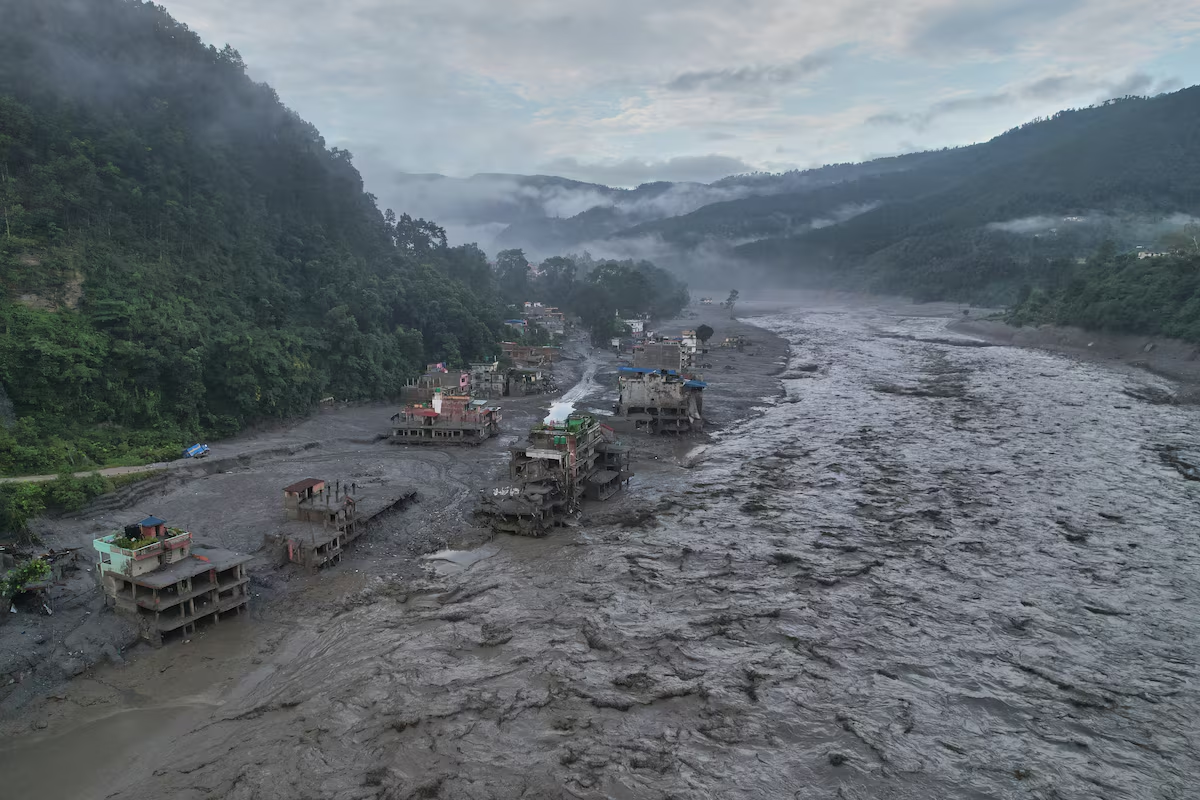

Relatives of the missing religious pilgrims swept away in last week’s Nepali floods, a group that included 12 from Canada, are being told by the trip’s organizer that their family members most likely did not survive.
The India-based Isha Foundation said in a statement posted online that the impact of the flood in the area where its group of travellers had last reported arriving, an immigration control building, leaves little room for hope.
“At this time, there seem to be no encouraging indications of survivors at the immigration office area,” the statement said.
“The local experts who know the terrain well, have told our on-ground team that it is very unlikely that anyone could have possibly survived the force of the flood,” it said. “The mix of debris and water rose very high, probably as high as 150 feet with immense force, completely wiping out the whole building complex.”
Explainer: What to know about Mount Kailash, a sacred site for pilgrims missing after floods in Nepal and Tibet
The pilgrims are among 31 Canadian citizens and permanent residents reported missing in the disaster. On Saturday, Foreign Affairs Minister Anita Anand said in a statement that one person from Canada that was previously missing had been located alive.
Nepal’s disaster agency said that as of Sunday the death toll had climbed to 788 with more than 2,502 missing, while Chinese authorities reported 16 deaths and 546 missing on the Tibetan side of the border. More than 400 foreign nationals remain missing in Nepal.
The pilgrims reported to the Isha Foundation that they had arrived at the Tibet-Nepal border facility at 9:05 a.m. local time, shortly before flash floods swept the building away.
Isha’s spiritual leader, Jaggi Vasudev, commonly known as Sadhguru, said during an event livestreamed Sunday that the group usually arrives at the border early to avoid lineups later in the day. The group was on the way back from a pilgrimage to Mount Kailash in Tibet, a sacred site for Hindus, Buddhists and others.
“I only wish we didn’t have so much discipline. I wish we had gone there half an hour later. But we went there on time,” he said.
Residents gathered on higher ground for safety on Sunday (August 30) as river water levels rose in Roshuki Bazar in Nepal. Drone footage on Saturday (August 29) showed the extent of damage at a village that was hit by the floods.
Reuters
During the event, Sadhguru spoke to his followers about the need to accept fate.
“You can’t reclaim lives that are gone. That is not in our hands. Death is a resounding silence,” he said.
Asked for answers by the sister of one of the missing during the livestreamed event, Sadhguru said no one has brought back the dead or those who are gone.
“There are no words which can bring back lives. There are no words which can erase the pain,” he said.
In south-central Nepal’s Chitwan district, authorities have begun burying yet-to-be-identified bodies in temporary graves – a move that has drawn criticism from some, including a former Nepali prime minister.
Anil Thapa, a police inspector co-ordinating the handling of the bodies, told the Associated Press that temporary burial was necessary because many of the bodies had remained submerged in flood waters for days and were decomposing by the time they were recovered.
Open this photo in gallery:
Army personnel in hazmat suits arrive to bury unidentified bodies recovered from the flash floods at a mass burial site in the Devghat Forest on Sunday.Ezra Acayan/Getty Images
Insp. Thapa said the authorities are preserving DNA samples and photographing distinguishing facial features and recording other identifying details. The bodies are assigned a reference number to help families claim them later.
Fifty bodies were having DNA samples taken ahead of their likely burial Sunday. A day earlier, 100 victims were buried.
“People are worried that this could be a permanent burial, but it is only temporary management,” Insp. Thapa said. “If someone is able to verify the identity later using the available information, they can take back the body and perform the appropriate funeral rites.”
The Nepali government has opened an official website where it has posted more than 2,000 images and descriptions of the deceased to help family and friends of the victims identify those lost.
Ruby Chaudhary, who has two missing relatives, told the Associated Press that the burials should not proceed without families’ consent.
Families comb through lists of missing people in Nepal as steep mountains hamper rescue efforts
“The dead deserve to be treated with dignity,” she said. “Our tradition is to cremate them on the riverbank, surrounded by their immediate family.”
Authorities in Nepal also warned of additional flooding early Sunday, after information from Chinese authorities of increased water flow upstream, according to Dharam Raj Uprety, chief executive of Nepal’s National Disaster Risk Reduction and Management Authority.
Chinese state news agency Xinhua, citing the country’s water resources ministry, said a new lake formed after Wednesday’s floods high in the mountains had largely drained.
But Xinhua said the ministry warned that a crater located 5.6 kilometres upstream, which held an estimated 1.4 million cubic metres of water, still posed some risk and required close monitoring.
With reports from The Canadian Press and the Associated Press