
Listen to this article
Estimated 5 minutes
The audio version of this article is generated by AI-based technology. Mispronunciations can occur. We are working with our partners to continually review and improve the results.
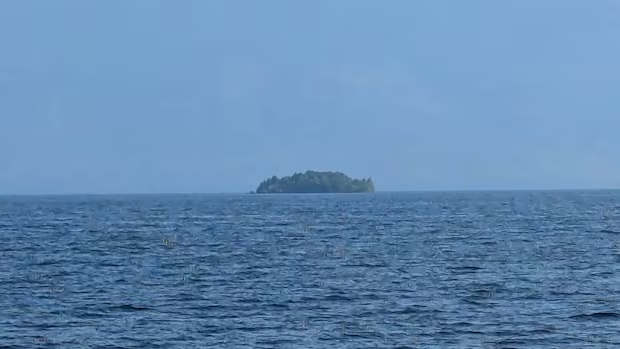
No one knows where it came from or where it went, but a massive new island might be floating out somewhere in the Williston Reservoir in northern B.C.
The forested land mass caught the attention of B.C. Hydro and local residents earlier this month after it was spotted bobbing in the massive man-made lake north of Mackenzie.
Rocky Avery says video and pictures of the island were taken by a boater and later shared with him. He posted them on social media, and they quickly went viral.
“It was a pretty amazing sight to see, never seen anything like that in my 40 years in this country,” said Avery.
“There was a big fishing derby coming up, so I wanted to make sure everybody was aware of what was going on. And I wanted B.C. Hydro to know too that it was out there, just in case it was floating down their way.”
The discovery left a B.C. Hydro spokesperson incredulous when CBC News first inquired about the island’s origins.
Bob Gammer says he was first skeptical about the origins of the video because of the rise of generative AI technology. Not everything posted online can be trusted as being credible at first glance, he said.
“It’s certainly something we’ve not heard of before,” said Gammer. “And with not very many people reporting it, it was difficult to locate.”
LISTEN | Floating island on Williston Reservoir:
Radio West3:57A floating island in northern B.C.’s Williston Reservoir
But satellite imagery dated July 21 confirmed the island was in fact real, and floating in the main body of the reservoir west of Finlay Bay, about 100 kilometres west of the W.A.C. Bennett Dam.
Gammer says the island was estimated around 70 metres wide and 140 metres long, or about 9,800 square metres in area.
According to those estimates, that’s roughly the size of two NFL football fields.
By Aug. 5, the island was no longer showing up in satellite data.
“We’ve been taking more updated snapshots and we can’t see the object anymore. So it’s disappeared now,” Gammer said.
“It doesn’t mean it’s gone to the bottom of the reservoir. It may have returned to a more sheltered area along the shoreline.”
Gammer says no operational impacts are expected, though B.C. Hydro is monitoring for the island’s possible reappearance.
 Satellite data provided by B.C. Hydro shows the location and size of a floating island found in the Williston Lake reservoir in northern B.C., about 100 kilometres west of the W.A.C. Bennett Dam. (B.C. Hydro)
First full reservoir in 14 years
The Williston reservoir, impounded behind the W.A.C. Bennett Dam in 1968, is the seventh-largest reservoir in the world and visible from space.
High winter snowpacks and steady summer rains have filled it to the brim, forcing B.C. Hydro to open the dam’s spillways in June and July to release water.
Gammer says it’s likely the island formed over many years somewhere along the shore where driftwood accumulated, allowing plants and trees to take root in the decomposing debris.
As reservoir levels rose, it broke free, and winds carried it out into open water.
“We haven’t had a full reservoir in 14 years,” Gammer said. “We can’t pinpoint the origin of this floating island [but that’s] one explanation that seems reasonable.”
Avery says this year’s high water has washed out shoreline sand dunes popular for quad-biking, and pulled more trees and debris out into the lake than usual.
“There’s areas we would never even drive a boat on before, and now we’re going up over top of it,” said Avery.
 High water levels in the Williston Lake reservoir in northern B.C. prompted B.C. Hydro to open the W.A.C. Bennett Dam spillways in June and July to release water. (Matt Preprost/CBC)
Phenomenon seen across the world
While a rare sight in Williston Lake, floating islands are a rather common phenomenon seen in dam building.
In Wisconsin, massive chunks of peat bog broke off from the bottom of Lake Chippewa after it was flooded for the Winter Dam.
One of them, called the “Forty Acre Bog,” has to be pushed by boat every year to prevent it from drifting into a local bridge.
In Africa, researchers are investigating how floating islands in Lake Victoria are impacting transportation, fisheries and water quality. The world’s second-largest freshwater lake spans across three countries.
 Mackenzie, a town north of Prince George, is one of numerous communities along Williston Lake. (Chris Corday/CBC)
Lake needs public help to monitor
Gammer says the power utility relies on public reports in monitoring its reservoirs.
Because the Williston reservoir is so huge, he says it’s not feasible to surveil it by water, and that B.C. Hydro will keep an eye out for sightings of the island via satellite.
Avery says local tugboat crews do a good job pulling what logs they can out of the lake, but says people need to be careful boating on the waters.
“When it’s calm, it’s fine. You can usually see them, but you get a little bit of choppy waves and it’s really hard to see them until you’re right on top,” he said.
“Some are full-size trees and it’ll do a lot of damage to your boat. So you got to be super careful.”
Subscribe to CBC’s Fort St. John Weekly for a roundup of the best news and stories from B.C.’s Peace and Northern Rockies.
