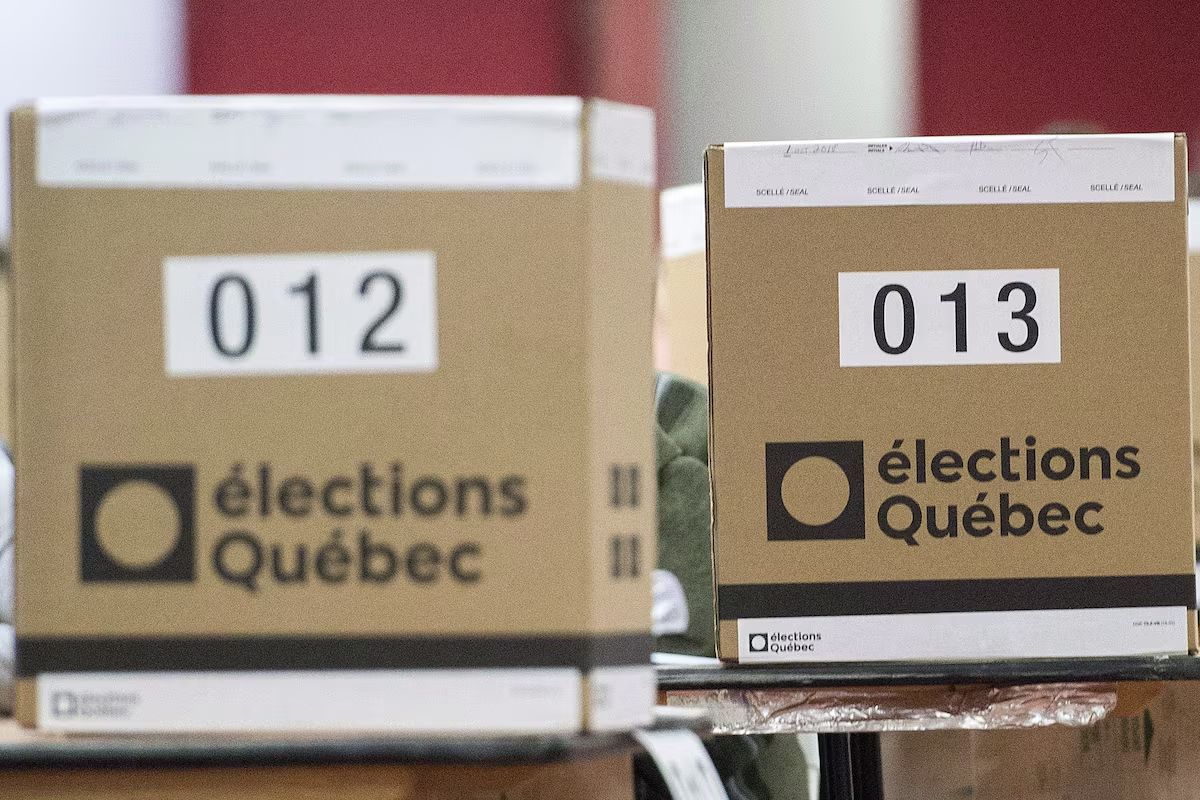

Open this photo in gallery:
Quebeckers will head to the polls on Oct. 5.Graham Hughes/The Canadian Press
He’s not on the ballot. He’s certainly not Québécois, although he does proclaim to “love French Canadians.” But Donald Trump is currently the most influential politician in Quebec.
As the province embarks on a high-stakes election campaign, with a separatist party leading in the polls, emergency rooms overflowing and infrastructure crumbling, the U.S. President has imposed himself as the X factor.
With his escalating trade war against Canada, ratcheted up days before Quebec’s writ drop on Thursday, the question from Gaspé to Gatineau is which prospective premier will be Mr. Trump’s most effective foil.
It was not supposed to be this way. Until the Trump administration threatened to impose 50-per-cent tariffs on $28-billion worth of Canadian goods, then apparently scuppered the talks with last-minute demands, this was a provincial campaign about change, or holding a third independence referendum, depending on who you asked.
Trump hangs over launch of Quebec election campaign
The Coalition Avenir Québec, unpopular after eight years in power, was struggling for viability under new leader Christine Fréchette. The Parti Québécois was riding high in the polls by hammering her government’s scandal-plagued record, but was vulnerable over its insistence on holding a separation vote in its first mandate.
It was, in other words, a fairly conventional Quebec pre-election season. But nothing about Canadian politics is conventional in the second Trump presidency.
Ms. Fréchette, like Mark Carney in 2025, so far looks to be the winner from the Trump effect. As Premier, she has had the good fortune of standing next to Mr. Carney at the unveiling of several major industrial and infrastructure announcements in recent months. That includes the federally facilitated hydro deal between Quebec and Newfoundland and Labrador, and a massive icebreaker contract for the Lévis, Que.-based Davie shipyard unveiled this week.
Open this photo in gallery:
Prime Minister Mark Carney at the Davie shipyard in Lévis, Que., on Aug. 24, with Quebec Premier Christine Fréchette.Jacques Boissinot/The Canadian Press
Both projects were pitched by the Premier and her federal counterpart – still the most popular politician in Quebec after riding the province’s support to an election victory last year – as insurance against Mr. Trump’s hostile trade policies.
On Monday in Lévis, across the St. Lawrence from Quebec City, Ms. Fréchette was clearly relishing her role as Carney ally and Trump opponent.
“I’m getting more and more used to our Monday meetings,” she beamed at the Prime Minister.
Sure enough, a Synopsis poll on Friday showed the CAQ virtually tied with the PQ, a seven-point jump for Ms. Fréchette’s troops since the imposition of U.S. tariffs. It is little wonder she began the campaign by describing Mr. Trump as her “real opponent.” The incumbency advantage and a perception of Ms. Fréchette as steady and economically minded make her likeliest to reap the rewards of American aggression.
In turn, her rivals have accused the outgoing Premier of “instrumentalizing” the crisis to her political advantage, in the words of Quebec Conservative Leader Éric Duhaime, and using it to “save her skin,” as Quebec Liberal Leader Charles Milliard put it.
PQ Leader Paul St-Pierre Plamondon, who seems to have the most to lose from the Trumpian turn of events, pleaded with Quebeckers not to let U.S. tariffs “confiscate” their election.
Quebec’s Gen Z sovereigntists, focused on fun times, bristle at the PQ old guard’s message
It may be too late. Already some observers are drawing parallels to the 2025 federal election, when a moribund governing party was saved by a fresh-faced leader and the anxiety produced by economic warfare.
The PQ stands to play the role of the federal Conservatives, led by Pierre Poilievre. He lost an imposing lead by “resisting the pivot at all costs,” said Dimitri Soudas, who was prime minister Stephen Harper’s spokesperson and chief Quebec aide.
“The ballot question was very different seven days ago,” Mr. Soudas added. “The ballot question has become who can protect Quebeckers against Donald Trump.”
The U.S. President will continue to loom unpredictably over the campaign. At any point, a reporter in the Oval Office could ask him if he supports the separatist party running in Quebec, noted the former PQ leader Jean-François Lisée.
Konrad Yakabuski: PQ’s new blueprint for sovereignty sets the stage for a high-stakes election campaign
“If he says yes, that will be a tough week for St-Pierre Plamondon.”
The wild card influence of Mr. Trump could cut many ways. His administration has already complicated matters by publicly denying Canadian claims that French-language labelling rules were a sticking point in trade negotiations – which Mr. St-Pierre Plamondon has used to suggest the Premier and Prime Minister misled the public.
“That’s a bit of a problem for the Fréchette-Carney team,” Mr. Lisée said.
Ironically, the trade war could also help the PQ by pushing its promise to hold a referendum further onto the back burner. The party’s polling lead has obscured the fact that support for separation in Quebec is historically low. Mr. St-Pierre Plamondon has tried to square his commitment to a referendum with the current mood by promising to push such a vote until after Mr. Trump leaves office. The recent escalation will allow the PQ leader to talk even less about independence.
The staying power of the Trump factor is another unknown. This is not the first time the President has slapped Canada with tariffs, so the shock may wear off faster now, pollster Jean-Marc Léger said.
“The question is whether Quebeckers are immunized against this.”
Konrad Yakabuski: After drawing a red line on protecting French, Carney can’t cross it now
It will also be harder for Ms. Fréchette to convince voters that she can protect them as a mere provincial leader. Mr. Carney won his election by credibly claiming he could take a tough line against the U.S. in negotiations. The Premier of Quebec can’t say the same.
“Madame Fréchette is not the decider,” Mr. Léger said. “Quebec is still a province; it’s not at the negotiating table.”
At the moment, at least, Quebeckers seem unconcerned with such nuance. The Trump trade war is front of mind, and Ms. Fréchette seems poised to benefit. Confronted with the CAQ’s apparent leap in support on Friday, Mr. St-Pierre Plamondon told reporters he would like to wait for other polls before believing in such a sudden turnaround.
On the other hand, he wouldn’t be the first Canadian politician to underestimate the Trump effect.