
Open this photo in gallery:
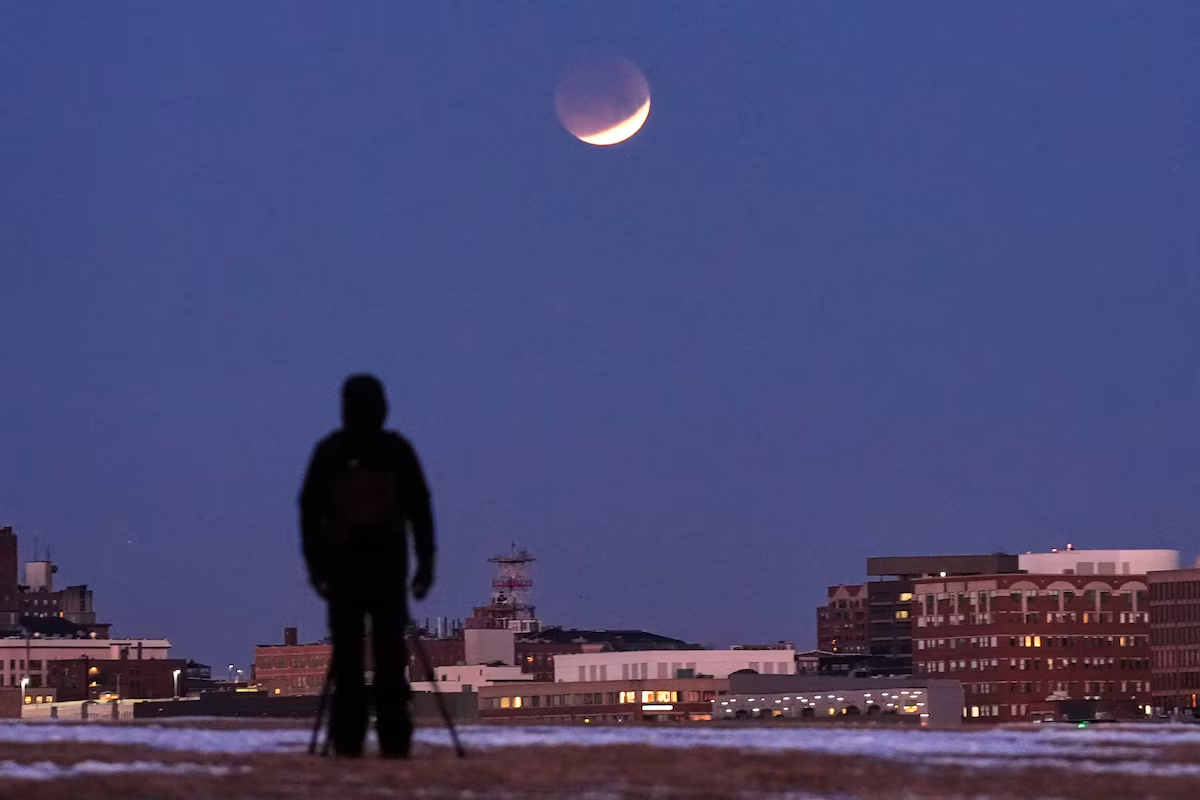
A man views the lunar eclipse in on March 3, in Maine. Canadian skywatchers with a clear view can watch a nearly total eclipse of the moon on Thursday night.Robert F. Bukaty/The Associated Press
Just two weeks after a solar eclipse plunged parts of Europe into an eerie daytime darkness, Canadian skywatchers will have the chance to experience the reverse effect.
On Thursday night, those with a clear view can watch a nearly total eclipse of the moon.
The two events are closely related. A solar eclipse can occur only when the moon’s position lines up with the sun and temporarily blocks it from view. If the moon covers the sun completely – as it did for observers in some areas of Iceland and Spain on Aug. 12 – the solar eclipse is total.
Where to see all the total solar eclipses for the rest of this decade
Fast forward about 15 days, when the moon has moved to the opposite side of its orbit. The same alignment is still in play, except now Earth has the light-blocking role and it’s the full moon that is about to go dark.
The result is a lunar eclipse, though in this case, the eclipse will not be total because one edge of the moon will remain illuminated at the peak of the event.
For observers in Canada, the eclipse officially begins at 9:22 p.m. ET, when the left side of the full moon first makes contact with the outer portion of the Earth’s shadow, called the penumbra. There will be no perceptible change at this time, since the reduction of sunlight on the moon’s leading edge will be too slight to notice at first.
The real action starts at 10:33 p.m. ET, when the moon drifts into the umbra – the central part of Earth’s shadow, where direct sunlight is totally cut off. From that point, the eclipse will proceed rather dramatically as more and more of the moon’s silvery disk slides into shadow.
By the middle of the eclipse, around 12:13 a.m. ET (9:13 p.m. PT), most of the moon will be in near-total darkness. It will not disappear entirely, however, because of sunlight refracted through Earth’s atmosphere that falls on the moon’s surface and may give it a reddish tinge. And since this lunar eclipse is not quite a total one, a fingernail-like portion along the moon’s top edge will retain its normal colour and stand out much brighter than the rest.
The entire event will be visible in east and central Canada. Those on the West Coast will miss the first part and instead be treated to the moon rising in the east just before 8 p.m. PT, with the eclipse already well underway.
Lunar eclipses, when total or nearly total, as this one will be, are always worth a look. Having one occur during late summer, when it’s generally pleasant to be outside at night, is an added bonus.
Unlike solar eclipses, no special equipment or eye protection is needed to enjoy an eclipse of the moon, though a pair of binoculars can add to the experience. And with the next good lunar eclipse more than a year and a half away, there’s every reason to step outside if skies are clear on Thursday night for a lunar rendezvous.