Like a fox trying to bring down a moose, Canada’s retaliation against the latest U.S. tariffs is a classic case of asymmetrical warfare.
That’s because the U.S. economy is about 12 times larger than Canada’s, says economist Trevor Tombe.
“It’s incredibly hard for a small country to move the needle in aggregate in the United States. That’s why it’s important to zoom in on specific states where possible. But even in these heavily affected states, the effects are small,” he said.
Not only is the U.S. much bigger than Canada, it’s also much less dependent on international trade, because its internal market consumes so much of what it produces.
WATCH | Canada mounts response to U.S. tariffs:
Canadian counter-tariffs target appliances, fish, cosmetics
The federal government laid out Canada’s plan to strike back at the U.S., announcing billions in counter-tariffs on hundreds of America products including fish, cosmetics and furniture.
And so with its counter-tariffs set to take effect after Labour Day, Canada must maximize every conceivable advantage if its tariff jiu-jitsu is going to throw its heavier opponent off balance.
But it’s not as simple as just looking for maximum pain points in the U.S.
“You have to be very conscious of limiting self harm against our own importers and exporters,” said Brian Clow, who was chief of staff to International Trade Minister Chrystia Freeland during Canada’s last tariff war with the U.S. and chief adviser to Prime Minister Justin Trudeau on Canada-U.S. relations.
“There were a whole bunch of categories that it looks like the Canadian government didn’t touch precisely for that reason.”
Canada’s tariffs need to be politically targeted, reciprocal and proportionate, said Clow.
Change behaviour or go home
There are three main objectives when selecting a target, says Tombe.
The first, what he says is most important, “is changing the behaviour on the part of the target country.”
Second, he says, it has to come at a cost to the U.S. — something “difficult for a smaller country to do.” It makes little sense to tariff products where Canadians make up only a small part of the overall export market for U.S. producers, Tombe says.
WATCH | NDP leader says trade war should hurt Trump:
‘This trade war could and should hurt President Trump,’ says NDP Leader Avi Lewis
Opposition leaders from the Conservative Party, NDP and Bloc Québécois all met with Prime Minister Mark Carney on Tuesday to discuss the government’s response to the latest 50 per cent U.S. tariffs. Federal NDP Leader Avi Lewis says he ‘was struck’ by the prime minister’s tone regarding the likelihood of a deal while U.S. President Donald Trump is in office.
Third, he said the target must be a product where Canadians have options at home or beyond the U.S.
“You want to go after areas of the country that will cause the business community in the United States to speak up, and therefore cause politicians in those areas to speak up, and try to influence the president and his team,” Clow says.
He pointed to how Canada went hard on Kentucky in 2018, the home state of U.S. Sen. Mitch McConnell, who was the majority leader at the time.
“Kentucky was a big target, but we definitely targeted Pennsylvania, Michigan, Ohio, Wisconsin, some of those key swing states that elected Donald Trump as president,” Clow said.
States at play in midterms big exporters to Canada
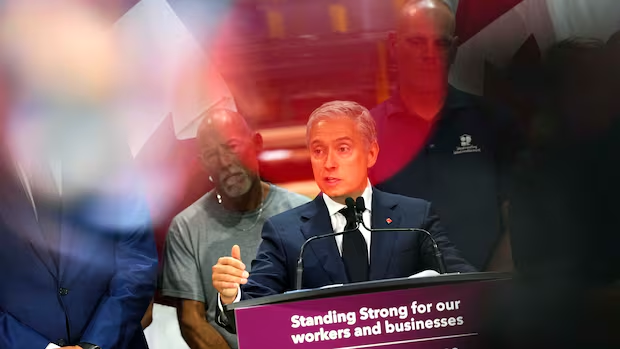
The federal government hasn’t explicitly said the counter-tariffs are designed to make an impact on the U.S. midterms. Finance Minister François-Philippe Champagne said on Tuesday that Canada’s response is “proportionate, targeted and strategic.”
If swing states seem to be even more of a target today, that’s probably just because the 2026 midterm battlegrounds happen to fall in some of the northern states that trade most with Canada.
Two in particular, Michigan and Maine, send about 40 per cent of their exports to Canada, and both have tight election campaigns underway that are critical to the Republicans’ continued control of the U.S. Senate.
Tombe estimates Canada’s planned retaliatory tariffs on Michigan exports amount to about 0.3 per cent of the state’s economy, similar in percentage terms to the latest U.S. tariffs’ impact on Canada’s GDP — and far greater than the overall hit to the U.S. economy.
WATCH | How federal supports will work amid trade war:
How Canada’s federal supports will help workers amid the Canada-U.S. trade war
U.S. President Donald Trump’s tariff onslaught looms over Canada’s economy. Tyler Meredith, head of economic policy for former prime minister Justin Trudeau, says the current government is trying to ‘keep people connected to work as long as possible.’
Clow says the goal of influencing swing states is why some food products are on Canada’s retaliatory list — even though those tariffs will likely lead to higher prices at the grocery store.
“It looks like they decided to go after all sorts of seafood products in order to impact political discussions in Maine,” he said.
“You could make the same argument about Alaska, where there’s also a competitive Senate race coming up. They also export a lot of fish products into Canada.”
Tit-for-tat on some sectors
Reciprocity is clearly a motivation behind many of the tariff choices — increasing targeted industries’ share of the Canadian domestic market to offset export losses.
That explains why nearly half of the volume of the Canadian counter-tariffs targets American metals and metal products. Those are typically products where Canada both imports and exports, and a Canadian substitute is generally available.
If tariffs are applied to harder to replace items, “a particular type of circuit board, say, or piece of machinery,” then putting a tariff on it merely complicates life and increases costs for the Canadian importer, said Tombe.
This is particularly important because the need to offset U.S. tariffs means that a high proportion of Canada’s tariffs are aimed at intermediate inputs and capital goods (such as metalworking tools, railway switches and industrial robots), even though Canada usually prefers to tariff consumer-facing goods (such as bread ovens, heat pumps and kitchen utensils) in order to minimize disruption to Canadian manufacturers.
LISTEN | Front Burner on the trade war view from the U.S.:
Front Burner30:20How the trade war is registering in America
But Tombe says it’s not really possible to create a domestic market equivalent to the one lost in the U.S.
“What’s much more important, in terms of the protection that these tariffs provide for businesses and workers, is not changing Canadian buyer decisions, but financing the large support package that the government has also announced.”
He estimates the counter-tariffs could bring in about $1 billion a month.
“So there’s a mechanism to pay for the supports that we’ll be providing to affected workers and businesses,” he said. “That’s going to matter a lot more than any indirect protection our tariffs might provide.”
He said strong support for the individuals and companies most affected by the trade war is key to maintaining unity. He says he also sees signs that the counter-tariff package was structured in such a way as to minimize sticker shock for Canadian shoppers.
“A list of retaliatory items that Canada would target to minimize the broader economic costs in Canada would have been a lot more consumer goods and food,” Tombe said.
Canada’s goal should be to maintain cohesion within the country, while encouraging division and recriminations in the U.S., he said.
Talking while tariffing
The communications strategy that goes with tariffs is important, says Tombe, in steering American anger away from Canada and back toward the White House.
“Love him or hate him, when [Ontario Premier] Doug Ford is on U.S. news networks, that’s part of trying to influence the nature of the political response there to retaliation,” Tombe said.
But Clow says Americans already know who’s to blame.
WATCH | Ford makes rounds on U.S. programs:
Doug Ford softens trade war message on U.S. TV
A day after hurling insults at U.S. President Donald Trump, Ontario Premier Doug Ford took a more measured approach while discussing the trade war during appearances on American TV. Meanwhile, Canadian officials rebuffed Trump’s threat to change Lake Ontario’s name to Lake America.
“Folks know where this trade war started and they know how it’s going to be solved,” he said.
“If you’re a U.S. business that’s hit by Canada’s retaliation, you know that the person you need to call to lobby is on the U.S. side of the border, in the Trump administration.”
While Clow says that Canada’s unity and determination gives it strength out of proportion to its size, the massive weight of the U.S. economy makes it difficult to imagine going through multiple rounds of escalation.
U.S. Trade Representative Jamieson Greer told CBC News on Wednesday that the White House is “not going to just sit down and take” the planned counter-tariffs.
“This will be a very tough judgment call for the prime minister and his team,” Clow said.
The best tariffs — the ones that hurt the U.S. most with the least blowback for Canada — have been used this round, say the experts.
“My own estimates suggest that if you were to narrow yourself down to areas where Canada represents a majority of U.S. sales and where they are a minority of our imports, and we’re talking about swing states only,” said Tombe, “you have a few billion dollars’ worth of trade that could be targeted.”
Any subsequent round of tariffs would involve more pain for less gain.