
Open this photo in gallery:
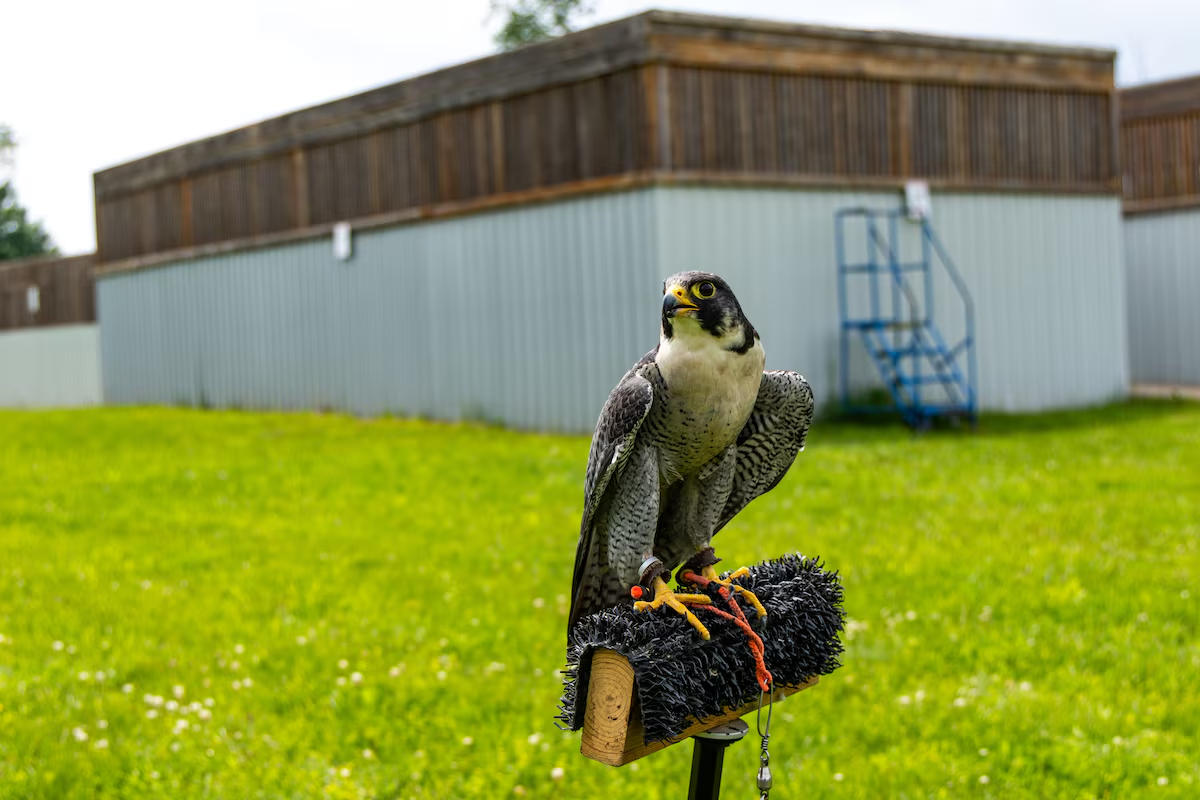
A peregrine falcon in front of its aviary in Acton, Ont. on Thursday.Alejandro Gomez Garcia/The Globe and Mail
Less than three weeks before the first World Cup game at Toronto’s BMO Field, four peregrine falcon chicks were getting ready to leave their nest in the rafters high above the soccer pitch.
The chicks, which will grow into some of the fastest animals in the world, were about to learn to fly and their highly protective parents posed a safety risk for workers setting up lights and speakers, and hanging up signs near the top of the stadium.
Stadium officials contacted Dan Frankian.
Mr. Frankian, a professional wildlife falconer, founded Hawkeye, a bird and animal control business, in 1989 and has been called upon as a problem-solver hundreds of times.
BMO Field groundskeeper ‘thrilled’ at state of pitch ahead of World Cup opener
“They said, ‘Dan, can you handle this kind of thing?’ and I said, ‘We already have a standing permit for this kind of thing.’”
Removing the nest was not Mr. Frankian’s preference.
“Why do we bother doing all the nest removal, moving all this, moving all that, and then having to find a different spot?” he said, referring to the idea of relocating the falcon nest.
Instead, his solution was a series of nets and protective equipment aimed at keeping the birds separated from the workers because Mr. Frankian knew the birds would learn to take flight before the first game.
Mr. Frankian said his job was to adjust his methods based on his observations of the birds’ behaviour.
Open this photo in gallery:
An owl-shaped hanger holds the gloves used by falconer Dan Frankian while handling the raptors under his care.Alejandro Gomez Garcia/The Globe and Mail
Peregrine falcons are notoriously defensive around their nests, even after their young have left, said David Bird, an emeritus professor of wildlife biology at McGill University. The young chicks still rely on the parents for food as they learn to fly and hunt, perching nearby to be fed.
Dr. Bird said anyone who went near the young during this phase would hear the falcons making a lot of noise and may even have the adult falcons dive at them.
Every peregrine falcon is different, just like people, said Dr. Bird. Some are defensive while others might just fly away.
Dr. Bird wasn’t surprised the peregrine falcons had chosen the rafters above the stadium as a nesting site. The species is flexible when it comes to nesting locations, though the birds particularly like to nest on cliffs at the edge of a body of water.
To a peregrine, a lakeside city is an oasis of steel and glass cliffs, with abundant nesting sites and lots of seabirds and pigeons for food. To top it off, the activity of a city keeps away predators of peregrine falcon eggs like the great horned owl.
Open this photo in gallery:
Frankian holds a Harris’s hawk. He trains the raptors to deter nuisance birds at commercial sites.Alejandro Gomez Garcia/The Globe and Mail
Civic conservation authorities are also motivated to protect the birds. Starting in the mid-1900s, the insecticide DDT was heavily used in North America to control malaria-bearing insects and pests.
The peregrine falcon population across Canada began to disappear. Biologists started finding peregrines laying eggs with shells that were too thin and broke when adult falcons sat on the eggs to incubate them.
Since the falcons are at the top of their food chain, the insecticide accumulated in the birds through their prey. By 1990, the use of DDT had been completely phased out in North America, owing to the environmental damage it caused.
“Peregrine falcons are what I call canaries in the coal mine,” said Dr. Bird, pointing to more recent research that has shown DDT is carcinogenic.
The populations of peregrine falcons have been brought back through extensive conservation efforts.
Open this photo in gallery:
The peregrine falcon chicks have now successfully left the nest and will be swooping around the city, learning to hunt.Alejandro Gomez Garcia/The Globe and Mail
Sally Williams, a volunteer with Friends of Canadian Peregrine Foundation, gives peregrine falcon chicks a second try at flight, picking up stunned fledglings that have just had their first awkward effort at leaving the nest.
“The first flight is a very clumsy, slow flap, flap, flap, and then they come to the ground. We put them back up high,” said Ms. Williams. When they land on the ground, the young are vulnerable and freeze up in response to the unfamiliar environment and hazards of a city.
Ms. Williams and other volunteers monitor seven nesting sites for peregrine falcons across the Greater Toronto Area, since the birds often nest in the same locations every year. The Friends of Canadian Peregrine Foundation also bands the falcon chicks, to identify and keep track of them.
Imane Boussaid, a spokesperson for the City of Toronto, said in an e-mailed statement the city monitors peregrine falcon activity at BMO Field every year and it has been involved in ensuring appropriate safety measures were taken for the falcons and workers this year.
In an e-mailed statement, Mike Fenn, a spokesperson for Ontario’s Ministry of Natural Resources, confirmed that the department was made aware of the peregrine falcon nest at the stadium and that it is monitoring the situation.
BMO Field did not respond to a request for comment.
Open this photo in gallery:
Frankian says his job is to adjust his methods based on his observations of the birds’ behaviour.Alejandro Gomez Garcia/The Globe and Mail
A FIFA spokesperson said the organization has a wildlife and stray animal policy, which was followed. But he did not comment on further details.
The peregrine falcon chicks have now successfully left the nest and will be swooping around the city, learning to hunt. Mr. Frankian said he was proud of his work.
“Nobody got hurt,” he said.
“When people ask me, ‘Why do you spend so much time caring for birds of prey?’ it’s two reasons. A: I love birds of prey just for the pure love of birds of prey. But second, and this is somewhat very important: Anything they die of, we die of.’”
Editor’s note: In a previous version of this article, the caption accompanying the third photo from the top incorrectly misidentified the bird Dan Frankian is holding. It is a Harris’s hawk. The article has also been updated to correct the location of the first photograph, which was taken in Acton, Ont.