
Care Between the Lines is a summer series, which will introduce you to volunteers in health care who fill gaps and provide compassion in a system that can be isolating and scary.
Susan Heydon didn’t immediately recognize the woman walking toward her.
Then the woman stopped at the information desk just inside the main doors of the rural Ontario hospital. She pointed to the man standing beside her, who looked to be in his 30s.
“You remember him? You were with me when he was born,” she told Ms. Heydon.
As it turned out, Ms. Heydon did remember. Three decades ago, she had just started working as an assistant on the maternity ward when she encountered the woman, who was in labour. “We just kind of connected and she said, ‘You wouldn’t just stay with me, would you?’ ” So Ms. Heydon held the woman’s hand and talked her through a series of breathing exercises.
“This many years later, that was pretty nice,” Ms. Heydon says of the chance reunion. There she was, once again, guiding the woman and her son toward their destination.
Open this photo in gallery:Open this photo in gallery:
Stevenson Memorial handles almost 35,000 patients a year in Alliston and surrounding communities.
More than 50 years after starting as a paid staff member, Ms. Heydon is now part of a team of volunteers at Stevenson Memorial Hospital. In the quiet farming community of Alliston, Ont., about 90 kilometres northwest of Toronto, Stevenson’s volunteers provide a friendly, small-town feel when assisting hospital patients and visitors. Many already know each other, perhaps from church, or the bank, or the Alliston Potato Festival held every August.
Volunteers spend roughly 12,000 hours a year working to provide an extra element of human connection. With a major hospital expansion under way that could bring in patients from farther afield, the volunteers are hoping to preserve the community spirit that has always kept the place going. It takes a village.
Aside from a short period during the Second World War, the auxiliary has been operating since 1928, when the hospital was first built. Originally consisting of a handful of female volunteers, the group has now grown to almost 100 people, ranging from high-school students to seniors in their 70s.
Auxiliary members stock and operate the hospital gift shop, fill supplies on medical wards and maintain the building’s vending machines, which gross approximately $45,000 a year that is donated, along with gift-shop revenue, to the hospital. Some work directly with patients and their families, fetching warm blankets, entertaining children with activity books or serving guests at the “coffee corner,” a makeshift kitchenette in the corner of the emergency department.
“You just kind of make your rounds and see if anyone needs anything,” as Ms. Heydon humbly describes it.
At Stevenson, where everyone filters through a single entrance, a friendly volunteer is often the first person a patient encounters when the doors open. “People go out and say, ‘This is the nicest hospital. I love this hospital. I wouldn’t go to any other place,’ ” Ms. Heydon says. “So we feel like we’re doing something right.”
Open this photo in gallery:
Volunteers can also serve visitors from a coffee station at the main entrance.
Home to just over 23,000 residents, the town of Alliston has its roots in agriculture and auto manufacturing. The community is known for its rolling hills, a tiny downtown lined with historic brick buildings and a cinema built in 1938.
Stevenson Memorial Hospital serves almost 35,000 patients a year, including from the surrounding communities of Essa, Adjala-Tosorontio, Innisfil, New Tecumseth and the Canadian Forces base in Borden. Rebuilt in 1964, the tiny hospital still bears a sprinkling of mid-century touches from that decade, including a pair of brown-and-yellow tiled pillars standing sentinel at the front entrance.
Ms. Heydon began her career at Stevenson Memorial in high school, working in the laundry department. Despite not having any formal medical training, she did stints in the hospital’s lab and maternity ward before eventually landing in the payroll department, where she worked until retirement.
She met her husband, a maintenance worker, on the job. Living in the tight-knit community meant they could walk or bike to work.
After her retirement three years ago, Ms. Heydon found herself unable to say goodbye to the place that had shaped so much of her life. She’s volunteered at the information desk every Monday since.
“The volunteering’s been good for me because I still see people that come in and they go, ‘Oh my gosh, you’re still here,’ ” she says. “It’s just a comfort thing, I think, for people. It still feels like a small-town community.”
Open this photo in gallery:
The pins on Gary Munro’s vest are a record of his years of service in Alliston.
Gary Munro has been a friendly face at the hospital for almost 15 years. As the auxiliary’s president, one of his tasks is overseeing its fundraising efforts.
A talented carpenter, the 77-year-old builds wooden Muskoka chairs with matching ice chests, which are raffled off and purchased by people or businesses in the community.
Last year, the auxiliary raised $50,000 for the hospital. This year, it’s raising money for a new incubator, which comes with a price tag of $56,000.
Mr. Munro also relishes the rare moments when he gets to put down his toolbelt and greet people at the information desk. He knows they might be in pain or simply overwhelmed.
A simple “How can I help you?” often yields a look of visible relief on a patient’s face.
“That made my whole day when I saw stuff like that,” Mr. Munro says.
“They’re there on a bad day, and you have the chance to make it a tiny bit better.”
Unlike a larger hospital that may have a dedicated staff member – or an entire department – assigned to managing volunteers, the auxiliary recruits and onboards all of its own members.
They ask for a one-year commitment and a minimum of one three-hour shift a week, but many members choose to spend even more of their time volunteering, seeing it as a way to socialize and connect with the community.
Six years ago, those recruitment efforts brought in Donna Ross, another long-time Alliston resident looking for an opportunity to give back to the community in her retirement. Ms. Ross’s mother was also an auxiliary volunteer at Stevenson Memorial.
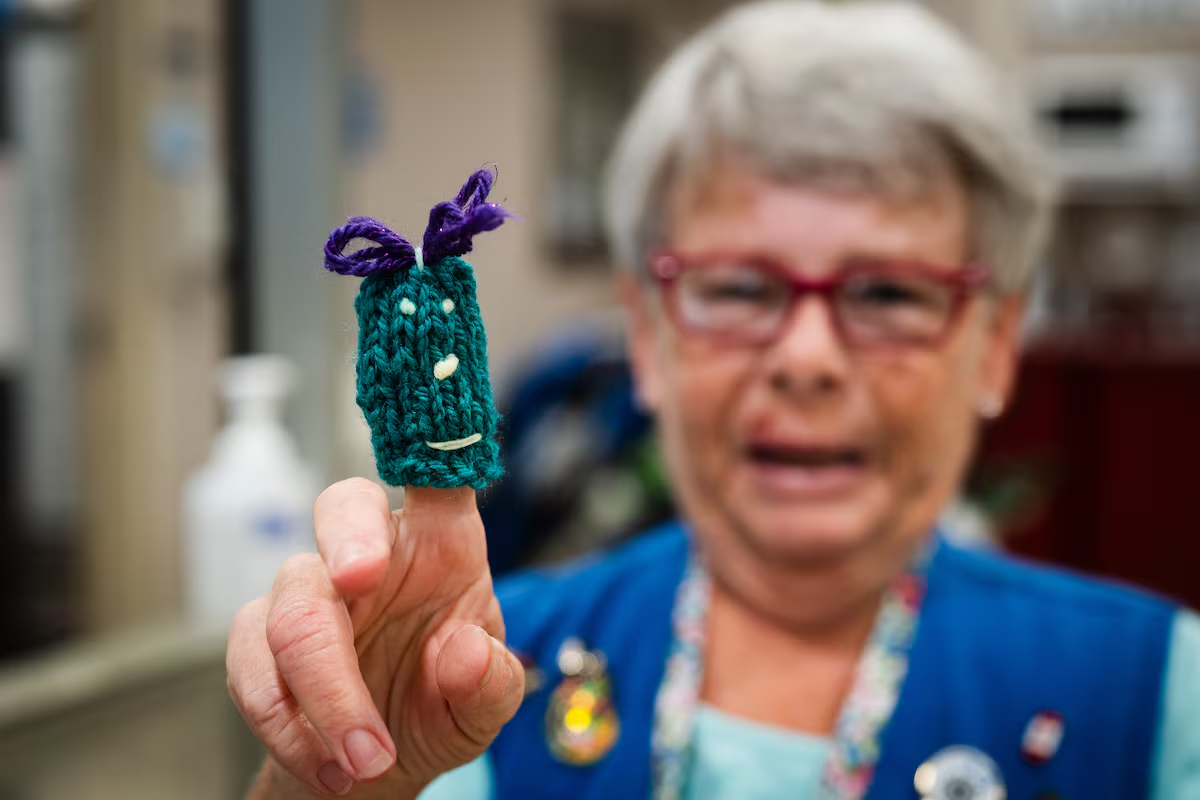
Ms. Ross handles many volunteer tasks at the hospital, but her favourite thing to do is knitting and handing out finger puppets to pediatric patients or kids accompanying a parent to an appointment.
How do kids react when given a finger puppet? “Great!” says Ms. Ross, using her fingers to draw an exaggerated smile on her face. “It keeps them busy if they’re a little upset. It kind of takes their mind off things.”
In fact, a simple walk-through of the emergency department makes it easy to tell when Ms. Ross is on shift, Mr. Munro says.
“I’ve seen mom, dad and the little one, all three of them with the finger puppets on,” he says. “It’s kind of cute.”
Open this photo in gallery:
Ms. Ross’s finger puppets are a dose of levity for young patients in the hospital.
Ms. Ross, who’s also known to don an elf costume for her shifts during the holidays, estimates that she and her volunteers knit about 900 finger puppets each year. Sometimes she presses one or two into the hands of paramedics who are waiting to deliver or transport a patient.
“They usually ask, ‘What are they for?’ I said, ‘Well, you can entertain one another when you’re not working, or if you have to pick up a child that is scared to go in the ambulance.’ ”
She figures her finger puppets are probably “all over Alliston” by now.
Finding new people to put on the blue vests takes effort for existing volunteers. Some high-school students get bursaries for helping out.
As much as Stevenson Memorial holds on to its long-time volunteers, it also depends on a next generation to fill gaps. That’s one of Susan Kean’s volunteer tasks, and it’s one she takes seriously.
She’s been volunteering at the hospital for four years, following in the footsteps of her mother, who also spent many years as an auxiliary volunteer.
In addition to scheduling shifts for the information desk volunteers, Ms. Kean recruits, interviews, trains and oversees about 20 high-school student volunteers each year, many of whom go on to study medicine at the postsecondary level.
The auxiliary provides bursaries for some of those students. Depending on their interests and maturity level, Ms. Kean decides where best to place them: at the information desk, the gift shop, the emergency department or in the medical/surgical ward, where they help restock supplies such as alcohol swabs and latex gloves.
She has yet to see any of them return to work at Stevenson Memorial on staff, but she keeps tabs on them from afar.
“It’s really neat to see how they’re doing. All of a sudden, they send me an e-mail saying, ‘I finished this term. I did really good. How’s your family?’ ”
Like her mother, Ms. Kean is a self-described “talker” who loves to chat with patients and visitors, some of whom she also encounters at the cafés, thrift stores or churches that line Alliston’s historic downtown.
“It’s nice seeing old faces: people that know me and my parents and my grandparents.”
Open this photo in gallery:
Ms. Heydon says she hopes the expanded hospital will have the same small-town cohesion as the current one.
The hospital is at an inflection point.
As Alliston’s population grows – driven by urban exodus and more housing development – so, too, does the need for more medical care. Earlier this year, the hospital broke ground on a $174-million redevelopment that will double its capacity and see its emergency department triple in size.
A new addition is set to add more in-patient beds, two new operating rooms, expanded lab space and a new MRI machine, meaning more patients can be treated on-site instead of being sent to larger hospitals in Barrie or Newmarket.
The expansion is expected to be completed in 2028, just in time for the hospital’s 100th anniversary.
Renderings show a three-winged building that wraps around the existing mid-century hospital, almost as though it’s cradling it. Maintaining that original hospital building, which has strong roots in the community, will be important, the auxiliary volunteers say.
On a quiet Monday afternoon in mid-July, a storm is rolling in over the hospital grounds, where construction is well under way.
Under dark skies and a slowly rotating crane, Ms. Heydon walks a patient out of the main hospital doors and guides her into a waiting vehicle with a cheerful wave.
Most volunteers agree the expansion is necessary. The current emergency department, built in 1964, was designed to accommodate about 7,000 patients a year. Now, the hospital sees almost five times as many.
As she gazes upward at the looming crane, Ms. Heydon reflects on the 50 years of patients she’s seen walk through the hospital doors and the tight-knit community she’s helped support.
“I’m hoping that when we get bigger, we don’t lose that,” she says. “But I don’t think we will.”
Open this photo in gallery:
Editor’s note: A previous version of this article incorrectly stated that Stevenson Memorial Hospital was rebuilt in 1968. It was rebuilt in 1964. It also incorrectly referred to Alliston as an unincorporated community; it is a community under the municipal jurisdiction of New Tecumseth. This version has been updated.
Canada cares: More from The Globe and Mail
The Decibel podcast
Maryam Fatima had her first seizure within minutes of being born. On bad days, she had hundreds. To save her brain, doctors would have to destroy part of it with a radical surgery, never used in Canada before. Health science reporter Jennifer Yang spoke with The Decibel about what happened next. Subscribe for more episodes.
Care Between the Lines
In Montreal, kidney donors and transplant recipients help put hesitant patients at ease
In Vancouver, cycling volunteers help seniors break out of isolation and feel the wind in their hair
In Saskatchewan, volunteer drivers go the distance to bridge rural health care’s transportation gap