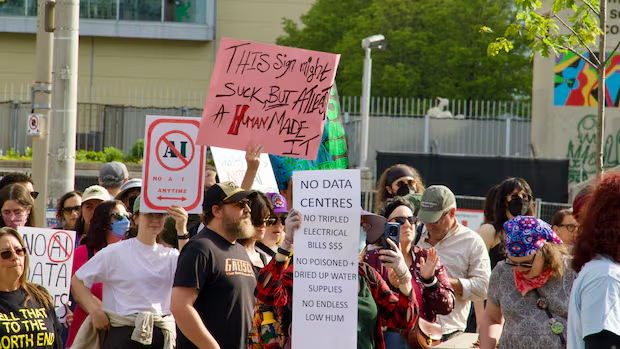
Hamilton city council is set to vote Wednesday on whether to approve a moratorium on the development of data centres, as debate over such facilities has drawn mixed opinions and even protests.
Last week, the city’s planning committee unanimously supported a motion to pause development of such facilities, which securely store, process and distribute digital information
Currently, the city has no rules specifically governing the building of data centres. If approved by council, a moratorium would give Hamilton time to develop regulations before companies building data centres set up shop.
The motion directs staff to prepare an interim bylaw that would restrict data centre development until current city rules are assessed and any recommendations are made to improve them, with data centre development in mind. The review would consider factors including energy and water use, noise and heat impacts, the motion says.
Ahead of Wednesday’s vote, CBC Hamilton spoke to some of the hundreds of community members who were at last week’s committee meeting to share their views.
The growth of artificial intelligence (AI) has accelerated the development of physical facilities that store, process and run data and software. But it’s also sparked protests across Canada, including over the amount of water and energy need to keep these sites up and running.
In Hamilton, there are at least two proposed data centre projects (both say they’d support acacemic research):
- A pitch to the federal government by the Digital Research Alliance of Canada (DRAC).
- A proposal by s2e, an Ontario company that’s pitching a data centre to McMaster University for the former Hamilton Spectator building. The building is owned by McMaster Innovation Park, which supports business startups.
Artists wants local control of data
For musician and marketer Lliam Buckley, the ability to own and control one’s data is key in the debate.
The Corktown resident, who manages the CoLodge art studio at James and Barton streets, said he wants digital systems to serve the public.
The federal government says data sovereignty is a goal in its push to develop data centres.
According to a June 16 statement from Hamilton West-Ancaster-Dundas MP John-Paul Danko, the DRAC pitch to build a research AI supercomputer on former industrial land would power research breakthroughs “while protecting Canadian intellectual property and reducing Canada’s current reliance on foreign compute infrastructure and private corporate AI services.”
DRAC is a federally funded non-profit that supports digital research infrastructure. Its members include universities, institutions and research hospitals.
WATCH | Learn what DRAC is proposing:
National group still going ahead with Hamilton data centre proposal
The organization behind a data centre proposal for Hamilton’s waterfront says its proposal to the federal government is still going ahead. The Digital Research Alliance of Canada is proposing to build, own and operate a “National AI Compute Facility” on former industrial land owned by Slate Asset Management. Slate recently applied to section off a portion of that land to begin development of a larger project but was denied after hundreds protested the potential data centre.
Buckley said he’d rather see data centres built by organizations like DRAC or s2e than by private companies. He noted that s2e has a track record of sustainable development.
“I think that not having these things built in our city doesn’t make them go away. It just pushes them to another area, and it gives us less control over how they are built and how they are developed,” Buckley said. “We aren’t removing the harm. We’re just kind of exporting it.”
Logan McLean, a McMaster University student who lives near where s2e hopes to build, said that if data centre proponents plan to build environmentally friendly facilities, they should be OK with waiting to meet local regulations.
“Good projects shouldn’t be afraid of good rules,” said McLean, who’s going into their fourth year of undergraduate studies and serves on the McMaster senate and students’ union. “The just-trust-us approach could be irreversible.”
CEO says projects already regulated
S2e CEO Milfred Hammerbacher told CBC Hamilton he doesn’t see it that way.
In his experience, Hammerbacher said, regulations aren’t inherently good for the environment and can unnecessarily hamper projects.
Right now, he said, it’s too soon to tell what a moratorium on development could mean for the proposal, other than that “it would not have a positive impact.”
Industry is moving at “lightning speed,” he said, and by waiting, Hamilton risks putting itself at a disadvantage. What’s more, there are already regulations in place for how much noise the proposed data centre could generate and how much power it could use, Hammerbacher said.
LISTEN | The pros and cons of data centres:
Fresh Air13:36What are AI data centres, and why isn’t everyone on board with them?
The federal government is pushing to build data centres in this country. They will increase Canada’s computing power and AI adoption, but they come with some serious concerns. Shion Guha is a computer science professor at the University of Toronto. He gives us an overview of the pros and cons of building AI data centres.
“Casting a wide net like this is actually going to hurt the community,” Hammerbacher said, adding he doesn’t think most people’s fears about such facilities apply in s2e’s case. For example, he said, the first phase of the data centre project it wants to launch in the former Spectator building will require no more power than the newspaper used when it ran out of Frid Street.
Hammerbacher co-signed a June 15 letter to the city planning committee with Gailene Tobin Vandenheuvel, CEO of McMaster Innovation Park (MIP), whose institution owns the former newspaper building where s2e wants to build a data centre. In the letter, they propose an exemption moratorium for “smaller scale data centres that make use of existing structural footprints established primarily to support research activities.”
Lyndsey Beutin, a McMaster professor who teaches communications, warned of “university-washing,” saying research is not inherently good and therefore not worth bypassing accountability measures for.
She said she wants to see more “meaningful” community consultation about s2e’s proposal and has struggled to find information about it.
A question of trust
McMaster has stressed that the proposal is just that and any final decision would require approval from its board of governors.
The university has refused CBC Hamilton’s interview requests, with spokesperson Andrea Lawson saying it won’t have more to share about the project until its due diligence phase ends on June 30.
Hammerbacher said that while he’s happy to answer questions about the proposal, not all his partners are comfortable discussing a project that could be worth $1 billion while they’re still sorting out details.
“I can stand here and say look at our background. Look at all these things that we’re about,” he said. “But I get it. How do you trust?”
For Beutin, public support for a moratorium amounts to an “informed citizenry” asking questions of parties that could gain “a lot” of money.
“This is about fighting for Hamilton.”
CBC Hamilton requested an interview with DRAC, but spokesperson Vanessa Nelson said the organization couldn’t schedule one this week.