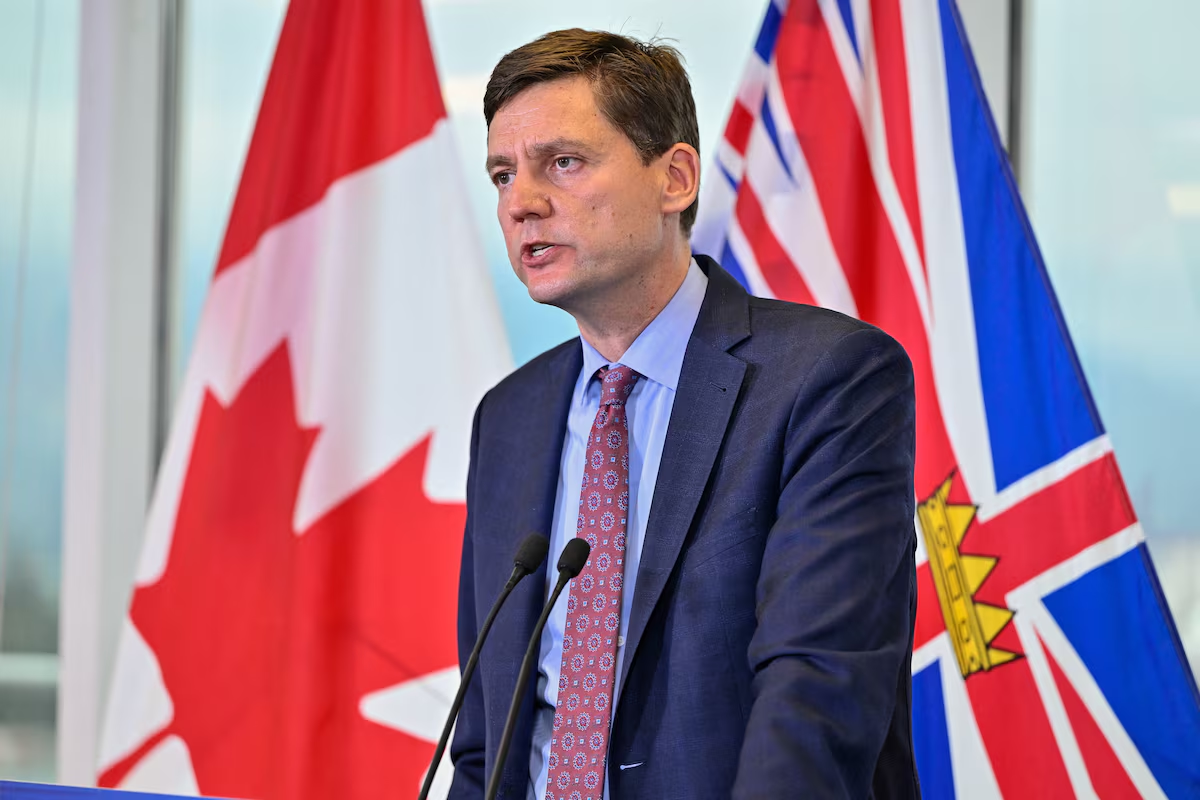

Open this photo in gallery:
British Columbia Premier David Eby’s office told The Globe last week that he was on vacation with inconsistent cell service during Wednesday’s trade meeting with Prime Minister Mark Carney.Jennifer Gauthier/Reuters
Experts are calling for improved communications channels for Canadian leaders, after B.C. Premier David Eby said he couldn’t attend a vital all-premiers’ meeting about U.S. trade negotiations last week because of poor cellular service.
Mr. Eby said last Wednesday’s meeting where Prime Minister Mark Carney briefed premiers on trade talks in Washington was called with short notice and he had “spotty internet and cell service” where he was located, so he sent Deputy Premier Niki Sharma in his place.
“I wasn’t able to attend in the way that I wanted to for such an important meeting, and I think she did a good capable job of it in order to receive the update from the Prime Minister,” he said during a Saturday news conference.
Canadian and U.S. officials spent days deep in negotiations last week, as Ottawa attempted to reach a trade deal that would avoid U.S. President Donald Trump’s new tariffs on US$20-billion in Canadian goods, and reduce the pain of other sectoral tariffs the White House enacted last year.
While Mr. Eby attended a Saturday meeting with Prime Minister Mark Carney and Canada-U.S. Trade Minister Dominic LeBlanc after a tentative deal was scrapped the night before, the B.C. Premier noted that three of his fellow premiers missed that update and sent their deputies: New Brunswick, Newfoundland and the Northwest Territories.
Opinion: The U.S.’s deal was no deal at all
No public reasons have been given for those premiers’ absences and the three provinces didn’t respond to The Globe and Mail’s request for comment. Mr. Eby’s office told The Globe last week that he was on vacation with inconsistent cell service during Wednesday’s meeting with Mr. Carney.
Cellular service dead zones have plagued much of Canada and measures to improve the gaps have been slow. The Globe has previously reported that thousands of kilometres of Canadian highways often do not have any signal.
Across the country, roughly 15,000 kilometres – or 13.4 per cent – of major roads have no mobile service, according to the Canadian Radio-television and Telecommunications Commission. B.C. has some of the worst service gaps, with 32 per cent of its major roads lacking connection. Further, other communications systems, such as satellite technology, are mostly controlled by U.S.-based companies such as Starlink, which is owned by tech mogul Elon Musk through his aerospace firm SpaceX.
As the trade war with the U.S. ramps up, experts say Mr. Eby’s connectivity issues signal a broader problem that Canadian leaders need to address: the lack of nationwide secure and stable cellular service.
Fenwick McKelvey, an associate professor in information and communication technology policy at Concordia University, said cellphone accessibility raises questions about how robust Canada’s telecommunications networks are and what channels are available for political leaders during emergencies.
Campbell Clark: The trade cold war suddenly turns hot again
He said Canada needs to prioritize secure communications infrastructure for its leaders, particularly when Mr. Carney has characterized the breakdown of trade negotiations and U.S. demands as the country being “attacked.”
“We seem to be moving into a more and more precarious global landscape that requires a degree of seriousness and a kind of rapid action that I don’t think we’ve encountered before,” Prof. McKelvey said.
Christian Leuprecht, a professor at the Royal Military College of Canada, said other countries, such as Finland, have made cellular service a national security priority and view it as a right, and Canada needs to do the same.
“The fact that we live in a country where even some first responders can still have difficulties with communications, says a lot about the value that politicians put in rural areas,” he said.
The CRTC, a quasi-judicial body that regulates telecommunications providers in the public interest, said last year it has set a goal of connecting 100 per cent of Canadian households and “as many major transportation roads as possible” to mobile wireless service by 2026.
Satellite cellular service has become a potential solution to fixing the gaps, but progress is slow.
Globe readers share frustrations and worries about cellular ‘dead zones’ in their areas
Rogers is the only Canadian company that offers direct-to-mobile device satellite service. It allows for text messages and emergency connectivity in areas beyond traditional coverage, including some dead zones. The range extends to all provinces up to the 58th parallel, excluding the northern territories.
Telus and Bell plan to launch similar services later this year.
The Globe previously reported Quebec-based satellite service company Terrestar Solutions Inc. is raising funds to launch its satellite constellation to provide a domestic, sovereign option for connectivity that doesn’t rely on foreign companies such as Starlink.
Aileen Machell, former deputy chief of staff to Mr. Eby from December, 2022, to January, 2026, said it’s common for premiers to send deputies to first ministers’ meetings because of prior commitments, such as trade missions or travel within their province.
“People would like for politicians to be doing all of the things, all at once, and all the time. But there are going to be, you know, the occasional time where they will need to have someone fill in on meetings,” she said in an interview.
Premiers are typically reachable in emergencies, but poor cell service can prevent them from attending virtual meetings, Ms. Machell added.
Nelson Wiseman, professor emeritus of political science at the University of Toronto, said it was “perfectly reasonable” for Mr. Eby to send his deputy to last week’s meeting.
“If you send a deputy, they are there to articulate your position,” he said.