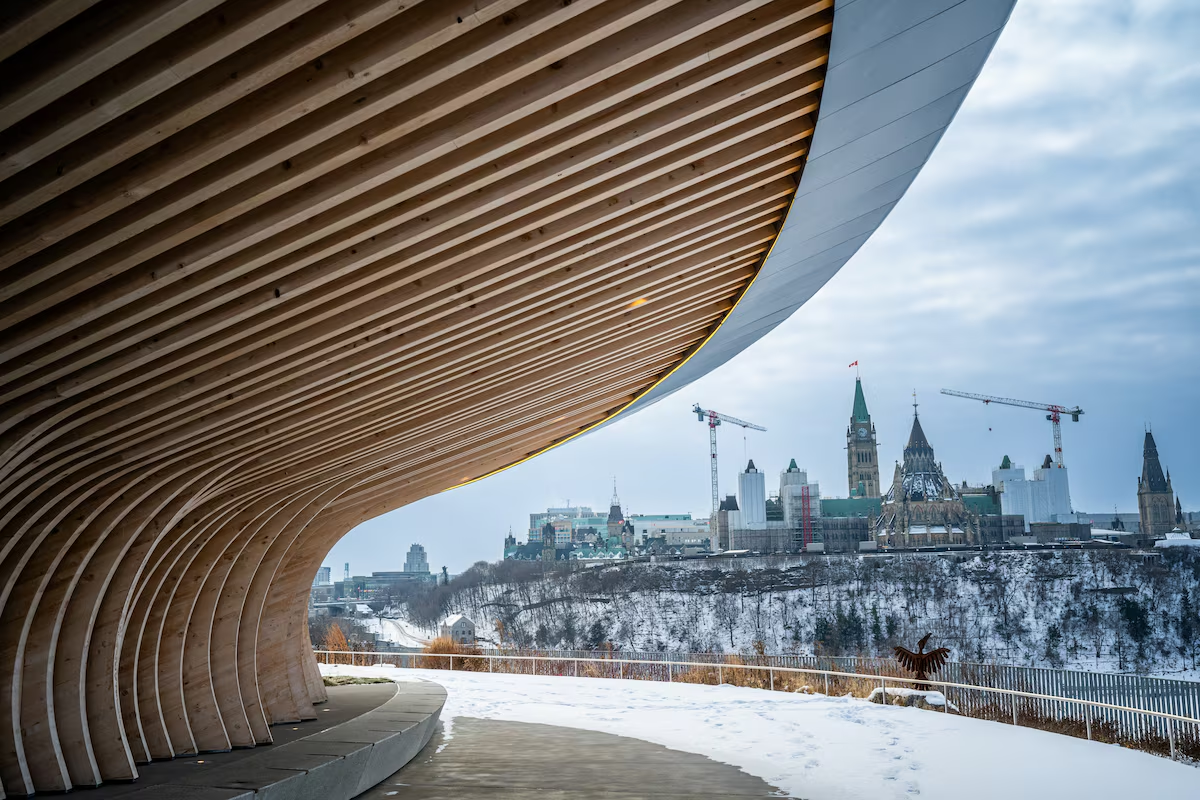

Open this photo in gallery:
Whispering Point at Ottawa’s Kìwekì Point.Ashley Fraser/The Globe and Mail
Canadian architecture is going public.
This year’s winners of the Governor General’s Medals in Architecture, the country’s top award in the field, hint at a welcome improvement in Canada’s public architecture.
Too often, the best design in this country belongs to lavish private houses. But of the 11 awards announced Thursday, four of them went to public buildings – among them two park structures, a fire station and an extraordinary parking garage.
The parks first: The winners include Kìwekì Point in Ottawa, by Patkau Architects with Janet Rosenberg & Studio, and the O-day’min Park Pavilion in Edmonton, by gh3 with CCxA Landscape Architecture.
The Ottawa park, as I wrote last year, is a remarkable integration of architecture and landscape that animates a crucial site in the nation’s capital. A delicate pedestrian bridge links two parks overlooking the river valley, and a semi-circular building folds into the earth, a platform for visitors to take in views of the city.
The new Indigenous House at U of T Scarborough accomplishes a rare 21st-century feat
In Edmonton, O-day’min Park features a collaboration between some of the country’s best designers: Montreal landscape architects CCxA, formerly led by the late Claude Cormier, and architects gh3. The building arrays a set of deep red barrel vaults above a welcoming glass pavilion. It deploys the geometric insistence of minimalist art in a building that captures the attention. It is one of many such triumphs for gh3, whose leader Pat Hanson also won the Royal Architectural Institute of Canada’s Gold Medal this year.
Credit is also due to Edmonton city architect Carol Bélanger. Over a decade, he has reformed the way the city procures design, hiring some of the best talent in the country and beyond for projects both glamorous and utilitarian. The Windermere Fire Station by gh3, another medal winner, is an elegant case in point.
In Saskatchewan, Muscowpetung Powwow Arbour by Oxbow Architecture with Richard Kroeker poignantly blends Saulteaux tradition with a clear-span timber structure that appears to float above the prairies.
In Calgary is a surprising winner: the Parkade of the Future in the East Village, designed by Winnipeg’s 5468796 Architecture along with Kasian. A parking garage is typically the farthest thing from high architecture. But this one is indeed forward-looking – its elliptical helix form can efficiently adapt into housing or office space. This is sustainable architecture, a building that doesn’t need to be demolished in order to serve a completely different purpose. Credit again goes to a sophisticated public-sector client, the Calgary Municipal Land Corporation.
Opinion: Why can’t Toronto build good parks?
And, of course, the lead architects. 5468796, who arrived on the scene a decade ago, win a second medal for Veil House in Winnipeg. It’s a residence wrapped in a weathered steel “veil” that, according to the award jury, “captivates through both its expressive geometry and its shadowy presence.”
The balance of the winners include three firms who have been on this list, almost without exception, for the past three decades: Vancouver’s Patkau Architects, Halifax’s MacKay-Lyons Sweetapple and Toronto’s Shim-Sutcliffe. Each of these boutique firms has generated consistently vigorous and beautiful work for a generation now.
Patkau’s Arbour House in Victoria, with its rhythmic pleated hemlock ceiling, and MacKay-Lyons’s Hilltop Cottage in New Brunswick reflect long-standing preoccupations. For Patkau, that’s complex timber forms, and for Brian MacKay-Lyons and company, it’s the updating of vernacular maritime forms.
Finally, the remaining entries address the need for urban housing and thoughtful density. Ulster House in Toronto, by LGA Architectural Partners, exemplifies the missing middle by transforming a single-family lot into a multiplex of five compact homes. The groundbreaking project offers lessons in how to make such a design deliver high-quality housing.
In Montreal, 900 Saint-Jacques by Chevalier Morales Architectes with Brian Elsden Burrows updates the residential high-rise. Drawing on Montreal’s brutalist tradition, the architects used a weave-like precast concrete to create an uncommonly handsome addition to the skyline. The constraints of development have made room for real architecture here.
Books, plants and playgrounds: Montreal creates a place to come together
As is the case with Shim-Sutcliffe’s Ace Hotel in Toronto. Completed in 2022, that 14-storey structure in Toronto’s Fashion District is largely a box – but it is a jewel of a box. The architects designed panels of precast concrete with inset iridescent brick, turning a generic product into poetry. Inside, the streetside restaurant and bar sit within a two-storey armature of sculpted concrete, accented by warm plywood and bespoke details. This is a space for the ages.
But the public buildings here demand attention. In three cities, especially Edmonton, governments have produced intellectually serious architecture that engages people.
Where’s everybody else? Where are Toronto and Vancouver? Where is the federal government and where the provinces, who spend tens of billions on construction each year? Where are the excellent hospitals and the inspiring school buildings? The Carney government’s push for a muscular nationalism has not found any expression in how we build, and that work ought to begin now.