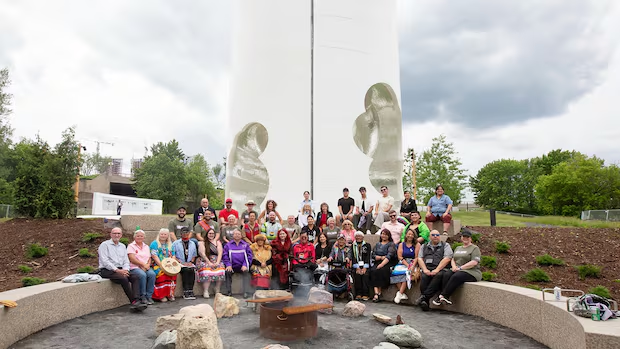
The monument is called Thunderhead. The cylindrical shell is broken open by a thundercloud. Visible from the inside are thousands of tiny mirrors. And when no longer hidden, they sparkle with light.
For Wayne Davis, and the other Canadians purged from the military, RCMP and civil service for their sexuality between the Cold War-era and 1990s, the monument sheds light on the discrimination of 2SLGBTQ+ people during Canada’s history.
“The visibility of the monument I love. People are not going to forget the glitter,” Davis said, shortly after it was officially unveiled in Ottawa on Friday.
Davis says he also expects some will be learning for the first time about a dark time in Canadian history.
The 79-year-old from Vancouver still remembers the shock of standing before his RCMP supervisor after being asked why he’d been spotted in a gay bar.
Davis answered honestly.
“I said, ‘I was in a gay bar because I’m gay.'”
 Wayne Davis is seen in 1967 when he graduated from the RCMP Depot. (Submitted by Wayne Davis)
For a split second, he felt a rush of relief, that he no longer had to live a double life.
“I thought it was okay,” Davis said.
For the RCMP leadership, it wasn’t okay.
Davis was told he could either quit or be fired. He had to pack up his things by the end of the day.
It was 1985. Davis had risen within the ranks to staff sergeant — working in Duncan, Sidney and Victoria, and then being tasked with helping to set up a new division in the Lower Mainland.
It was a dream career for a self-described high school dropout from Drumheller, Alta.
“That was the career I envisioned. I was very attached to the idea of being a Mountie,” the Vancouver resident said.
 Wayne Davis outside Parliament at the signing of the Canadian Charter of Rights and Freedoms on April 17, 1982, three years before he was purged from the RCMP for being gay. (Submitted by Wayne Davis)
Davis was not the only one who lost his career. An estimated 9,000 2SLGBTQ+ Canadians were hunted down, harassed and either forced to quit or fired from the military, RCMP and civil service.
It was based on the prejudiced belief that their sexuality posed a security risk, and could be used against them as blackmail by Soviet operatives.
Victims felt shame
Davis said many victims of the purge felt ashamed to tell their families why they lost their job.
“They couldn’t tell their family, they couldn’t go home,” he said. “So people lost their careers and their jobs, but they also lost their family.”
 Sgt. Robert David Van Norman is seen here in old photos in the home of his great niece, Elenore Sturko. (Ben Nelms/CBC)
Elenore Sturko says no one in her family talked about what happened to her great uncle until well after he died.
“This was a very shameful and stigmatized thing that happened in my family,” said Sturko, the Independent MLA for Surrey-Cloverdale.
Sgt. Robert David Van Norman was a decorated RCMP officer who served in remote communities in Canada’s north and worked on the radar defence system to detect Soviet bombers.
“He was an advocate for the people that he served,” said Sturko, adding that her uncle learned to speak Inuktitut so he could better help Indigenous communities in Iqaluit, Pond Inlet, Nunavut and Fort Smith, N.W.T.
In 1964, after 17 years in the job he loved, he was forced to resign after someone spotted him at the Lord Elgin Hotel in Ottawa, a known hangout for gay men.
“He forfeited his pension. He died in poverty. His life was never the same after that. He really struggled in finding a sense of purpose,” Sturko said.
 Elenore Sturko looks through a journal her uncle Dave made while stationed in the North. The journal is now displayed in a museum in Iqaluit. (Ben Nelms/CBC)
It also caused a rift between Van Norman and his father, who was ashamed and embarrassed, Sturko said.
Van Norman died of AIDS in 1988 at the age of 60. Sturko’s career in the RCMP took a different trajectory. Openly gay, she was the spokesperson for the Surrey RCMP before retiring and moving to provincial politics.
Both Davis and Sturko were in Ottawa in 2017, when former prime minister Justin Trudeau apologized for what is now called the LGBT Purge.
Davis said being with others who had been purged was a level of emotion he was not expecting.
“The fallout was not just the person, but the ripple effect on their family. It was a lot of cheers, a lot of shaking. The emotional level was like the old expression, you could cut it with a knife,” he recalled.
 Elenore Sturko, the Independent MLA for Surrey-Cloverdale and a former RCMP officer, holds a photo of her great uncle, Sgt. Robert David Van Norman, in front of the new 2SLGBTQ+ monument in Ottawa. (Submitted by Elenore Sturko)
Davis and Sturko were in Ottawa again Friday as the Thunderhead monument was unveiled.
“It’s going to be an awakening for people to go through it,” said Davis, who is now a director and treasurer of the LGBT Purge Fund, a non-profit organization set up to manage the settlement money from a class-action lawsuit against the federal government.
The monument was funded by some of the settlement from the class-action lawsuit, although many of the victims died before the could get any restitution.
During the ceremony, Sturko was hit by a spoken word performance by writer Ivan Coyote.
“They talked about a thundercloud is something that shifts and changes us and brings in something new into the environment,” Sturko said. “This is something new. Dave Van Norman would love this monument, despite how he was treated by the RCMP.”