When the Ontario government announced plans earlier this year to build what could become one of the world’s largest nuclear power plants in a picturesque community of roughly 18,000 people, the news came wrapped in a series of celebratory speeches.
The province’s energy minister, Stephen Lecce, hailed the project as “another positive step” toward a secure energy future, while the local mayor said it would help usher in a “stronger and more resilient future” not only for the community about 100 kilometres east of Toronto, but for the entire province and country.
Though the news was welcomed by some, it shocked a generation of Port Hope residents old enough to have lived through the community’s fraught history with the nuclear industry, a legacy that permeates backyards and public properties to this day.
“I personally was outraged when I heard this announcement, and elected officials of every level were lined up here making this announcement as if this was good news,” said Faye More, a 75-year-old resident rallying against the project in the community.
The community has felt “invisible for about 80 years in the matter of the operation of these plants,” and is feeling the same once again as the province forges ahead with the new project, More said in an interview.
WATCH | Port Hope residents speak out against plans for a nuclear power plant:
Big nuclear plan leaves small town wrestling with radioactive past
A troubled past with nuclear waste has residents of a small Ontario town wrestling with a plan to build one of the world’s largest nuclear power plants in their backyard. For The National, CBC’s Nick Purdon goes to Port Hope where history haunts a present-day push for more energy sovereignty.
Port Hope’s history with radioactive materials
It has been almost a century since the Eldorado mining company, which later became a Crown corporation, opened a radium refinery plant in Port Hope in the 1930s. When uranium suddenly became a prized commodity about a decade later, ore that was once considered a waste product was in demand. The plant began refining uranium instead, supplying the material to the United States military during the Second World War, where it was used in the Manhattan Project, the U.S. government program that produced the first atomic bombs.
Over several decades, the plant dumped contaminated soil, rocks and building materials across Port Hope. The materials were used mainly as backfill, but also in the construction of parks, roads, schools and homes — including the home where More grew up and the one where she later raised a family of her own.
In 2001, the federal government signed an agreement with Port Hope and nearby Clarington, committing to cleaning up, isolating and managing the historic, low-level radioactive waste that contaminated the region.
The project, known as Port Hope Area Initiative, is being implemented by the Canadian Nuclear Laboratories, which manages historic waste sites on behalf of the Crown corporation Atomic Energy of Canada Ltd.
WATCH | CBC documentary dives into Canada’s history with atomic bombs in World War II:
Canada collaborated on atomic bombs in WWII | Atomic Reaction
Canada, England and the United States made a private pact to build atomic bombs, one of the most destructive technologies, during WWII. Stream Atomic Reaction on CBC Gem and CBC Docs YouTube.
The provincially owned company in charge of the new nuclear power project is assuring residents that the sector operates much differently than when it was in its infancy.
“Today’s nuclear industry operates under one of the world’s most rigorous regulatory frameworks, with stringent federal oversight governing every aspect of nuclear safety, environmental protection and waste management,” Neal Kelly, a spokesperson for Ontario Power Generation, said in a statement.
OPG has owned the land for more than 50 years specifically for the purpose of electricity generation, the statement said. The new plant would support more than 10,500 jobs across the province and contribute about $235 billion to Ontario’s GDP over its lifespan, it said.
Once up and running, the site could provide up to 10,000 megawatts of power-generating capacity, according to Ontario Power Generation’s project description, which would make it the world’s largest nuclear power station. For comparison, Bruce Power’s eight reactors in Kincardine, Ont., produce about 6,500 megawatts.
The province has said that OPG hopes to receive construction and operation licences for the Port Hope project in the 2030s and begin operating in the 2040s.
Current standards would regulate new project: expert
Port Hope Mayor Olena Hankivsky has also touted the project, stressing that the ongoing cleanup and the proposed nuclear site in the municipality’s Wesleyville neighbourhood are separate initiatives.
“While both subjects relate to the nuclear sector, they involve fundamentally different circumstances, timelines and regulatory frameworks,” she said in a statement.
The cleanup “addresses a historic legacy challenge, whereas a new nuclear project would be designed, constructed, operated, and regulated under today’s world-leading standards from the outset,” she said.
That view was shared by Chris Malcolmson, the acting health physics director at McMaster University. He said Canada is managing and controlling radioactive waste based on robust national and international standards that are constantly being reviewed and improved.
He said while low-level radioactive waste has a low hazard potential, it is being cleaned up in Port Hope because it “slightly” exceeds the criteria for “unconditional clearance levels,” which requires no formal regulatory licence for the waste to be possessed, used or transferred.
LISTEN | Residents speak out on concerns with proposed new plant in Port Hope:
Ontario Morning14:43Divide over nuclear expansion in Port Hope
The province of Ontario is looking to advance a major energy project in Port Hope, though the proposal has sparked concerns. Longtime resident Sarah Sculthorpe, who has lived in Port Hope for four decades, shared her concerns. Additionally, we spoke with Paul Seguin, OPG’s Senior Vice President of Wesleyville Large New Nuclear.
“The risks associated with radioactive materials and exposure to radiation from those radioactive materials is extremely low,” he said in an interview. “I say there’s a lot of control in place even for these risks that are extremely low.”
On the proposed nuclear plant, Malcolmson said the benefits “far outweigh” its potential safety risks.
Those assurances haven’t swayed critics.
The municipality is already home to two nuclear operations on top of the decades-long remediation project, More said. Another nuclear plant is not welcome, she said.
The community is being “treated like [it’s] expendable” as the government seeks to expand nuclear power generation, More said. “But the people here have been exploited and they have borne the price of this and we say no more.”
Another nuclear plant is not welcome: residents
To many, the new power plant may seem like a done deal, but More and several other residents who oppose the project said they are optimistic their efforts will bear fruit.
More, who heads a local committee focused on health concerns, said the group will keep raising awareness of the proposal as well as lobbying the government to reverse its decision.
In June, she sent a petition to Canada’s auditor general, seeking protection under the upcoming National Strategy Respecting Environmental Racism and Environmental Justice. The strategy, according to the federal government, aims to promote efforts to recognize and address the “existing inequalities faced by Indigenous, racialized or otherwise marginalized communities” when decisions are made about the environment.
Consultations on the draft strategy closed this week and the final version is expected to be tabled this fall.
Turning to the courts could also be an option, More said.
The mayor, meanwhile, said the proposal is still in the early stages of review, with a “comprehensive” assessment looking into its environmental, health, social and economic impacts, as well as how it could affect Indigenous peoples.
“We are committed to ensuring local voices help inform the municipality’s position as this process unfolds,” she said.
One of Canada’s largest cleanup projects is ongoing
Port Hope is one of the most contaminated towns in Canada when it comes to low-level radioactive waste; the Canadian Nuclear Safety Commission says the bulk of historic waste is there and in nearby Clarington.
The $2.6-billion remediation plan currently underway is “pretty much the largest environmental cleanup that’s ever been undertaken in the country,” said Bill Daly, the director of communications for the Port Hope Area Initiative, the organization behind the cleanup and long-term monitoring project.
Daly said some 5,000 sites in the municipality have been tested and about 1,200 were found to have some level of contamination.
More than 400 private properties and more than a dozen major public sites have been fully remediated and restored, and almost three million metric tons of low-level radioactive waste materials, mostly in the form of dirt and rock, have been transported to a storage facility outside the municipality, Daly said.
The work to clean up the two remaining public sites is expected to wrap up next year, while the remediation of some 800 private properties is expected to be complete in 2032, he said.
The process to clean up an individual property can take several years from start to finish, he said. “It’s true … this is a very disruptive project for people to do and we empathize with that.”
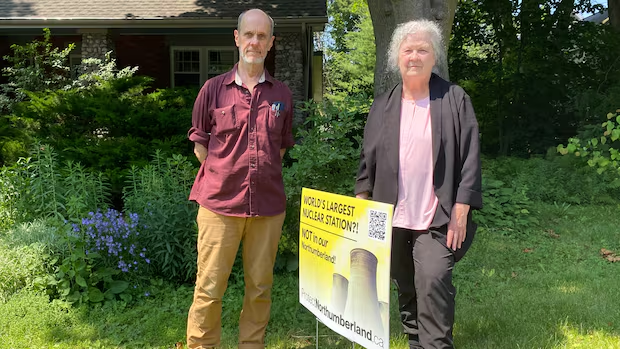
 A lawn sign is seen on the front yard of a home across from the proposed nuclear site in Port Hope, Ont., on Tuesday, June 30, 2026. (Sharif Hassan/The Canadian Press)
About 120 sites were being worked on earlier this summer, he said, including a sprawling landfill where workers loaded a truck with dirt on a sunny day in June.
At the time, several private properties and fenced-off public sites displayed signs that read: “Danger due to open excavation.”
One of them was the home where David Erland and his partner live. The property’s backyard, shed and deck were undergoing cleanup, he said. On their front lawn, a sign declared: “World’s largest nuclear station? Not in our Northumberland.”
Like several others in the municipality, Erland said he can’t fathom why Port Hope was chosen to house a nuclear reactor.
“The irony couldn’t be lost that just while this remediation is being undertaken on our property, we’re learning that the government now wants to build the largest nuclear power plant in the world in this area,” the 66-year-old said.
The work on his partner’s property began last September and is expected to finish by early fall, he said.
Residents worry proposed plant will be close to homes
For some residents, the process has stretched much longer.
Autumn Woolsey said she and her family have gone through a long and painful cycle of testing, remediation and restoration on their property.
“This summer has been the first summer in eight years that we have not had anything going on,” she said.
No health monitoring was conducted in that time, even after Woolsey repeatedly asked for it, she added.
Woolsey, who fiercely opposes the new reactor, said she’s fighting for future generations.
“I can’t change what has happened and what we’ve been exposed to, but if I can advocate and fight for my children, their children … that is what my goal, my mission is in life,” she said.
“Do not come in here to a community that has suffered for decades and think that we’re going to be happy to hear about this.”
 Port Hope residents expressed concerns that the proposed nuclear plant wouldn’t have enough of a buffer between residential homes in the area. (Patrick Morrell/CBC)
Few might be affected as directly as Sarah Sculthorpe and her family if the new plant goes ahead. The farm property where Sculthorpe moved nearly 50 years ago after marrying an eighth-generation Port Hope resident shoulders the site chosen for the project.
Over the last several months, Sculthorpe has been knocking on neighbours’ doors, talking to politicians and nuclear experts, doing online research and taking copious notes — all aimed at preventing what seems to be the inevitable.
“The only way to win a battle is to raise the knowledge and the voices of people,” she said. “And if we cannot educate people and let them know why we don’t want this, it will happen, because [for] most people, it’s out of sight, out of mind.”
The land earmarked for the plant spans 1,300 acres, with 700 acres deemed environmentally sensitive, she said.
Sculthorpe’s biggest concern, she said, is that building one of the country’s largest reactor sites on a plot of that size might mean there’s no space for a buffer zone between the plant and her property.
She argues Ontario Power Generation has not been transparent with the plant’s potential neighbours — an accusation denied by the corporation, which said it has “engaged extensively” with residents near the site and throughout the municipality.
Sculthorpe said her husband remembers seeing yellowcake, a powdery form of uranium oxide, in the ditches when he walked to school as a child, and later became of a member Citizens for Responsible Nuclear Waste Disposal. The grassroots group successfully lobbied for the environmental cleanup of Port Hope in the 1980s.
She said she doesn’t want her grandchildren to be raised next door to a nuclear reactor.
“For me it’s a very emotional battle,” she said.