
Open this photo in gallery:
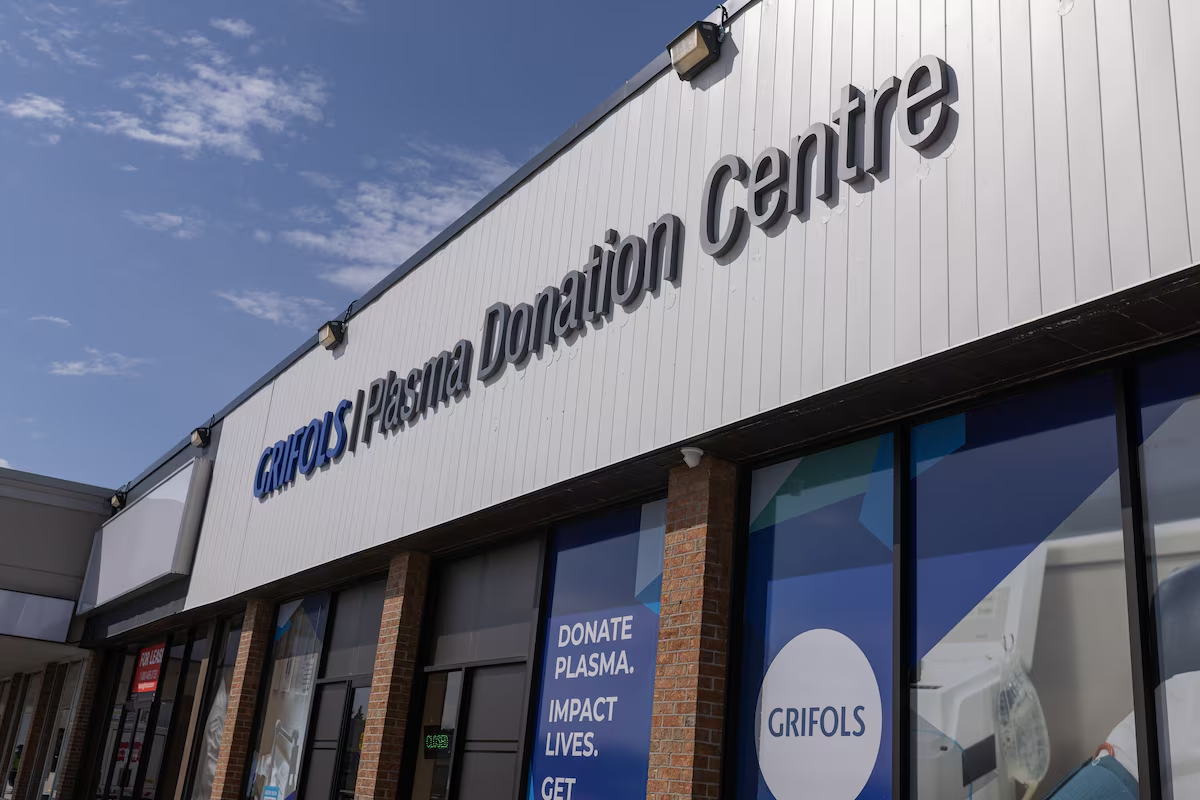
Grifols said its review of past reports found that most were misclassified and did not meet the definition of a serious adverse reaction under the regulations.Shay Conroy/The Globe and Mail
Private plasma collector Grifols has revised past reports on donors who had serious injuries or died, saying now there were six such incidents at the company’s facilities, including three deaths in Winnipeg, since 2018 instead of 25.
Grifols says the company reviewed past reports issued to Health Canada and now believes some of the 25 incidents did not meet the definition of a “serious adverse reaction” as outlined in federal regulations.
Health Canada has accepted Grifols’s revised reports.
The revision comes as Grifols temporarily paused its collection operations in the country starting on Aug. 14 because of multiple critical Health Canada investigations of its clinics.
Grifols, which is headquartered in Barcelona, operates 17 locations across six provinces that pay donors for their plasma, a protein-rich fluid found in blood that is used to make medicine, particularly for patients with immune disorders.
Grifols has come under scrutiny in recent months after two donors died in Winnipeg and after media reports that revealed the concerns of Health Canada inspectors, such as some Grifols staff not responding properly to alarms on donation machines or some donors with disease risk being inappropriately cleared to donate.
Grifols lifted plasma-donation ban despite disease concerns, Health Canada report shows
Health Canada’s guidance document on blood regulations defines a “serious adverse reaction” as being an unexpected response in a plasma donor that led to one or more of the following consequences: hospitalization; a persistent or significant disability or incapacity (or a medical or surgical intervention to prevent such a disability); a life-threatening condition; or a death.
Those regulations say the collector must inform Health Canada if a donor has such a reaction during or within 72 hours of the donation. The collector is required to inform Health Canada within 24 hours if there is a death, or within 15 calendar days if there is another serious response.
In June, Health Canada informed media, including The Globe and Mail, that it had records of 27 serious adverse reactions involving plasma donors since 2018: 25 at locations operated by Grifols or its predecessor companies, and two at locations operated by Hema-Québéc, the non-profit operator that provides the province with blood products. Canadian Blood Services reported no serious adverse reactions during that time, the regulator said.
Grifols’s predecessor companies include Prometic Plasma Resources, which for many years operated a single site in Winnipeg on Innovation Drive, and Canadian Plasma Resources, which operated multiple sites across Alberta, Saskatchewan, Manitoba, New Brunswick and Nova Scotia. Grifols acquired the two companies in 2022 and 2023 respectively and opened five new sites in Ontario in 2025.
Health Canada told The Globe and Mail in recent days that after providing those records dating back to 2018 to the media, it reached out to all operators of blood and plasma donation sites to reconfirm their records of serious adverse reactions.
Hema-Québéc told Health Canada that it had actually submitted three such reports, in 2019 and 2020. The regulator said one report was not filed through the standard reporting channel and had not been tracked properly until now.
Grifols said its review of past reports found that most were misclassified and did not meet the definition of a serious adverse reaction under the regulations.
The company said the correct number of such incidents was six: one at Prometic’s Winnipeg clinic on Innovation Drive in 2018; another at Prometic’s clinic in 2021; one at a Canadian Plasma Resources facility in Saskatoon in 2023; one at a Canadian Plasma Resources facility in Winnipeg on Taylor Avenue in 2023; another at the same facility in 2025; and another at the Innovation Drive site in Winnipeg in 2026.
Canadian Blood Services CEO defends Grifols partnership after deaths of two donors
Health Canada said the revised total of serious incidents is nine, after accounting for the revisions from Grifols and Hema-Québéc.
Few details of these reactions have been made public.
A Manitoba man filed a lawsuit alleging he had suffered an acute kidney injury as a result of donating at the Taylor Avenue location in 2023. Grifols said in a statement of defence that donors are made aware of risks of the procedure. The case has not yet been decided in court.
Health Canada has previously said the 2018 incident resulted in a death, as did the incidents in Winnipeg in 2025 and 2026.
The donor who died in Winnipeg in 2025 was 22-year-old university student Rodiyat Alabede. Documents the family provided to The Globe and Mail have shown that Ms. Alabede’s donation machine sounded five alarms over 45 minutes before she began to have serious cardiac problems, and shortly after that she was pronounced dead in a hospital.
Health Canada told media there was “no linkage” between Ms. Alabede’s death and the donation activity. In response to concerns from family about the investigation into Ms. Alabede’s death, the regulator has said it is not its mandate to determine a cause of death.
The incidents no longer being counted as serious adverse reactions occurred between 2018 and 2025 and included sites in Moncton, Saskatoon, Calgary, Regina, Edmonton and Saint John.
Health Canada spokesperson Mark Johnson said no details of the reports were changed as a result of their “reclassification.”
He said the reporting and classification of the reactions was the responsibility of the blood collector. He said Health Canada also looked over all of Grifols’s reports, including those being reclassified, and “none were deemed to warrant additional compliance measures or additional investigation.”