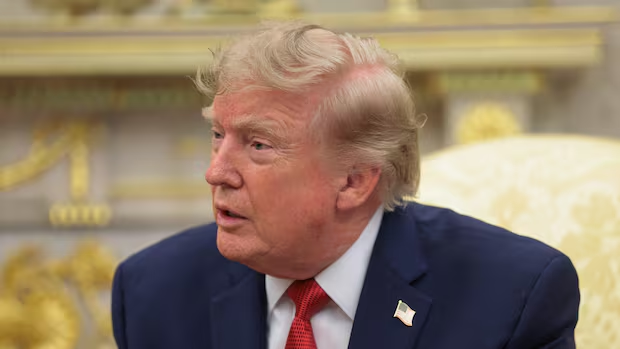
U.S. President Donald Trump announced late Tuesday he will pause the implementation of 50 per cent tariffs on a range of Canadian goods for three days, posting the decision less than two hours before the crushing levies were set to take effect.
In an initial online post, the president said he delayed the levies “based on the fact that Canada and the U.S.A., subject to the finalization of documents, have a DEAL!”
A White House declaration later said the suspension is “in the public interest” because Canadian negotiators “expressed a commitment” to concede on trade grievances the Trump administration had cited as the reason for threatening the tariffs in the first place.
In his own statement an hour later, Prime Minister Mark Carney did not speak of a tentative deal, did not say which concessions might have been made and characterized the administration’s decision as a postponement.
“Substantial progress has been made, although there is important work still to be done,” read the statement shared with CBC News.
“While we continue this work, Canada remains focused on building a stronger, more independent, and more competitive economy at home.”
WATCH | Tariffs to be delayed for at least 3 days:
Trump pauses 50% tariffs, saying new trade deal reached
U.S. President Donald Trump has paused 50 per cent tariffs on Canada, saying the two countries have reached a new trade deal that just needs to be finalized. In a statement, Prime Minister Mark Carney said ‘substantial progress has been made.’
The Trump administration’s latest round of tariffs were originally scheduled to take effect at 12:01 a.m. ET on Wednesday. The levies would have applied to hundreds of products worth more than $28 billion, from plywood and cement to wine and hockey sticks.
The delay buys time for negotiators who had been racing to reach an agreement ahead of the deadline. It also brings some degree of momentary relief to companies on both sides of the border who worried the fees would devastate small businesses, disrupt supply chains and drive up the cost of living for everyday families.
There is no guarantee Canada can dodge tariffs long-term. Trump did not say whether any deal, if finalized, would lead to the levies’ permanent cancellation.
Canadian trade representatives have met with their American counterparts in D.C. a number of times in recent weeks for negotiations Carney previously described as “intense” and “delicate.” The prime minister spoke to Trump by phone on Monday and earlier Tuesday.
After the Carney-Trump call, Canada-U.S. Trade Minister Dominic LeBlanc again spoke to U.S. Trade Representative Jamieson Greer and Commerce Secretary Howard Lutnick to try and close the gap in the negotiating positions.
In a statement after Trump’s announcement, Greer said the deal included “comprehensive market access for all American goods, economic security commitments, digital trade alignment, and many important provisions that will continue to protect our market and American workers, along with our Canadian partners,” without offering specifics.
Trump suggested a deal could revive Keystone XL, a pipeline project that would have moved oil from Alberta to U.S. Gulf Coast refineries. His online post on Tuesday said the venture, cancelled by the Biden administration in 2021, “may be awoken from the grave!”
Auto tariffs have been a sticking point: sources
Earlier Tuesday, sources cautioned that Canada and the U.S. remained at loggerheads over some finer points, including what sort of tariff, if any, will be applied on Canadian autos bound for the U.S.
CBC News is not identifying the sources because they were not authorized to publicly discuss the talks.
Trump threatened to hit Canada with the 50 per cent tariffs on a long list of Canadian products ostensibly in retaliation for Ottawa imposing tariffs on some U.S. goods, tariffs that were only levied after Trump launched his trade war on Canada last year.
WATCH | Trade talks expected up until deadline, adviser says:
Trade talks with U.S. ‘may go down to the wire’: Charest
With 50 per cent tariffs set to take effect just after midnight, negotiators from Canada and the United States continue to work toward a deal. Member of the Advisory Committee on Canada-U.S Economic Relations Jean Charest joins Power & Politics to break down what the state of negotiations means for Canada.
A senior government official previously said Canada was working on a response in the event those tariffs came into effect.
Carney has been weighing a range of options to hit back at the U.S. on trade, including more retaliatory tariffs, the official said. Canada had planned to see the legally binding paperwork on these prospective U.S. tariffs before deciding on an appropriate response.
A key issue in the negotiations has been just how much Canada can get out of the U.S. in exchange for a series of concessions of its own.
LeBlanc has pushed for the U.S. to scrap the new Section 338 tariffs but also lower the existing Section 232 tariffs on industrial products like steel, aluminum, autos and lumber.
WATCH | Entrepreneur says tariffs would ruin his livelihood:
Michigan furniture maker says U.S. tariffs threaten his family business
Michael Howard, owner of Howard Family Designs, a custom furniture business in Warren, Mich., and says the Trump administration’s tariffs on lumber and other goods are driving up costs, making them lose orders and putting his shop’s community mentorship program on hold.
The Americans want U.S. liquor back on the shelves of provincially run stores, ending a boycott that has been devastatingly effective. The Trump administration is also pushing for Canada’s retaliatory tariffs on U.S. autos removed, and tweaks to how the supply-managed dairy sector allocates quotas.
Greer has repeatedly signalled the U.S. is not open to dropping its tariff regime entirely, but there are some signs that the rate may be flexible if the Canadians address some U.S. demands.
Canada wants the U.S. to drive down tariff rates to the lowest possible level, and what’s been presented so far by Greer and his team is not satisfactory, sources said.
On autos, the latest U.S. offer would lower the tariffs on Canadian-made vehicles to a headline rate of 15 per cent, down from the current 25 per cent. The headline rate would be the official rate enacted by executive order.
WATCH | NDP on the state of tariff talks:
Carney has given ‘concession after concession’ on U.S. trade: NDP
New Democratic Party parliamentary leader Don Davies says Canadians are ‘very worried’ about the impact new U.S. tariffs could have on Canadian jobs. U.S. President Donald Trump has threatened to hit Canada with 50 per cent tariffs on a long list of Canadian products if a deal isn’t reached by midnight.
But the tariff on Canadian-made vehicles can be reduced further by having more U.S. content, down to an effective rate (the actual duty rate collected) of 7.5 per cent.
Sources said that is still higher than Canada wants.
The new deadline expires at the end of the day on Friday. In the meantime, some Canadian businesses will keep rushing sales out the door to try and beat any levies. Others have already lost American customers because the situation is too volatile.
Bob Rae, a former Canadian ambassador to the United Nations, said Trump’s tariffs don’t need to take effect to achieve the administration’s desired result. The will-they-or-won’t-they waiting period creates uncertainty that destabilizes the Canadian economy.
“The whole thing is designed to make Canada feel like a less secure place to do business,” Rae told CBC News. “We have to respond in such a way to indicate that, ‘No, We’re going to continue to go ahead. We’re not going to be put off by this.'””