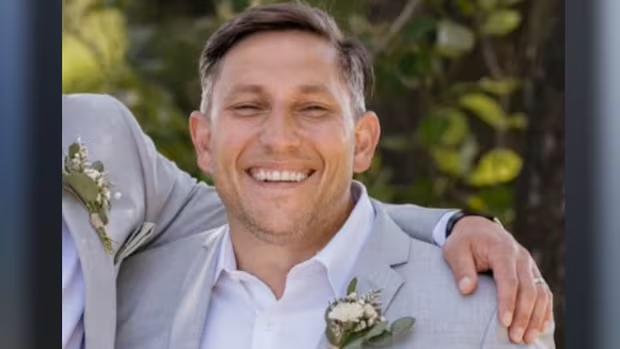
A high-level cocaine trafficker, a nightclub owner working as a drug courier and a recently divorced father have pleaded guilty to various roles in a drug bust Winnipeg police once worried had been compromised by a corrupt officer.
Mohamed Ali, Abdullah Khan and Ahmed Dini were charged in 2024 as part of Project Roasted, a months-long investigation into a drug trafficking network. It culminated in one of the accused being arrested at his home and the other two being taken into custody as they left Stella’s on Pembina Highway with about two kilograms of cocaine in one of their cars.
Months later, police got a warrant to search one of the men’s seized cellphones because of “concerns that the drug investigation had been compromised” and a belief the phone data would establish a link between Ali, his associates and then-Winnipeg police officer Elston Bostock, an agreed statement of facts filed during Bostock’s sentencing said.
“I believe that Ali and other members of the organized crime world in Winnipeg are receiving police information from … Bostock,” a detective sergeant wrote in a warrant document filed to search Ali’s phones.
Bostock, then a veteran constable, was sentenced this year to seven years in prison after admitting to a long list of corruption-related offences, including providing confidential police information to people outside the force.
When police went through the cellphone data, they found photos of Bostock with people the agreed facts described as “criminal associates” and text messages between Ali and others referencing Bostock looking up police information for them.
While few details about those targeted in Project Roasted were previously shared, recent court hearings shed light on the three men who have now been convicted in the case — and how some of them became involved in the drug operation.
Cocaine in Winnipeg, Niverville
A federal prosecutor told Court of King’s Bench Justice Shawn Greenberg during a hearing in June that information about Ali’s cocaine trafficking activities sparked Project Roasted.
The ensuing investigation included search warrants that allowed police to do repeated covert entries at Ali’s home in Niverville, Man., south of Winnipeg. Investigators found cocaine, cutting agents, large amounts of cash and other drug-related items throughout the house and garage, in addition to the two kilograms later seized after Ali and Khan were arrested outside Stella’s.
While Khan was moving the drugs around, Ali was the one directing those meetings, court heard.
“The accused was a high-level cocaine trafficker with some decision-making authority or responsibility,” Jean-Pierre Deniset said.
Ali admitted to possessing cocaine for the purposes of trafficking in Winnipeg and Niverville from October 2023 to February 2024. Deniset said lawyers plan to jointly recommend he get eight years in prison at a sentencing expected to happen early next year.
Club owner’s involvement ‘baffling’: judge
During Khan’s sentencing in May, court heard the drug courier was the owner of the Moonlight Lounge nightclub on Osborne Street at the time of the investigation and had no criminal record.
His lawyer, Brett Gladstone, said he believed Khan’s “poverty-related concerns,” debts and other financial challenges contributed to the decisions his client made in the drug case and another incident he was later charged in.
Khan admitted to picking up a load of 20 kilograms of cocaine and delivering some of it before he was arrested with two kilos still in his car. He pleaded guilty to possession for the purpose of trafficking.
Khan also pleaded guilty to attempting to obstruct justice in a separate case, after he misled police following a shooting at his nightclub last year. He was sentenced to a total of seven years during an emotional hearing in May, where Khan apologized through tears for his actions.
“It’s an individual who simply wants to do better,” Gladstone said. “He regrets deeply the choices that he’s made.”
Provincial court Judge Kael McKenzie said it was “baffling” why Khan, who court heard is almost 50, was involved in the drug operation — but said it wasn’t lost on him that the accused was running a nightclub at the time.
“I don’t know if this is where you made these acquaintances,” McKenzie said. “But it’s probably not unusual, from where I sit, that people who are involved in nightclubs come across people who are involved in other things.”
While a spokesperson for the Liquor, Gaming and Cannabis Authority of Manitoba previously said Moonlight Lounge’s liquor licence was suspended in February 2025, the authority said this week it later got notice the business had been sold, with a request to withdraw its licence effective May 1, 2025.
‘Regretted every day since’
In a sentencing in August 2025, court heard Ahmed Dini, described as a hard-working father in his 40s who’d spent years working with people with developmental disabilities, was also among those arrested in Project Roasted.
Court heard the same day police arrested Ali and Khan outside of Stella’s, they did a search of Dini’s apartment and found 213 rocks of crack cocaine stashed in a dresser drawer. His lawyer, Eric Wach, said Dini agreed to keep drugs there while at the “lowest point” of his life, as he dealt with a divorce and hard financial times.
“A friend of his said, ‘Hey, there’s an opportunity to make some money and, you know, stash some drugs and so forth,'” Wach said. “He took that opportunity, and it’s something that he’s regretted every day since. He talks about praying every day for forgiveness.”
Provincial court Judge Lisa LaBossiere said she was “puzzled” why, despite Dini’s financial circumstances, he’d involve himself “in something like this” as a father of eight children.
“The repercussions, even on your family alone, are significant,” she said.
Dini was given a roughly two-year conditional sentence, to be followed by two years of supervised probation, as part of a joint recommendation from lawyers.
Charges against two other co-accused in Project Roasted were stayed last year. A spokesperson for federal prosecutors declined to provide specific reasons for the decisions to stay those charges.