
Good morning. Prime Minister Mark Carney says he will speak with U.S. President Donald Trump before new U.S. tariffs take effect on Wednesday. More on that below, along with a Churchill Falls hydro deal and Canada’s accidental landlords.
Open this photo in gallery:
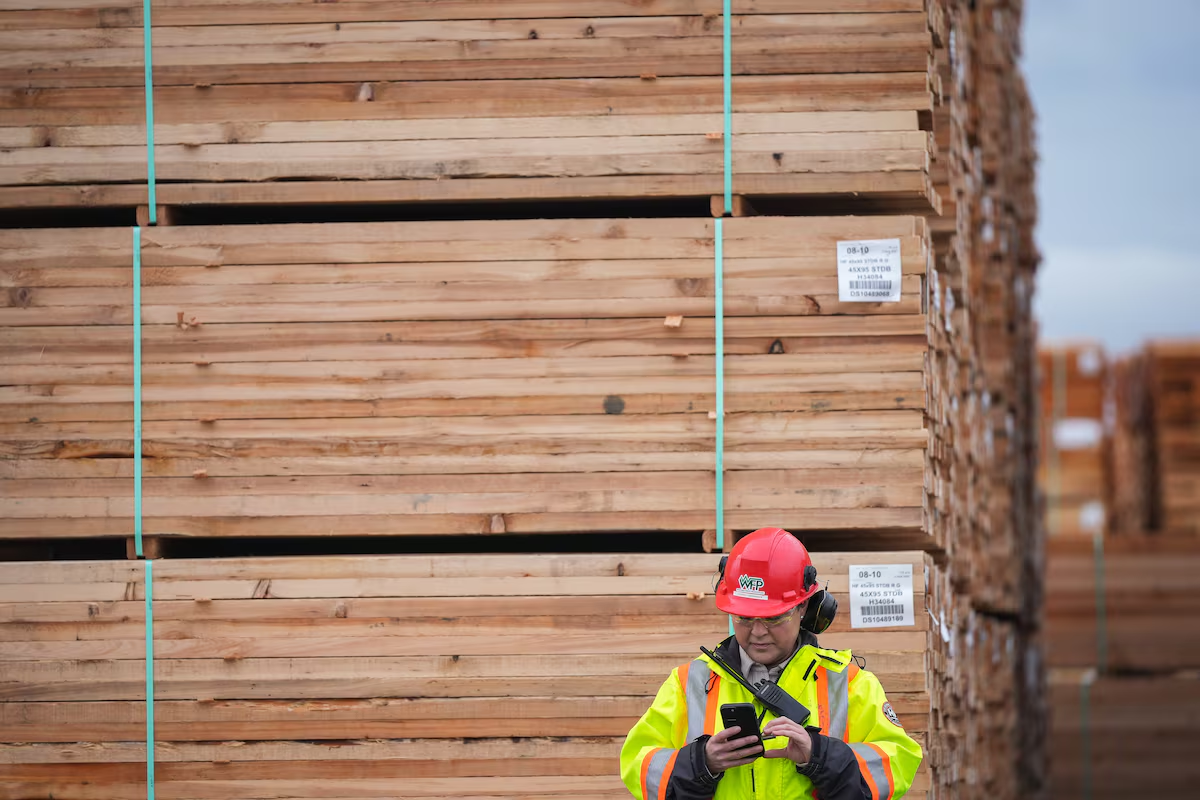
Autos and forestry remain major points of contention in U.S.-Canada trade talks.DARRYL DYCK/The Canadian Press
TOP STORIES
Ottawa pushes for tariff relief
Prime Minister Mark Carney says he will speak with U.S. President Donald Trump before the new U.S. tariffs take effect tomorrow, and that the federal government is planning for all outcomes – including Canada’s response if the U.S. imposes 50-per-cent tariffs on billions of dollars worth of goods.
The talks: Canada-U.S. Trade Minister Dominic LeBlanc and the country’s top negotiator, Janice Charette, met with their American counterparts in Washington yesterday, and U.S. Commerce Secretary Howard Lutnick joined the discussions alongside U.S. Trade Representative Jamieson Greer.
The sticking points: Under the terms of the prospective agreement, Trump would lower tariffs on Canadian autos, steel, aluminum and forest products in exchange for Canada conceding to a long list of U.S. trade demands, including on alcohol, dairy and procurement. Autos and forestry, however, remain major points of contention.
Autos: As talks approach the deadline, the auto industry is finding itself making grim calculations, including what level of tariffs it can absorb without idling more plants.
What’s next: If Trump’s new tariffs kick in, Charette has told the U.S. team that Canada would stop negotiating and retaliate. Whether Carney would be able to sell a deal is an open question – what’s on the table would mean accepting some of Trump’s tariffs, while also making concessions and not retaliating.
Sign up for Morning Update:
Reading this online? Start your morning with context and insight on the day’s biggest stories, in your inbox every weekday.
Open this photo in gallery:
Prime Minister Mark Carney speaks to the media alongside Newfoundland and Labrador Premier Tony Wakeham and Quebec Premier Christine Frechette in St. John’s on Monday.Paul Daly/The Associated Press
A new Churchill Falls agreement
Hydro utilities in Quebec and Newfoundland and Labrador reached a non-binding agreement to share energy from Labrador, with help from the federal government. The deal touts potential investments of $70-billion in new hydro, wind and transmission projects in Labrador, more than twice the amount considered under a memorandum of understanding in 2024. The fate of that MOU had been in doubt since a change in government in St. John’s.
The background: The deal would resolve a decades-long dispute over the low price Hydro-Québec pays for power from an existing generating facility in Labrador. But with a fall election scheduled in Quebec, the new agreement could end up caught in political turbulence similar to what the MOU faced, Konrad Yakabuski writes.
A side benefit: The deal strengthens Carney’s hand in trade talks with the U.S., Andrew Willis writes.
Open this photo in gallery:
People sit outside an election campaign office with posters of opposition candidate Brian Mundubile in Lusaka, Zambia, last week.GIANLUIGI GUERCIA/AFP/Getty Images
Zambia arrests opposition members
After days of secrecy, Zambia’s government confirmed that it arrested many of the country’s most senior opposition politicians on the night of its national election, accusing them of involvement in an armed insurrection plot with foreign links. Police made the arrests during a raid on the home of the main opposition candidate, Brian Mundubile, who said the allegations were completely false.
The election: Zambia has a reputation as one of Africa’s most democratic countries, holding multiparty elections regularly since 1991. But during the campaign, opposition rallies were disrupted or blocked by police and supporters of the ruling party, and the electoral commission suspended its vote count for six hours on Friday. Despite an unexpectedly strong showing by Mundubile, President Hakainde Hichilema was re-elected to a second term yesterday.
The geopolitics: Western investors are watching the election closely because Zambia is one of the world’s biggest copper producers. Canadian mining companies are among the global players that have been recently flocking into the country.
Open this photo in gallery:
Elections Alberta is recruiting staff ahead of the Oct. 19 referendum vote, which will include a separation question.Todd Korol/The Globe and Mail
Elections Alberta seeks help for fall referendum
Alberta’s elections agency is looking for aid from other provinces to help run its Oct. 19 referendum that could lay the groundwork for secession from Canada. Elections Alberta says it’s seeking skilled staff from other jurisdictions for the massive undertaking, which could require millions of ballots to be counted in just 48 hours.
A big lift: The agency has faced a mountain of work since Premier Danielle Smith announced the referendum. The out-of-province elections staff would be on top of at least 60,000 poll supervisors, ballot box clerks, scrutineers and other workers that the agency is recruiting inside Alberta. As of two weeks ago, it had received just 24,000 applications for those roles.
Open this photo in gallery:
Jane Tsang didn’t set out to be a long-term landlord when she bought her condo in downtown Toronto, but has decided to rent it out and continue living with her parents.Arlyn McAdorey/The Globe and Mail
Canada’s accidental landlords
A sluggish condo market and changing life circumstances are turning a segment of first-time buyers into landlords. Realtors say that as some clients receive underwhelming offers for their units, they’ve decided to rent them out until the market recovers.
A changing market: Condo prices have dropped since their pandemic highs. A late June report from RBC Economics said condo price corrections have been “sharper than other housing types” and returned affordability to 2019 levels in many markets. Meanwhile, one realtor said that while average rents have declined, they are still fairly competitive – and in some cases, condos receive no worthwhile purchase offers but several offers to rent.
The Take
Mr. Carney was chosen to decide for us – to employ his particular experience, intelligence and judgment to determine what to do on our behalf.
— Scott Reid, principal at Feschuk-Reid and former communications director to former prime minister Paul Martin
Mark Carney now faces the toughest moment of his premiership, Scott Reid writes: If he miscalculates the public mood, deference could spoil into disappointment.
The Shot
Open this photo in gallery:
Volunteer Brenda Archer introduces her guinea pig Rosie to a resident of the Village Langley B.C.Jennifer Gauthier/The Globe and Mail
In Village Langley, a unique cottage-style retirement community for seniors living with dementia, a mother-daughter duo and their three furry friends have been offering companionship.
The Wrap
What else we’re following
At home: MPs launched a study of security screening protocols after a Canadian intern was arrested on suspicion of espionage at NATO headquarters in Belgium.
Abroad: Iran vowed to escalate tensions in Hormuz and the wider region, while Trump threatened to bomb Oman.
By the numbers: Researchers told The Globe how they would measure the true toll of Canada’s wildfire seasons.
The merch table: A decade after the Tragically Hip’s last concert, the band’s brand lives on.
Squawk: Far from home, Hong Kong’s wild cockatoos could be the answer to saving their species.
Woof: From loudest bark to smartest nose, Corgis are testing their skills at a growing international race.