
Good morning. We’re mentally preparing for a big week in trade negotiations, but our reporters have entertaining distractions to offer in the meantime. More on tariffs below, along with a new life for IMAX and the secret sauce behind a successful food festival.
Open this photo in gallery:
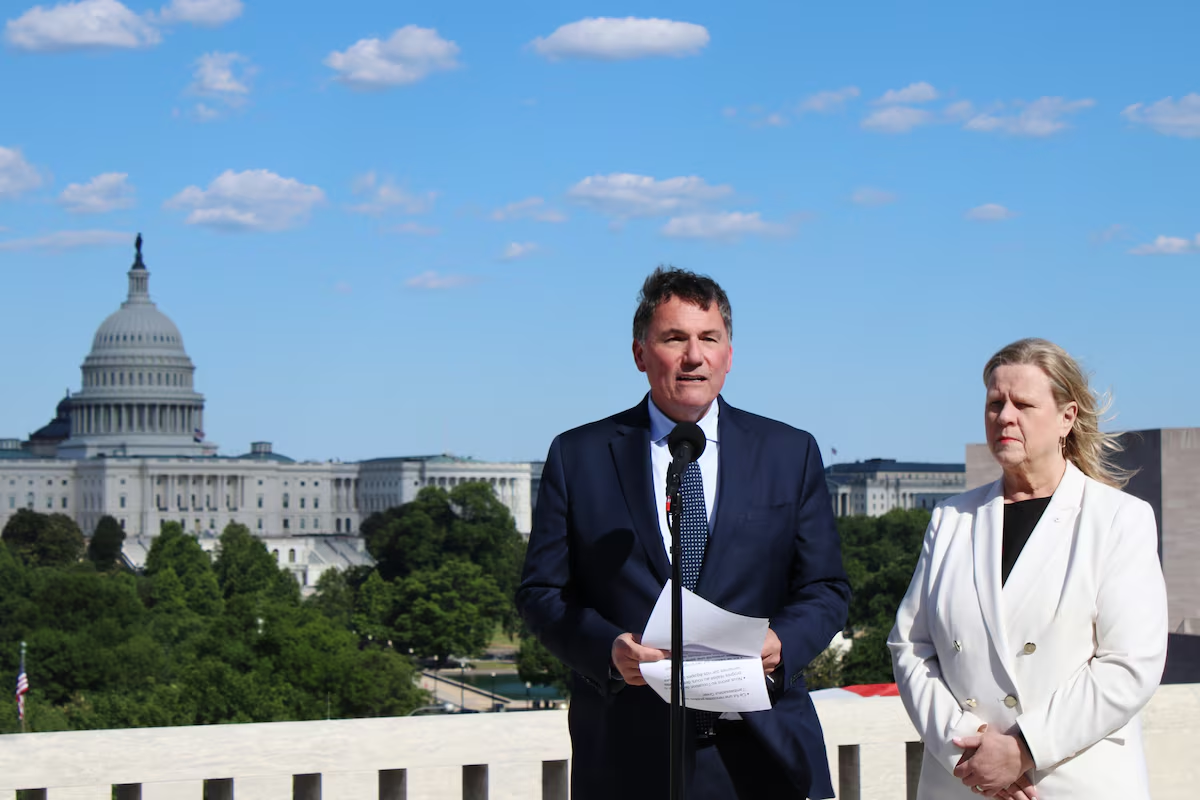
Canada-U.S. Trade Minister Dominic LeBlanc and Chief Trade Negotiator Janice Charette in Washington, D.C., on June 2.Kelly Geraldine Malone/The Canadian Press
TOP STORIES
Clock ticks down to new tariffs
Canada-U.S. trade talks are down to the wire this week as Ottawa tries to avert punitive new tariffs scheduled to be imposed by the Trump administration on Wednesday.
Negotiators were bargaining throughout the weekend, culminating Sunday afternoon with a virtual meeting between Canada-U.S. Trade Minister Dominic LeBlanc and U.S. Trade Representative Jamieson Greer. The two were joined by Canada’s lead trade negotiator, Janice Charette, Mr. LeBlanc’s office said Sunday.
Mr. LeBlanc remained in Washington on the weekend and his office said he would stay through Monday as the fight for a deal heats up.
In advance of Mr. LeBlanc’s Sunday meeting, five sources briefed on the discussions said Section 232 tariffs on autos and lumber remained the biggest points of contention. According to the sources, American negotiators have opposed lowering those tariffs on lumber and proposed reducing the tariffs on autos to 15 per cent – a number that is too high for Canada to accept.
Ottawa, meanwhile, is preparing plans for retaliation if the White House makes good on its threat to slam new levies on US$20-billion worth of Canadian goods on Wednesday, one of those sources and a different source confided.
The Globe and Mail is not identifying the sources who were not authorized to disclose details of the confidential negotiations.
Mr. LeBlanc’s office said that the minister and Ms. Charette had a constructive hour-long meeting with Mr. Greer. “They took stock of the work that has been done by their respective negotiating teams, and discussions are continuing,” spokesperson Gabriel Brunet said.
Read the full story from senior political reporter Marieke Walsh and U.S. correspondent Adrian Morrow.
Explained: Five things you need to know about the Canada-U.S. trade talks.
Opinion: One big, grand trade bargain with the U.S.? The devil is in the sectoral details.
Open this photo in gallery:
A person wears an Alberta First hat in Stony Plain, Alta.JASON FRANSON/The Canadian Press
Data show international interests target Alberta separatist debate
Canadian researchers using artificial intelligence, conducted through Cipher AI, to track foreign interest in the Alberta separatism debate found the political discourse is being targeted online by Russian and American interests, but in different ways. The project is also producing reports for the federal and provincial governments.
Russia vs. America: One study indicates that Russian content farms have been pushing pro-separatist content into communities and using Canadians to “launder” those messages by sharing such material on their social media feeds. Meanwhile, U.S. podcasts and influencers have openly promoted the notion that Canada is a failed state that Alberta should leave.
Open this photo in gallery:
Trucks are seen driving along Highway 401 from Franklin Blvd. in Cambridge, Ont., on May 19.Keito Newman/The Globe and Mail
Critics call for overhaul of Ontario truck driving school inspections
Trucking industry experts are calling for a significant overhaul of Ontario’s oversight of commercial truck driver training in the wake of a scathing Auditor-General’s report that raised concerns about shoddy enforcement. In a recent letter sent to the Ontario transport ministry, obtained by The Globe and Mail, the Private Motor Truck Council of Canada said the transportation regulator should have a bigger role in monitoring driving schools.
The context: The report found that around a quarter of Ontario’s 216 private colleges offering truck driver training had never been inspected by the Ministry of Colleges, Universities, Research Excellence and Security – noting it employed just eight inspectors to audit all 595 private colleges in the province.
Open this photo in gallery:
DARRYL DYCK/THE CANADIAN PRESS, JESSE WINTER/The Globe and Mail
Inside a wildfire battle in B.C.
As the Bald Range wildfire erupted on Friday, Aug. 7, The Globe and Mail had exclusive access to the provincial wildfire service’s Regional Wildfire Coordination Centre in Kamloops, B.C., seeing firsthand how the system responded to one of the most aggressive and damaging wildfires in recent years. Jesse Winter and Andrea Woo take us inside the chaos, and difficult decisions the command centre had to make.
Most recently: Evacuation orders related to the Bald Range and Quilpituk Creek wildfires were downgraded in recent days, and many residents are allowed to return to their homes near Summerland and West Kelowna. Emergency officials also downgraded evacuation orders to alerts around the community of Clinton.
Open this photo in gallery:
Projectionist Jyun Oki threads the film reel of The Odyssey in the Cineplex Cinemas in Vaughan, Ont., on Aug. 13.DUANE COLE/The Globe and Mail
The Odyssey breathes new life into IMAX
Christopher Nolan’s film broke records for the company, reeling in US$52-million at the box office on the opening weekend. The Odyssey is the first feature-length film shot entirely with IMAX cameras, and the director’s evangelism for the format has had a real financial impact.
Don’t forget: When Nolan fired up the hulking cameras to shoot his latest epic, he was employing made-in-Canada technology. IMAX was invented by Canadians Graeme Ferguson, Robert Kerr, William Shaw and Roman Kroitor.
Behind the scenes: The stakes are high for projectionist Jyun Oki. He unwinds the film and threads it around multiple rollers before a showing. The film strip is so large – weighing 600 pounds, and measuring nearly 18 kilometres – that it cannot be encased in the projector. It also cost roughly US$50,000 and has to be kept in peak condition, screening after screening.
The Take
If we decide that watching out for the next generation is a priority, we must centre harm reduction for youth, address gambling advertising, ensure proper age verification, crack down on unregulated sites and invest in gambling literacy.
— Rob Csernyik, author of A Losing Hand: The Human Costs of Canada’s Gambling Epidemic
When it comes to legalized gambling, Canada’s youth are being dealt a losing hand, writes Rob Csernyik.
The Shot
Open this photo in gallery:
Father Valan climbs up a rope ladder to board a large cargo ship and visit with the crew.James Griffiths/The Globe and Mail
A Catholic priest in Hong Kong is dedicated to making seafarers “feel welcome in a strange place” by helping this vulnerable population navigate geopolitics and corrupt ship owners.
The Wrap
What else we’re following
At home: Crews are planting 1.25 million trees in Gros Morne National Park to help its forests recover from a moose population that was once among the most abundant on Earth.
Abroad: An Israeli lawmaker in Prime Minister Benjamin Netanyahu’s coalition publicly advocated for killing “30 to 40” people in Gaza each night.
Attack: Ukraine has stepped up its attacks on Russia, with long-range missiles and swarms of drones increasingly targeting military industries and energy facilities.
Steal: Thieves stole four Renaissance artworks by painter Antonello da Messina from a Sicilian museum during an Italian holiday.
Retire: With his CBC series wrapping after five seasons, veteran Newfoundland comedian Mark Critch is finally saying goodbye to his childhood.
That’s fire: Food festivals aren’t all created equal. This one has found the secret sauce.