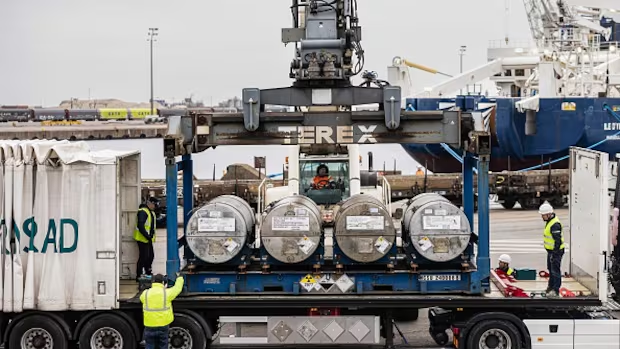
While Russian President Vladimir Putin’s military occupies Ukraine’s largest nuclear plant and attacks the country’s power infrastructure, Europe and the United States still depend on Russian nuclear fuel to power their own electricity grids.
Canadian-owned Westinghouse Electric is among the companies that receive low enriched uranium (LEU) from Russia to fuel commercial nuclear reactors in the U.S., shipping data analyzed by CBC’s the fifth estate shows.
The U.S. banned the import of Russian enriched uranium in August 2024 in order “to sever U.S. dependence on Russian material and secure a strong domestic fuel supply,” according to the U.S. Department of Energy (DOE).
But the Prohibiting Russian Uranium Imports Act allows the DOE to waive the ban if “no alternative viable source of LEU is available” or the “import of the LEU is in the national interest.”
The waivers are scheduled to end by Jan. 1, 2028.
The Bellona Environmental Transparency Center in Vilnius, Lithuania, reported in June that the U.S. imported 400 tonnes of low enriched uranium from Russia in 2025 alone worth around $1 billion US, and that the major recipients included subsidiaries of the French-owned nuclear company Framatome (more than 127 tonnes), U.S. nuclear fuel supplier Global Nuclear Fuel Americas (more than 110 tonnes) and Westinghouse (around 27 tonnes).
 Gas centrifuges at a uranium enrichment plant in Seversk, Russia, in December 2025. (Rosatom)
The European Union has no ban on the import of Russian enriched uranium and Canada has not sanctioned doing business with Russia’s state atomiс energy corporation Rosatom or its export arm, Tenex.
“We are against these exports while there is this situation of war [and a] direct threat to Ukraine,” said Dmitry Gorchakov, nuclear adviser at Bellona and co-author of the June report on Russia’s nuclear industry and the war in Ukraine.
“All countries should try to lower their dependence on Russia and cancel all possible co-operation.”
The fifth estate analyzed shipping data between Westinghouse and Tenex from U.S. Customs and Border Protection, collected by the commercial search engine ImportYeti. Over the four-year period of the war in Ukraine, Moscow-based Tenex exported various amounts of uranium from Russia to the address of Westinghouse’s sprawling fuel fabrication plant outside Columbia, S.C.
In one shipment in March of this year, Tenex reportedly delivered 50,612 kilograms of uranium to Westinghouse in four containers, departing Russia from the port of St. Petersburg and arriving in the U.S. at the port of Baltimore.
Enriched uranium shipped to Westinghouse’s South Carolina facility is processed into fuel pellets and then put into fuel rod assemblies that are sent to commercial nuclear power reactors.
“The way that it works is that usually a utility purchases uranium from a source and then the uranium is transported,” said Curtis Roberts, vice-president of communications at Orano USA, a subsidiary of the French nuclear fuel provider that also manages shipment of uranium to the U.S.
“The customer, the utility, is the one then who has a contract with the fuel fabricator. They purchase their uranium, their uranium is transferred to the fuel fabricator, the fuel fabricator then turns it into whatever fuel form is requested by the customer. And then the customer receives the fuel assembly to put into their reactor.”
Westinghouse Electric is 51 per cent owned by Brookfield Renewable Partners, a subsidiary of the Toronto-based investment management firm Brookfield Corporation. The other 49 per cent of Westinghouse is held by Saskatchewan-based Cameco Corporation, one of the world’s largest uranium miners and nuclear fuel suppliers.
Westinghouse and Brookfield did not respond to questions for this story.
 Canadian nuclear reactors, like those at the Bruce Nuclear Generating Station on Lake Huron, do not require enriched uranium for fuel. (Bruce Power)
U.S. lobbyist disclosures show that Cameco reported lobbying on the Prohibiting Russian Uranium Imports Act in Washington earlier this year, but in responding to emails from the fifth estate the company did not say why. Cameco said it “doesn’t handle enriched uranium” and directed us to speak to individual U.S. utilities.
The U.S. Energy Information Administration, a government agency within the DOE, does not publish the total amount of uranium purchased from Russia, citing “data protections designed for privacy” in an email to the fifth estate. But the administration’s latest uranium marketing annual report on July 29 did report that in 2025, Russia was the largest foreign provider to the U.S. of uranium enrichment services.
“It is a way for Russia and Rosatom and for Russian propaganda to say that you are dependent on us, that you can’t do anything without us,” said Gorchakov. “It’s important for them to be the supplier of the United States — it’s good money for them.”
Decades-long dependence
The U.S. and Europe have had a decades-long dependence on Russian enriched uranium that Western governments and industry are trying to replace by ramping up domestic production.
Russia supplies approximately 44 per cent of global enriched uranium and 20 to 30 per cent of enriched uranium used in the U.S. and Europe, according to a U.S. Department of Energy estimate from November 2025.
Russia has “been the major supplier of low-enriched uranium for many years and it takes a long time to make changes in the global infrastructure,” said Jeremy Whitlock, a Canadian nuclear scientist and adjunct professor at McMaster University in Hamilton.
Whitlock, who is also a nuclear safety consultant, said there can be an intent to make such a change, but if it’s a commodity that’s “desperately needed,” accommodations are required.
“You have simultaneously the intent to build up infrastructure elsewhere and domestic infrastructure or other suppliers while having to maintain the connection to the Russian supply in the meantime.”
Westinghouse is a major player in the U.S. nuclear industry. Brookfield Corporation CEO Bruce Flatt attended a ceremony last October in Tokyo, where he posed with U.S. President Donald Trump and U.S. Commerce Secretary Howard Lutnick, who announced that Westinghouse was going to “invest up to $100 billion in U.S. nuclear reactors to restore U.S. energy dominance.”
 U.S. Ambassador to Japan George Glass, left, Brookfield CEO Bruce Flatt, U.S. President Donald Trump and U.S. Commerce Secretary Howard Lutnick at the U.S. ambassador’s residence in Tokyo on Oct. 28, 2025. (Getty Images)
On its website last month, Westinghouse spotlighted a New York Times story that reported the company could also benefit from Trump’s recent announcement of a civil nuclear co-operation agreement with Saudi Arabia to build new reactors.
Although Cameco has two operating uranium mines in northern Saskatchewan, Canada doesn’t need enrichment facilities because its 16 operating CANDU reactors (15 in Ontario and one in New Brunswick) are fuelled by natural uranium.
WATCH | Selling uranium to India:
Sask. bags $2.6B uranium deal from India trade mission
Prime Minister Mark Carney’s trade mission to India has produced a multi-billion-dollar deal for Saskatchewan-based mining company Cameco. The uranium giant is expected to sell $2.6 billion worth of uranium to India over nine years. The province says the deal is nearly 10 times larger than a previous deal signed in 2015.
But proposed new reactors, including small modular reactors being considered by several provinces, would require enriched uranium. In 2024, the federal government announced it intended to “backstop” up to $500 million in enriched nuclear fuel purchase contracts from allied countries.
While Canada has imposed Russian sanctions against 875 entities and 1,739 individuals, Global Affairs confirmed to the fifth estate that Rosatom and its export arm, Tenex, are not listed.
“The government of Canada has not imposed sanctions on the state atomiс energy corporation Rosatom or Techsnabexport (Tenex),” the federal department said in an email. “However, a number of subsidiaries and individuals related to Rosatom have been sanctioned.”
The European Union has imposed 21 packages of sanctions against Russia targeting nearly 3,000 individuals and entities, but the bloc of 27 countries has not banned the importation of Russian enriched uranium.
According to Bellona, EU countries imported 583.4 tonnes of enriched uranium from Russia worth 251.8 million euros ($407 million Cdn) in 2025.
The European Commission did not respond to emails from the fifth estate.
“Canada and its allies must do everything possible to prevent Western companies, including Canadian firms, from knowingly or otherwise engaging with Russian state nuclear entities,” said Marcus Kolga, a senior fellow at the Macdonald-Laurier Institute, an Ottawa-based think tank.
“Every dollar that flows into Rosatom or its subsidiaries risks strengthening a Russian state enterprise that is directly tied to Moscow’s war against Ukraine and its broader campaign of coercion,” said Kolga, who has advocated for tough sanctions against Russia.
 Dan Lipman, Westinghouse president of energy systems, left; Aziz Dag, Westinghouse senior vice-president; German Galuschenko, Ukraine’s former minister of energy and Petro Kotin, former CEO of Energoatom, announce a fuel agreement in Italy in July 2025. (Westinghouse)
Supporting Ukraine
In its email to the fifth estate, Cameco also highlighted its support for Ukraine. The company signed a long-term agreement in 2023 with the state-owned nuclear energy company Energoatom to supply uranium hexafluoride, which is used to produce enriched uranium.
Westinghouse has also entered into agreements with Ukraine’s Energoatom to supply fuel and build new reactors, replacing Russia as the source of the country’s nuclear fuel.
Following a corruption scandal allegedly involving kickbacks for contracts at Energoatom last year, former Westinghouse CEO Patrick Fragman and the former chief of the Canadian Nuclear Safety Commission, Rumina Velshi, were appointed to Energoatom’s new supervisory board this past January.