
Open this photo in gallery:
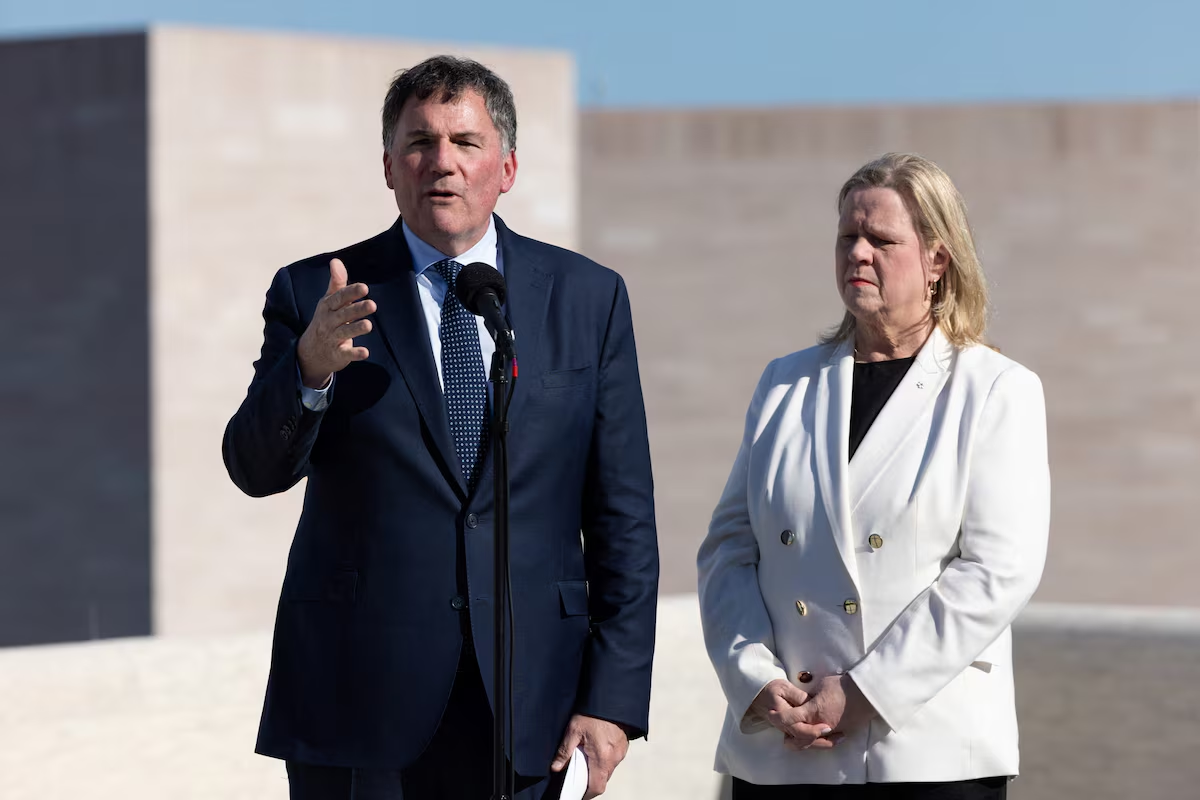
The Canadian minister responsible for Canada-U.S. relations, Dominic LeBlanc, and Canada’s chief trade negotiator to the United States, Janice Charette, speak to the media at the Embassy of Canada in Washington, D.C., U.S., on June 2.Anna Rose Layden/Reuters
Canada has less than 72 hours to strike a trade deal with the United States and avert punitive new tariffs that will harm a range of industries concentrated in B.C., Ontario and Quebec.
Canada-U.S. Trade Minister Dominic LeBlanc is scheduled to meet virtually with U.S. Trade Representative Jamieson Greer at 4:30 pm EDT on Sunday, his office said. Mr. LeBlanc remained in Washington over the weekend alongside top negotiator Janice Charette and the pair are expected to stay in the U.S. capital on Monday.
Ms. Charette has been speaking regularly with Jeff Goettman, Mr. Greer’s deputy for the western hemisphere Mr. LeBlanc’s office added.
His office added, though, that he will remain in Washington until at least Monday. Mr. LeBlanc’s spokesperson, Gabriel Brunet, also said that there was no meeting Saturday between Mr. Trump’s top trade negotiator, Jamieson Greer, and the Canadians. However, he did not clarify if other U.S. officials had met with them for talks.
Prime Minister Mark Carney is scheduled to be on vacation in Italy until Monday. His office did not immediately reply to a request for comment on whether he has spoken with President Donald Trump and whether his holiday plans remain unchanged.
Already beset by tariffs, Quebec braces for another big trade hit
On Friday, The Globe and Mail reported that the two sides remain far apart on key issues as they try to negotiate a deal that will avoid the imposition of new tariffs scheduled to take effect Wednesday. Canadians are also hoping the talks can address longstanding levies on steel, aluminum, autos and lumber known as Section 232 tariffs.
Sources with knowledge of the discussions pointed to both autos and forestry as key sticking points in the negotiations.
The U.S. has demanded that Canada accept a tariff rate of 15 per cent on autos exported to the U.S., plus a continued exemption for the value of American content. But, two sources said, Canada has argued that such a tariff is still too high for the industry to remain viable, as profit margins are in single digits.
On forestry, the U.S. does not want to offer any reduction of 232 tariffs on the sector, three sources said. Instead, the U.S. has argued Canada should wait for the results of a separate review by the Department of Commerce that is expected to reduce a different set of tariffs on softwood lumber, one source said.
The problem, however, is that the review will not deal with the 232 tariffs, which Canada wants reduced now, and which would be key for getting British Columbia to go along with a deal. A different source said that the best Canada could hope for is an agreement from the U.S. to discuss forestry tariffs further.
Two sources said that Canada is preparing options for retaliation if there is no deal by Wednesday and Mr. Trump unleashes his latest threatened tariffs.
The tariffs set to take effect Wednesday would be layered atop existing tariffs, adding a 50-per-cent duty to US$20-billion worth of Canadian electronics, dairy, alcohol, wood and other products using Section 338 of the Smoot-Hawley Tariff Act.
Ms. Charette has told U.S. negotiators that the imposition of the new tariffs would represent a “cliff” in negotiations: If they come into effect, Ottawa would be forced to retaliate.
According to previous reporting from The Globe, based on sources, the deal under discussion would see Mr. Trump lower – but not eliminate – his tariffs on Canadian steel, aluminum, autos and forest products, as well as shelve the new tariffs scheduled for Wednesday.
In exchange, Canada would eliminate its retaliatory tariffs on U.S. autos, agree to Washington’s interpretation of how dairy quotas should be allocated and have provincial governments stop their Buy Canadian programs and boycotts of American alcohol, among other things.
Two sources said Canadian negotiators are trying to lower the baseline tariff to be imposed on autos and lumber in the new deal.
On autos, sources told The Globe last week that a tariff rate of about half the current 25-per-cent levy was being contemplated. But the industry has pushed back on that, saying that even the lower tariff level would not be sustainable.
One of the sources said that’s because the depth of the supply chain integration between the two countries makes the auto sector particularly vulnerable to any tariffs.
For lumber and some cabinets and furniture, the current 232 tariffs range from 10 per cent to 25 per cent.
The Globe is not identifying the sources because they were not authorized to disclose details from the confidential negotiations.
B.C. Premier David Eby and Ontario’s Doug Ford have both said they will only agree to put American alcohol back on store shelves if there is a meaningful reduction in the tariffs applying to their hardest-hit sectors, including autos and lumber.
Former Quebec premier Jean Charest, who sits on Mr. Carney’s advisory committee on Canada-U.S. economic relations, said in a Sunday interview that the Prime Minister faces no good options as he navigates the current trade relationship with Mr. Trump.
Opinion: In the trade war showdown, it’s strong-hand Carney vs. weak-hand Trump
“There’s only bad choices in this world, and that’s the challenge of policy makers,” Mr. Charest said.
The Prime Minister has frequently argued that despite the trade war with the United States, Canada still has better access to the U.S. market than others. Mr. Charest agreed with that but noted that “it’s a difficult argument to make to a person who’s lost their job.”
“As we look at the overall picture, it’s not good, but there’s hope that it’ll be a better outcome or a better situation than what it is now, especially on the 232s.”
He said that if there is a deal, Canada needs to brace itself for baked-in tariffs across those sectors, but how they would be applied and at what level remain open questions.
That could be a difficult sell with Canadians who, Mr. Charest said, will have little patience for any perceived concessions that Canada makes in order to get a deal.
Iowa state fair an important opportunity for Canadians to make their pitch on trade
The former premier said the best way for the Prime Minister to convince Canadians of the decision is to continue to focus on the fact that, overall, Canada has done better relative to other countries.
“We’re dealing with an exceptional situation where we just have to make a judgment call on how much damage do we want to incur and how can we mitigate as much as possible the effect of tariffs,” Mr. Charest said.
He said that if no deal is reached and the new tariffs are imposed on Wednesday, the U.S. should expect a “strong response” from Canada.