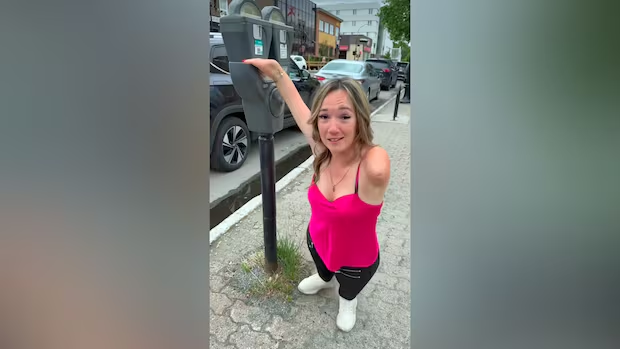
When Charlie Rousseau visited her hometown of Rouyn-Noranda, Que., for a festival in June, she noticed old-style parking meters requiring users to slip change into a slot.
The problem is, Rousseau cannot easily hold coins, let alone reach the slot with them. She was born with limb differences affecting her arms, legs and hand.
Knowing municipalities like Quebec City, Trois-Rivières, Saint-Jérôme and Sherbrooke allow people with accessible parking permits to park for free, she opted to risk it.
She returned to find a $40 ticket on the windshield of her car, which is adapted for her to drive. In the spur of the moment, the social media influencer filmed a video demonstrating how impossible it was for her to use the meters as she regularly makes posts aimed at spreading awareness about disabilities.
“On Monday morning, I am going to city hall and I am going to contest it,” she says at the end of the clip, referring to the ticket.
Published June 20, the French-language video racked up over 730,000 views and hundreds of comments. In the weeks since, Rousseau says strangers regularly ask her about the ticket and offer support.
Watch | Charlie Rousseau’s parking ticket video goes viral:
“I didn’t expect it to have such a big impact, because usually it only affects people with disabilities,” Rousseau told CBC News, noting the message resonated with non-disabled viewers too. “They were like, ‘Hey, she’s right! We don’t even think about it.'”
Rousseau said she plans to fight the $40 fine as a matter of principle.
“I want to fight for people in Abitibi and other regions,” Rousseau said. “Accessibility is like women’s rights — for us now, it’s an ‘of course.’ Maybe in a few years, we’re going to say that about physical disabilities. But for now, it’s not an ‘of course.'”
Meeting with the mayor
Rouyn-Noranda Mayor Gilles Chapadeau reached out to Rousseau shortly after the video went viral, and the two met at city hall. In footage posted to Rousseau’s TikTok channel, Chapadeau said his own family and friends saw her video and urged him to take action.
While final decisions rest with the city council, Chapadeau promised to use his influence to address the issue. He noted a previous proposal for free parking for accessibility permit holders was struck down in 2013.
 Charlie Rousseau sits down with the mayor of Rouyn-Noranda, Que., Gilles Chapadeau, to discuss free parking for people who have an accessibility parking permit. (Charlie Rousseau/TikTok)
In a statement to CBC News, Chapadeau commended Rousseau’s advocacy and reaffirmed his commitment.
“I have personally committed to ensuring that the issue of free parking for people with disabilities is reviewed. This is a matter we will move forward with over the course of the fall,” the statement says.
Advocacy group wants accessible infrastructure
Steven Laperrière, executive director of the provincewide advocacy group Regroupement des activistes pour l’inclusion au Québec (RAPLIQ), praised Rousseau for putting the issue on the map. He noted that infrastructure built solely for able-bodied people remains a widespread problem across Quebec.
However, Laperrière pointed out that RAPLIQ isn’t necessarily demanding free parking. Instead, the organization wants all municipal infrastructure built accessible from the start.
“Before claiming that things be offered for free, we’re more into claiming that things need to be accessible first and foremost,” Laperrière said, adding that disabled drivers who can use a paid service should pay like everyone else. “If it’s free, but it’s not accessible, what’s the point?”
Laperrière highlighted that accessibility barriers extend to newer infrastructure, like electric vehicle charging stations mounted too high or placed awkwardly on sidewalk edges.
“Imagine someone in a wheelchair having to grab the charging gun and bring it into your car,” he said. “It’s a nightmare.”
He added that municipalities rarely consult the disabled community before deploying new technology, leading to costly retrofits or exclusionary systems, like mobile payment apps that exclude people without smartphones.
“When it comes to disability issues, the biggest experts are the ones who live it on a daily basis,” Laperrière said.
Pushing for change
As for the 29-year-old Laurentians resident, her social media following has helped her become a prominent voice for disability rights and awareness.
While she does not claim to be an official spokesperson for the community, she feels a duty to push for systemic change.
“I’m living my best life and there are no limits, but there are still people today whose disability is more negative than positive,” Rousseau said. “If I can help change that in one way or another, I’m going to do it.”
She added that independent mobility is vital in a world where accessibility is often treated as an afterthought.
“Fifty years ago, I probably would have been hidden away — that’s the truth,” she said. “I was born in the right era to use my difference in a positive way. We just need to keep making changes.”