
Listen to this article
Estimated 4 minutes
The audio version of this article is generated by AI-based technology. Mispronunciations can occur. We are working with our partners to continually review and improve the results.
About 2,000 evacuees from across northwestern Ontario have returned home since a surge of wildfire activity in mid-July.
Still, about 829 people remain displaced as of Friday, according to officials at Ontario’s Ministry of Emergency Preparedness and Response.
This summer’s wildfires saw the evacuation of well over a dozen communities in the region, mostly consisting of First Nations, as well as the total destruction of two communities: Namaygoosisagagun First Nation (also known as Collins First Nation) and Whitewater Lake First Nation.
As wildfire threats have eased in much of the region, Kiashke Zaaging Anishinaabek (also known as Gull Bay First Nation) lifted its state of emergency from mid-July on Wednesday, with chief and council encouraging evacuees to return home.
Last week, Gull Bay’s Chief Wilfred King decried the Ontario government’s withdrawal of wildfire implementation and evacuation orders around the community, saying “our members are still at risk and our infrastructure is at risk.”
Though King had cautioned against premature optimism over reduced forest fire hazards, he and two band councillors were able to assess the situation in a helicopter on Tuesday morning.
 Chief Wilfred King of Gull Bay First Nation is leading the call for a public inquiry into the Ontario government’s wildfire response, including an overhaul of the province’s emergency management system. (Sarah Law/CBC)
“Although there were some hot spots, we were informed that MNR (Ministry of Natural Resources) was making sure that the west side of those fires were being manned properly,” King told CBC News on Thursday.
“We didn’t see big fires or a lot of smoke, so we were confident that things have improved dramatically.”
That said, King is continuing to advocate for a public inquiry into the province’s wildfire response due to concerns over lack of communication with First Nation leaders and inadequate emergency preparedness measures.
“There are some things initially that happened a month ago that still needs to be addressed,” King said.
‘If we need to evacuate again, we will do so’
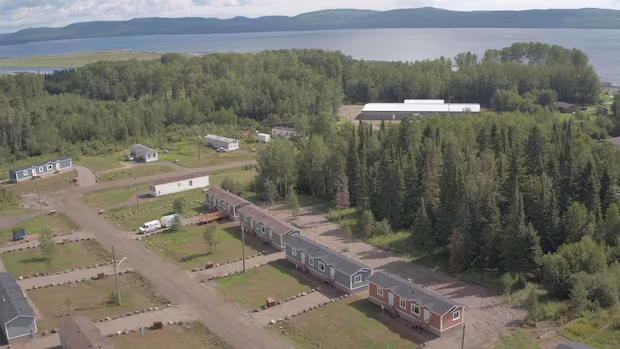
Gull Bay First Nation is an Ojibway community about 215 kilometres north of Thunder Bay. About 370 people live there.
While road access to Gull Bay has been restored, Highway 527 between Kopka River and Armstrong remains closed in both directions, as well as a large section of Highway 811, due to nearby wildfires.
There are just under 140 wildfires burning across Ontario, the majority of which are in the northwest. The closest fires to Gull Bay First Nation are:
- Thunder Bay 36, the largest wildfire in the province which remains not under control at more than 301,000 hectares.
- Dryden 34, which remains not under control at about 45,800 hectares.
- Dryden 35, which remains not under control at nearly 31,500 hectares.
- Thunder Bay 56, which remains not under control at nearly 7,950 hectares.
Thunder Bay 36, Dryden 34 and Dryden 35 are known as the Rinker Lake Complex.
“FireRanger crews from Manitoba, Nova Scotia, and Ontario continue suppression efforts across the Rinker Lake Wildland Fire Complex today,” Aviation, Forest Fire and Emergency Services said in its latest update Thursday evening.
“Approximately 60 firefighters from Mexico are expected to arrive over the next two days and will join crews on the fireline, providing additional capacity to support ongoing suppression efforts. Fire activity across the Rinker Lake wildland fire complex remains low.”
Wildfire hazards range from low to high across the region, with areas of high hazard primarily in the Kenora and Dryden fire management sectors.
Meanwhile, almost all evacuees from Gull Bay have returned home “and everybody was safe.”
“Nobody was injured, no property was [damaged], so we’re quite happy with the end result of everything,” King said.
However, he reminds people that the official wildfire season doesn’t end until Oct. 31.
“We’re just telling members to be vigilant, and if we need to evacuate again, we will do so.”