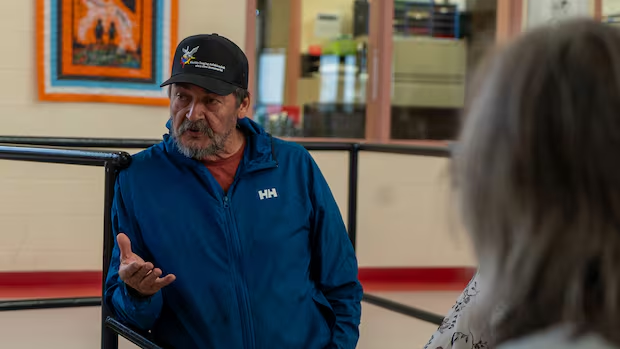
“I am heartbroken, and I’m angry.”
Those are the words John O’Nabigon shared over the weekend after losing another young community member to a drug overdose.
The chief of Long Lake #58 First Nation, located about 300 kilometres northeast of Thunder Bay in northwestern Ontario, is taking action following the third drug-related death of a young person this year.
“This loss is tragic and is another painful reminder of the ongoing drug crisis affecting our community,” he wrote in a statement to his community.
Frustrated by perceived inaction at various levels of government, O’Nabigon said he has now hired an Indigenous-run security company to run checkpoints in the community.
State of emergency
That comes after Long Lake #58 declared a state of emergency in January over “drug traffickers who are supplying to vulnerable members in our community.”
This spring, the community declared an additional joint state of emergency alongside neighbouring Ginoogaming First Nation over the same issue. The communities are closely connected, with their members sharing many familial ties.
 Chief Sheri Taylor of Ginoogaming First Nation says her community has seen fewer security incidents since hiring Anishinaabe Ambassadors Inc. this spring. (Submitted by Matawa First Nations Management)
“These types of losses that we’ve been having in our communities, especially our young people, we should not be losing them at such a rapid [rate],” Ginoogaming’s Chief Sheri Taylor told CBC News on Thursday.
Ginoogaming first declared a state of emergency in May 2024 “due to an increase in violence and drug and alcohol-related crime in the community, which has overwhelmed leadership and is causing community members to fear for their safety.”
Despite numerous emergency declarations being made, Taylor says provincial, federal and policing partners have failed to address the communities’ concerns.
“I find government tends to think that a state of emergency or an emergency is temporary,” Taylor said. “Some funding that might be available to address maybe an immediate need is not what I call taking us away or out of a crisis.”
Just over 560 people live in Long Lake #58, which is served by the Ontario Provincial Police (OPP), while more than 200 people live in Ginoogaming, where the Anishinabek Police Service (APS) oversees policing.
Both communities are part of the Thunder Bay district, which continues to have the highest opioid-related death rate in Ontario — nearly five times the provincial average — according to numbers from the Office of the Chief Coroner released earlier this month.
 Naloxone kits, which can be used to reverse the effects of an opioid overdose, are seen on a table at a community event in Thunder Bay, Ont., in July 2026. The Thunder Bay district continues to have the highest opioid-related death rate in the province. (Sarah Law/CBC)
“Since declaring a state of emergency, chief and council have repeatedly called on all levels of government and policing agencies for stronger enforcement, greater resources, and a co-ordinated response to the trafficking of dangerous drugs into our community,” O’Nabigon wrote.
“We will once again be writing to senior federal and provincial leaders, the OPP, and the RCMP to demand an immediate and co-ordinated response.”
Drugs trafficked from GTA
A spokesperson for APS provided an emailed statement to CBC News on Thursday, saying “drug traffickers importing violence to prey on the most vulnerable in First Nations communities is not new.”
“With increasing frequency, the Anishinabek Police Service (APS) is intercepting drugs being trafficked north from the Greater Toronto Area, including these arrests and these drug and weapons seizures related to Project Corridor,” wrote communications lead Jennifer Hartman.
“Front-line APS officers, in collaboration with our Major Crime Unit, continue to support Ginoogaming First Nation directly through focused enforcement and intelligence-led investigations.”
 The Anishinabek Police Service (APS) says it has been increasingly intercepting drugs being trafficked north from the Greater Toronto Area. (Erik White/CBC )
As for the RCMP, a spokesperson told CBC News in an email Friday morning that it “is responsible for keeping the border safe between the ports of entry and remains committed to working collaboratively with Indigenous leadership, policing partners, and other stakeholders to combat serious and organized crime in support of community safety.”
In an email to CBC News, a spokesperson for Indigenous Services Canada (ISC) said Long Lake #58’s “initiative to bring together partners for a co-ordinated approach to community safety is a strong path forward.”
Long Lake #58 received more than $1.3 million dollars in the last fiscal year for mental wellness programming and services, and also has a mental wellness team jointly funded by the provincial and federal governments, wrote ISC’s Jacinthe Goulet.
They’re starting to listen to us now and hearing us.– Chief John O’Nabigon, Long Lake #58 First Nation
CBC News has also reached out to the provincial government, and OPP for comment and is awaiting their responses.
O’Nabigon said he’s had productive conversations with the OPP in recent weeks about the importance of increased surveillance, visibility, intelligence gathering and community policing in Long Lake #58.
“They’re starting to listen to us now and hearing us,” O’Nabigon told CBC News on Thursday.
‘A right to have protection’
Taking matters into its own hands, Ginoogaming passed a community protection order bylaw in May and has hired a security group called Anishinaabe Ambassadors Inc. to help prevent illegal drug-related activities.
“Under our treaty, we have a right to have protection in our community and those gaps are real. We don’t have the protection. So as a community, as a First Nation, when we declared this state of emergency, we had no choice to bring in those extra supports because we’re not receiving it from our police,” Taylor said.
 Ginoogaming first declared a state of emergency in May 2024 “due to an increase in violence and drug and alcohol-related crime in the community, which has overwhelmed leadership and is causing community members to fear for their safety.” (Ginoogaming First Nation website)
O’Nabigon said Long Lake #58 has hired that same group, and that it’s expected to set up community checkpoints there over the weekend.
The program has seen positive results so far in Ginoogaming, said Taylor, and “people are noticing the change.”
“I am very grateful that we do have security measures in place for my community and I know my community feels the same way.”
Still, the initiative has come at the First Nation’s own expense, she said.
As for the issue of addiction, O’Nabigon said he’s continuing to advocate for more professional services to be delivered in the community so that people don’t have to travel elsewhere for care.
“We’re talking about making treatment more available, detoxing and making that more available,” he said. “The aftercare and the prevention at the community level is what we really need to do.”
His hope is that drug dealers in both First Nations are held accountable for the harm they’re causing, and that community members continue to look out for each other.
“Our strength comes from standing together, especially during times of loss.”