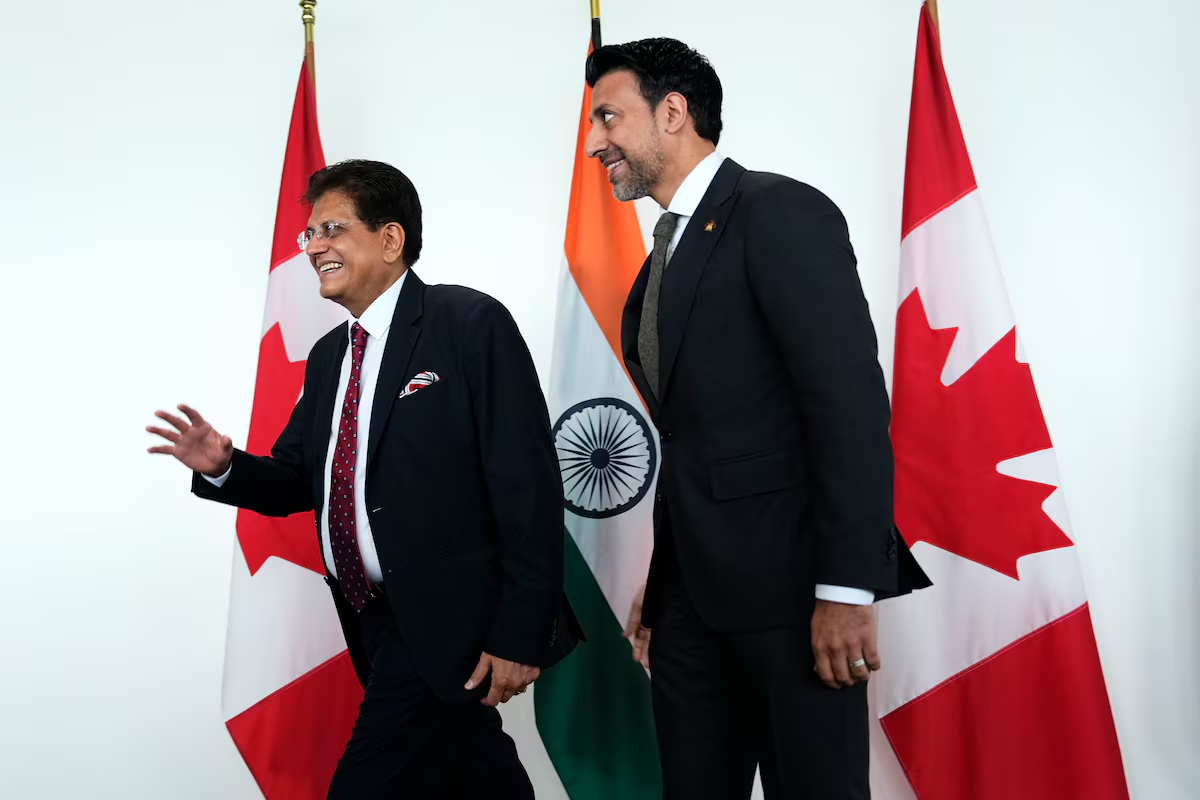

Open this photo in gallery:
Canada’s Minister of International Trade Maninder Sidhu, right, and India’s Minister of Commerce and Industry Piyush Goyal make their way to a bilateral meeting in Ottawa, May 25.Justin Tang/The Canadian Press
It’s a tale of two trade talks.
Canada’s negotiations with the United States may have turned “nasty,” but our country is steadily making progress with India on a comprehensive trade deal.
Although Ottawa and New Delhi still have much to work out at the bargaining table, they are discreetly advancing toward a Comprehensive Economic Partnership Agreement, or CEPA, by the end of this year.
U.S. President Donald Trump is not a party to those discussions, but he is motivating Canada and India to find common ground. An unwitting matchmaker, his trade antics with each of the Commonwealth countries are providing fresh incentives for Ottawa and New Delhi to get their own deal done.
Mr. Trump isn’t the only factor. But “the impact of the Trump 2.0 administration in bringing Canada and India closer should not be minimized,” Rajiv Bhatia, a distinguished fellow at Gateway House, writes in an article published by the foreign policy think tank on Aug. 6.
India seeks more Canadian fuel supplies, but regulatory hurdles may complicate plans
As a former diplomat, Mr. Bhatia offers an informed perspective about the reset in bilateral relations. He served as India’s consul general in Toronto from 1994 to 1998.
“The rough geopolitical treatment meted out by Washington, first to Canada and then to India, has convinced both recipients that their salvation lies in deepening bilateral relations,” he adds.
As part of his global trade war, Mr. Trump has imposed various tariffs on Canada and India since his return to the Oval Office.
In India’s case, the U.S. imposed a 50-per-cent tariff in 2025 as punishment for its purchases of Russian oil.
That rate was eventually reduced after New Delhi agreed to diversify its energy sources. Even so, there are new fears that India could be hit with even higher tariffs.
Last week, the U.S. Senate passed the Lindsey O. Graham Sanctioning Russia and Iran Act of 2026. If it is passed by the U.S. House of Representatives, the legislation would empower Mr. Trump to impose up to 100-per-cent tariffs on countries that are major buyers of Russian energy, including India.
No wonder India is increasingly eyeing Canadian oil and gas.
“The current focus is on expanding bilateral energy trade, including increased exports of oil and LNG from Canada to India and the supply of refined petroleum products from India to Canada,” Mr. Bhatia writes.
Canada and India, meanwhile, both face a 10-per-cent tariff from the U.S. for their alleged shortcomings in rooting out forced labour from their supply chains – findings that each country contests.
The U.S. is also targeting India and other countries in a trade investigation into allegations of surplus manufacturing capacity. Specifically, the Trump administration accuses India of having an overcapacity of products including textiles, steel, solar modules and petrochemicals – claims India refutes.
And let’s not forget how the U.S. unilaterally tinkered with the fine print of its interim trade agreement with India earlier this year. The two countries are still finalizing their trade pact.
Ex-Trump aide Scaramucci predicts President will ‘TACO’ on tariff threat against Canada
This past Saturday, Mr. Modi received a telephone call from U.S. Vice-President JD Vance to review progress on that deal among other matters. It seems the most tangible result, though, was Mr. Modi congratulating Mr. Vance on the birth of his latest child, according to an Indian government readout.
Canada and India have made their own headway.
“Indian Commerce and Industry Minister Piyush Goyal’s visit to Canada in May 2026 – accompanied by a delegation of over 120 companies, the largest ever sent abroad – was a good omen,” Mr. Bhatia writes.
“However, industry insiders point out that completing CEPA by year-end requires meeting a tight deadline. Should these efforts succeed, a visit by PM Modi to Canada by year-end is a distinct possibility.”
Mr. Modi is reportedly considering a visit to Canada either before or after the G20 leaders’ summit, which is scheduled to take place in Miami on Dec. 14 and 15.
Ottawa and New Delhi estimate that a bilateral trade pact would double two-way trade to $70-billion by 2030.
Securing preferential market access to India is also central to Mr. Carney’s goal of doubling non-U.S. exports by 2035.
For his part, Mr. Bhatia says the bilateral relationship is being advanced by “quiet, calibrated efforts.”
That stands in contrast to Canada-U.S. trade talks, which are ramping up again in the wake of Mr. Trump’s jab about our country’s “nasty leadership.”
Mr. Modi is known to cite an Indian expression that says “empty vessels make the most noise.” The juxtaposition of Canada’s trade talks with the U.S. and its negotiations with India demonstrate why that idiom holds truth.