
Listen to this article
Estimated 6 minutes
The audio version of this article is generated by AI-based technology. Mispronunciations can occur. We are working with our partners to continually review and improve the results.
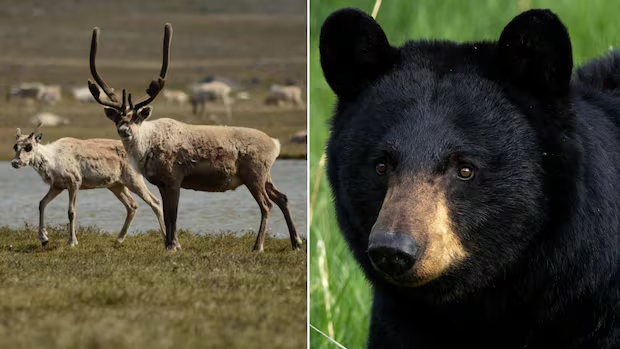
Letting hunters use dogs to hunt black bears is a move the Alberta government says will help caribou conservation efforts, but wildlife biologists aren’t convinced.
The province first made the regulation change last year under Forestry and Parks Minister Todd Loewen, prompting backlash from wildlife advocates and support from hunters. The decision to reinstate it this year has led to further controversy, including public calls for the hunt to be rescinded and a campaign to show support for the hunt.
“This is being done in order to support predator management in areas where caribou recovery is a concern,” reads this year’s Alberta Guide to Hunting Regulations, published annually with new rules and guidelines.
Woodland caribou numbers in Alberta have experienced a steep decline for decades — but the provincial government’s former caribou manager, Dave Hervieux, says the notion that hunting black bears with dogs would support caribou conservation efforts is false.
“There’s no scientific background or support for hunting black bears with dogs as a means to aid caribou,” said Hervieux, who worked with the Alberta government for more than four decades before retiring in 2024.
 Dave Hervieux pictured during caribou survey work in the Redrock-Prairie Creek mountain woodland caribou winter range in west-central Alberta. (Submitted by Dave Hervieux)
Hervieux says of the 23 wildlife management units where hunting black bears with dogs is permitted, 10 do not contain any caribou range, and another two “have almost no” caribou.
“These [wildlife management units] likely never had the landscape and habitat conditions that would constitute caribou range or enable caribou occurrence,” he said. “They likely never had caribou historically.”
“The hunting of black bears with dogs is considerably focused on areas which are not caribou range, do not have resident caribou, and historically were unlikely to have had caribou,” he said.
Wolf cull has helped caribou, but killing more bears won’t: Hervieux
The provincial government controls wolf populations in an effort to protect caribou.
“Delivery of wolf management has been sufficient to stabilize and in many cases increase caribou populations,” Hervieux said.
But wolves and bears are different beasts entirely.
“There’s virtually no evidence of consequential predation by black bears on caribou calves in Alberta, or many other parts of woodland caribou range in Canada,” he said.
Hervieux says actively reducing wolf populations is a temporary but necessary crisis-management tool to prevent caribou populations from going extinct immediately, but that true recovery is impossible without addressing the ongoing loss of habitat.
He says caribou habitat conservation and recovery are needed in order to avoid the need to cull wolves forever.
WATCH | Can Jasper’s new breeding centre save caribou from local extinction?:
Can Jasper’s new breeding centre save caribou from local extinction?
Parks Canada let CBC take a tour of the Caribou Conservation Breeding Centre in Jasper National Park. Seven calves were born at the $40-million facility last spring, giving hope that the local population will once again thrive in the wild. With only 50 caribou remaining in the Tonquin Valley
University of Alberta ecology professor Mark Boyce echoed Hervieux’s points about hunting black bears with dogs to help protect caribou.
“You will not find a biologist that would go along with that unless they’re employed by the hunting and fishing branch of the provincial government,” said Boyce, who serves as Alberta Conservation Association endowed chair in fisheries and wildlife at the university.
 Mark Boyce pictured at Elk Island National Park in 2022. (BoompaCanada/Flickr)
Boyce said that while black bears do kill caribou calves in some cases, his own research shows the actual impact of black bear predation on caribou in Alberta “is really small.”
And because the proportion of black bears involved in hunting caribou is so small, the probability of a hunter killing a bear that actually preys on caribou is “infinitesimally small,” he said.
Boyce also expressed concern with grizzly bears being targeted by dogs and possibly being provoked into attacking a human, as most of the area where the practice is permitted is also grizzly bear habitat.
Province calls caribou conservation ‘a secondary benefit’
In a statement sent to CBC News, the provincial Department of Forestry and Parks said “hunting regulations are informed by wildlife population data, harvest information, field observations and other scientific information collected across the province.”
Hervieux and Boyce say neither they, nor any biologists they know, were consulted by the province about the change.
The province’s statement says letting hunters use dogs to hunt black bears “provides Albertans with broader sustainable hunting opportunities,” and that caribou conservation is “a secondary benefit of this approach” — despite the Alberta Guide to Hunting Regulations referring to it as the primary reason.
“In select wildlife management units where black bear populations are abundant and can sustainably support this form of hunting, reducing black bear numbers may help alleviate predation pressure on neonatal caribou and contribute to improved calf survival,” the province said.
Last year, 2,431 black bears were harvested by hunters in Alberta.
“Alberta’s government actively manages predation on caribou, and providing additional tools and opportunities for black bear harvest in these areas will support caribou recovery and complement existing predation management efforts.”
WATCH | Dog use for black bear hunting introduced last year in Alberta:
Dog use now allowed for black bear hunting in Alberta
The province has updated its hunting regulations to allow for dog use in black bear hunts starting in September. The move is aimed at managing predator populations to support caribou recovery, but one biologist worries the hounds may chase after other species.
Hunting black bears with dogs is permitted in British Columbia and Ontario, as well as several U.S. states. In Alberta, the practice is permitted during September and October, which the province says prevents dog hunting from overlapping with caribou calving periods in the spring.
The province says the use of dogs is only permitted in areas where the use of bait is banned for hunting black bears.
Besides black bears, dogs can also be used to hunt cougars and game birds in Alberta.