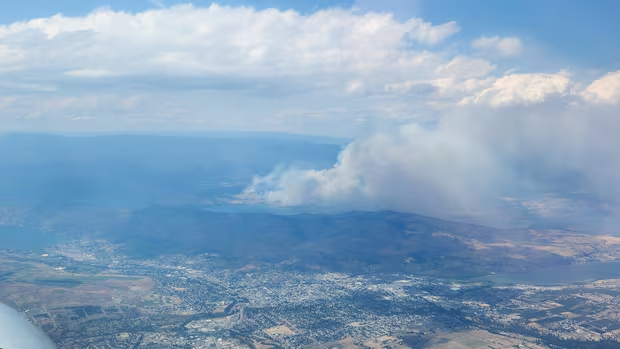
Toni Harris says she and her family didn’t have much time to leave their homes when the Bradley Creek fire raged through the Okanagan Indian Band (OKIB) reserve near Vernon B.C.
“A lot of us did not get warnings,” said Harris, an OKIB member and wildfire evacuee.
“I got home, and two minutes later, my uncle, Dave Lawrence, was … honking and saying, ‘You have to leave.’ And we asked, ‘Well, how much time do we have?’ And he’s like, ‘Now.”
Approximately 30 Okanagan Indian Band members and around 200 non-band members have lost their homes to wildfire over August long weekend, according to the band’s chief.
WATCH | Evacuees flee Bradley Creek fire:
Residents in B.C.’s Okanagan flee from fire that doubled in size
Thousands of residents in B.C.’s north Okanagan region say they had to leave everything behind to escape a wildfire that doubled in size over the weekend. The Bradley Creek wildfire was discovered on July 31 and as of the afternoon on Aug. 2, had grown to 26 square kilometres. It’s one of six wildfires of note burning in the province.
Evacuees say they faced issues and delays receiving financial support from Emergency Support Services between Aug 1. and Aug. 3, and many continue to struggle to secure hotel rooms in the Interior.
“We were told to to do our online application, but because there were so many of us, the ES services card site … it had crashed on us,” said Harris.
“A lot of us got really scared because the message came up that it would take up to their next business days that they were open to verify us.”
LISTEN | Chief Dan Wilson speaks on the devastation of the Bradley Creek Fire:
Radio West12:27Chief of the Okanagan Indian Band says about 200 homes have burned on reserve land
Dan Wilson is the chief of the Okanagan Indian Band. He flew over the area to see the devestation of the Bradley Creek Wildfire first hand.
A spokesperson from B.C.’s Ministry of Emergency Management and Climate Readiness said in a statement it is aware of delays to the e-transfers issued through the province’s evacuee registration system.
“Staff began investigating the issue as soon as it was identified, and the issue has been fixed with everyone that was waiting for their payment having received one by end of day on Monday,” said the spokesperson.
“If additional technical challenges arise, EMCR has alternate methods available to ensure support can still be provided to evacuees.”
Hotel issues
The Bradley Creek Fire was discovered on Aug. 1 and is listed as a wildfire of note according to B.C. Wildfire Service. It spans 28.53 square kilometres as of the morning of Aug. 7.
Dan Wilson, chief of Okanagan Indian Band, said some members had nowhere to go during the initial evacuation period over the long weekend.
“We had some people that had to sleep in their vehicles, some elders — especially because they had to move so fast that they they couldn’t grab their purses or or wallets,” said Wilson.
 Okanagan Indian Band Chief Dan Wilson said many government agencies need data before providing rebuilding funding — data which could take time to gather. (CBC)
The province has faced criticism for not calling a state of provincial emergency over the fire situation.
An emergency order would allow the province to prevent hotel rooms from being used for non-essential purposes, and free up accommodation for evacuees.
Harris she had to transfer from Four Points by Sheraton at the Kelowna Airport on Aug. 5 to the Hampton Inn & Suites by Hilton Kelowna Airport, but soon has to leave the second hotel.
“There’s probably about 200 of us, maybe a little more here, and we all move and leave on Saturday,” said Harris.
“Because the province has not considered a state of emergency yet, so their hands are tied.”
WATCH | How a state of emergency would change the response:
How could declaring a local state of emergency change the B.C. wildfire response?
Wildfires burning throughout B.C. have some people hoping officials will declare a state of local emergency. James Whitehead, a fire mitigation researcher and former firefighter, discusses what that could change for the response to the fires.
CBC Indigenous contacted Hampton Inn & Suites by Hilton Kelowna Airport, and the hotel confirmed it is hosting guests who will be in town for a conference by Earls Kitchen + Bar over the weekend.
Earls head office did not respond to request for comment.
WATCH | More evacuation orders in the Okanagan:
Wildfires force more evacuation orders in B.C.’s Okanagan
Increasing temperatures, decreasing humidity and higher winds in the forecast have forced people from more than 400 additional properties on Thursday in B.C.’s Okanagan region.
The Ministry of Emergency Management and Climate Readiness said in a statement that approximately 7,000 properties are under evacuation order and 3,500 properties are under alert.
Outside of full hotel rooms, Harris said she and many people she knows are having trouble paying deposits on rooms.
The Four Points by Sheraton at Kelowna Airport told CBC Indigenous it requires a $300 dollar cash or debit deposit, and a $150 credit deposit, on booked rooms.
“A lot of us were in a panic because … some of us don’t have credit cards, and some of us lost everything,” said Harris.
“We had $400, between me and my roommate, and when we got to Four Points … he’s like, well, that’ll be a $300 per room. And I’m like, I don’t have that.”
‘Boots on the ground’
National Chief Cindy Woodhouse Nepinak of the Assembly of First Nations said in a statement on Thursday the organization offers prayers and support to every community and every person affected by wildfires and forced evacuations.
“First Nations are on the front lines of the climate crisis. These situations grow in severity every season,” she said.
“We remind Canada of the urgent need for sustained investments in First Nations emergency management, community infrastructure, and all-season access. This is about the safety and security of our communities, citizens and families.”
Wilson said while his community is on track to healing, it will be a long road ahead.
He said that government agencies need data to provide funding that would help the community rebuild — data that can’t be gathered until the band is able to assess the damage to structures.
“To see the look on elders’ faces last night at the meeting … their homes, they lost memorabilia, pictures … Salish baskets, things like that, things that are irreplaceable,” said Wilson.
“There’s just no words for that.”