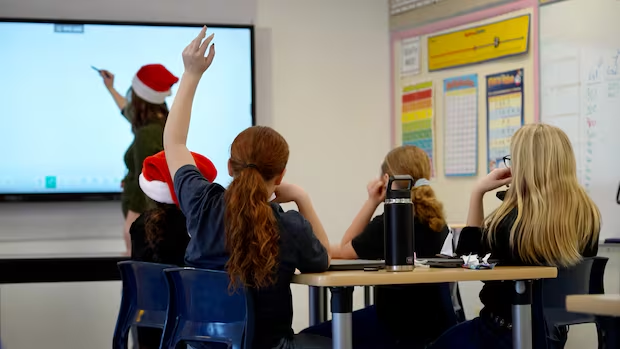
Students in the Northwest Territories are missing school more than one day every week on average, which means by the time students finish high school, some would be three years behind, according to an annual territorial report.
The report, released late last month, shows that numbers are worse in smaller communities, with Tłı̨chǫ communities seeing attendance as low as 35 per cent in secondary grades.
“In smaller communities, schools may face additional challenges related to staffing shortages, access to specialized supports, and limited local services,” Agata Gutkowska, a spokesperson for the education department, told CBC News in an emailed statement.
The territory has seen a decline in attendance since the COVID-19 pandemic, with numbers recently stabilizing but not recovering to pre-pandemic levels.
CBC News reached out to all 10 of the school boards across the territory and did not receive a response.
Some advocates say while low attendance isn’t a new problem, it is only set to get worse.
“I think by mid-September, we’re going to really feel the crisis,” said Rita Mueller, president of the N.W.T. Teachers’ Association.
“Students’ needs will not be met.”
She says the education sector in the territory has been dealing with a plethora of issues, including chronic underfunding, inability to retain teachers, and a lack of counsellors and speech therapists — discouraging students from showing up to the classroom.
Mueller and a Yellowknife MLA say they fear the numbers will only get worse now that the territory will not have funding through Jordan’s Principle, which provided vital support for Indigenous students across the territory.
Jordan’s Principle is a legal rule ensuring First Nations kids get timely access to public health and social services without bureaucratic delays over which government (territorial or federal) should pay for it.
 Rita Mueller, president of the N.W.T. Teachers’ Association says with low attendance and loss of funding, ‘we’re going to really feel the crisis,’ when students return to school in September. (Saloni Bhugra/CBC)
Shauna Morgan, the MLA for Yellowknife North, says she’s worried about children being left behind.
“It’s hard to look at the education system and… not be worried,” Morgan told CBC News.
She says funding hasn’t kept up in a decade and she worries about the number of positions lost at schools, especially support positions such as speech language pathologists and mental health support.
“With the loss of Jordan’s Principle, I think it’s just sort of the final crack where the system really is appearing to crumble.”
Mueller says the funding shortfalls will particularly affect Indigenous students.
“There’s going to be less adults in the school system to be able to support those specific needs,” she said.
The territory says it echoes those concerns.
Earlier this year, the territory announced $35 million to fill the hole left in the budget after the loss of $58 million through Jordan’s Principle. That still leaves schools with tens of millions in shortfall for the upcoming school year.
Staffing shortages
Mueller says the territory has been struggling to attract and retain teachers, especially with the nationwide teacher shortage.
With growing housing and affordability challenges, she says teachers often leave the community within the first year or two.
“That’s frustrating for them [students] because they’re just starting to develop a relationship and trust, and then those individuals are gone and they’re starting all over again,” Mueller said.
WATCH | Advocate decries changes coming to Jordan’s Principle funding program:
Advocate decries changes coming to Jordan’s Principle funding program
Canada has made significant changes to its Jordan’s Principle funding program to address a massive backlog and concerns over misuse. One Indigenous rights advocate says the changes will create serious barriers. The CBC’s Nadeer Hashmi has more.
Gutkowska with the education department says attendance and workforce stability are closely connected, and the government is focused on working with educators and families in smaller communities.
Aurora College will offer teacher training programs next fall as part of a long term initiative to train teachers in the North, Gutkowska said.
Looking for solutions
The N.W.T. is one of the places in Canada where completing secondary education is not legally mandatory and there isn’t a territory-wide policy to grade attendance.
Morgan and Mueller both say they don’t advocate for that as a solution.
“There are good reasons why people don’t have the same broad buy-in as to the importance of school, in particular because in the past the purpose of education has been colonial… to indoctrinate kids, to take them away from their families,” Morgan said.
She’s hoping other families, schools and government officials can come up with creative ways to encourage attendance.
 Shauna Morgan, MLA for Yellowknife North, says she’s worried about students left behind. (Saloni Bhugra/CBC)
Some of her examples include changing school schedules to minimize summer breaks and having an entertaining school bus.
“Let’s put our heads together and not be afraid to try new things,” she said.
The education department says it is in talks with the federal government about the impact of losing funding through Jordan’s Principle.
The territory is also implementing a renewed junior kindergarten to Grade 12 curriculum, adding well-being initiatives and Indigenous knowledge into learning, Gutkowska said.
“These efforts are intended to increase student engagement, strengthen a sense of belonging, and make learning more relevant to students’ lives and future goals,” the statement read.
Morgan and Mueller are hoping in the meantime, families and community members encourage students to engage in learning and reach out to the government about specific needs.