Approximately 326 years ago, around the year 1700, the Tseax volcano in northwest B.C.’s Nass Valley erupted — eventually forming what is now known as the Nisga’a Memorial Lava Bed Provincial Park.
The oral tradition of the Nisga’a people, known as adaawaḵ, records the eruption, and matches up with geological data.
Two villages were destroyed, and about 2,000 people are believed to have been killed. The lava flow also rerouted the Nass River, forever changing the landscape.
“It’s a place where western science meets oral history and Indigenous ways of knowing,” said Justina Moore, whose Nisga’a name of Gaahl Daats means “water lily.”
Moore works as an education and programs director at Hli Goothl Wilp-Adokshl Nisga’a, the museum in Laxgalts’ap.
“For me, it’s a place that holds a lot of history, and it really holds that validity in our oral histories,” she said.
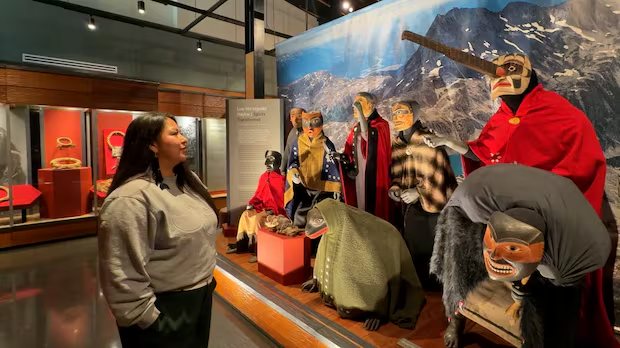
 Justina Moore works at the Nisga’a Museum, where she teaches visitors about the history of the lava beds and the story of the supernatural being, Gwaax̱ts’ag̱at (seen here to the right) , who is said to have stopped the lava flow with his nose. (Catherine Garrett/CBC)
She recalls growing up surrounded by volcanic rocks, but says she didn’t fully appreciate how unique the landscape was until later.
“When I was a child, I assumed that there was lava everywhere … I used to think that this was what the world looked like past our boundaries,” she said.
WATCH | Why the lava bed could be B.C.’s best roadside attraction:
Why the Nisga’a lava bed could be B.C.’s best roadside attraction
About 80 kilometres north of Terrace, B.C., on Highway 113, you will find the Nisga’a Memorial Lava Bed Provincial Park. It’s a sacred ground for the Nisga’a nation and the site of the most recent volcanic eruption in Canada. This site is part of our search for B.C.’s best roadside attraction. The CBC’s Catherine Garrett tells us more about it.
Respecting nature
According to the official adaawaḵ shared by the Nisg̱a’a Lisims Government, the story behind the eruption serves as a lesson in respect and balance with nature.
It says the eruption was triggered after two children mistreated salmon, prompting a warning from an elder about retaliation from nature, resulting in the eruption.
A supernatural protector, Gwaxts’agat, emerged to block and cool the advancing lava — saving the remaining residents.
“On your way back [from the museum] towards the lava fields, you might notice that they kind of just abruptly stop,” said Moore.
“Then you’re met with a lush green forest, the creeks, river and mountainside. So it’s really interesting to see how well our stories tie in with the land.”
 Trees have started to grow in between the volcanic rock, which is covered in lichen. (Catherine Garrett/CBC)
With special permission, this story of Gwaxts’agat is part of what Moore shares with guests at the museum, along with other teachings.
“I feel a little empowered knowing that I’ve shared a little bit of our history with our visitors,” she said.
“I feel it’s really impactful once our visitors leave this space, and they’re driving back to their place of origin, they walk away with this deeper appreciation … and it’s carried with respect.”
 The cooled lava from the Tseax volcano stretches for kilometres throughout the Nass Valley, covered in thick multicoloured layers of lichen. (Catherine Garrett/CBC)
Geological landmarks
The park is part of the Nisga’a Final Agreement, the modern treaty between the nation and the federal government, which came into effect in 2000.
It’s the first provincial park to be jointly managed by B.C. Parks and a First Nation.
 This model at the visitor centre shows where the eruption from the Tseax cone started and stopped, with the largest of the four flows stretching over 22 kilometres. (Catherine Garrett/CBC)
Four lava flows came from the Tseax volcano, with the main flow stretching over 22 kilometers.
Some rock formations tower over 12 metres above the roads that go through the terrain.
 The tree cast is one of the sites that visitors can take a short hike to view in the provincial park. It was formed by lava pooling around a tree. (Catherine Garrett/CBC)
Some of the sites at the park include the drowned forest, where trees now stand in water that was rerouted from the lava flows.
There is also the tree cast, where lava encased trees and left behind impressions.
Other landmarks include the natural hot springs, a dedication site where the area was officially designated a provincial park, as well as Crater Creek and Lava Lake.
 The drowned forest is one of many geological landmarks in the Nisga’a Memorial Lava Bed Provincial Park, and a marked stop on the self-directed tour. (Catherine Garrett/CBC)
Symbol of resilience
As the home of the most recent volcanic eruption in Canada, the site serves both as a monument to the power of nature, and as a tribute to the nation’s history, according to locals.
To Alexis Harris, whose Nisga’a name is Gwiix Gala’ak’um Gibuu or “playful wolf,” the landscape showcases the very best qualities of her people.
Harris works as a parks technician at Wilp T’aam Lax Sankw’ax (the visitor centre).
 Alexis Harris has worked at the Nisga’a Memorial Lava Bed Visitor Centre for about two years, where she enjoys sharing knowledge and history with visitors. (Catherine Garrett/CBC)
“The Nisga’a are resilient, it is a beautiful tourist destination, and it reminds us how strong we are and how far we’ve come,” she said.
“We survived two great floods. We survived the eruption. We survived famine. We survived smallpox, we survived residential schools. So that makes me very proud.”
Through her work, Harris said she’s met people from all over the world who come specifically for the lava beds — including from Egypt, Germany, Italy and the Philippines.
“Even when we’re picking up garbage in the field … we’re showing our pride, that we are good hosts and that we are welcoming,” said Harris.
“We want our facilities to be beautiful. And we want you to come back.”