
Listen to this article
Estimated 4 minutes
The audio version of this article is generated by AI-based technology. Mispronunciations can occur. We are working with our partners to continually review and improve the results.
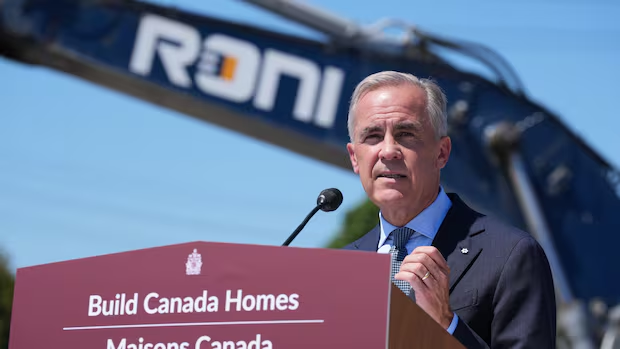
The federal government is pledging $2.7 billion over three years to build more than 18 housing projects across the city of Toronto, Prime Minister Mark Carney announced Wednesday.
The partnership between the government of Canada and city of Toronto includes 5,600 rental homes, 1,800 of which will be “deeply affordable,” supportive or rent-controlled, Carney said at a news conference Wednesday. He said 4,500 new homes — 80 per cent of the total — will be under construction by year’s end.
“For generations people have come from every single corner of the earth to build a life here in Toronto,” Carney said. “Crucial to this is to build a healthy rental market for every kind of renter.”
He said the projects will take place in neighbourhoods hardest hit by rising rent and evictions, and will include a 16-story complex in Parkdale and another in Scarborough at 158 Borough Drive.
Mayor Chow said the buildings will bring housing security to thousands of people: “If you work here, you should be able to afford to live here,” she said.
“If your rent is too high, if you’re looking for more space to raise a family, if you’ve been waiting for affordable housing for years — it’s coming.”
WATCH | Carney on Ottawa’s funding for affordable housing measures:
Feds to invest $2.7B in affordable housing in Toronto: Carney
Prime Minister Mark Carney announced that the federal government will be investing $2.7 billion into 18 affordable housing projects in Toronto over the next three years. The plan includes 5,600 rental homes, 1,800 of which will be ‘deeply affordable,’ supportive or rent-controlled, Carney said. He said 4,500 new homes will be under construction by year’s end.
Projects to fall into market-rate, non-profit channels
Projects will be divided into two channels, Carney said.
The first is non-market, non-profit housing, delivered through Build Canada Homes, a federal agency aimed at building affordable housing. This includes more than $310 million to advance nine projects on city-owned land, he said, which will result in 1,900 homes, with more than 700 of them meeting the definition of affordable housing.
The city of Toronto is also contributing $530 million, including 99-year exemptions from municipal and school property taxes, said Carney.
The second channel is market-rate housing — homes built by the private sector and backed by “attractive” financing, Carney said. This includes more than $1.8 billion in federal funding for low-cost financing for nine projects, resulting in 3,700 new homes, more than 1,000 of which will be affordable.
“All of these projects had been approved in the past … all of them were stalled for want of financing, until today,” Carney said.
The prime minister said the buildings will bring housing security to thousands of people, and referred to them as “not luxury condos but rather places people can afford.”
“The fact is that too many Torontonians have been struggling to afford their rent,” Carney said.
Among the 18 projects will be an Indigenous-led 100-unit housing development at 15 Denison Ave. and another at 1113-1125 Dundas Street W. built sustainably with timber, geothermal energy and low-carbon design.
The announcement is also happening against the backdrop of Ontario falling behind the province’s stated goal of building 1.5 million homes by 2031.
Conservative MP and housing critic Scott Aitchison said in a statement Wednesday that Carney’s latest news conference is “just another repackaging of projects already announced or already under construction, and will do nothing to build the millions of homes needed to restore the promise of homeownership for future generations.”
PM fields questions about island airport
The prime minister took questions after the conference, including on his government’s decision earlier this month to reject a proposal to expand Toronto’s city airport to allow jets to land and take off. That led Ford’s government to reconsider its support for Alto, the federal government’s proposed high-speed rail project.
Asked whether there would ever be commuter jets at the airport, Carney said that the results of the consultation were clear but “forever is a long time.”
The consultations garnered more than 87,000 responses with nearly 87 per cent of respondents opposed to changes for jets.